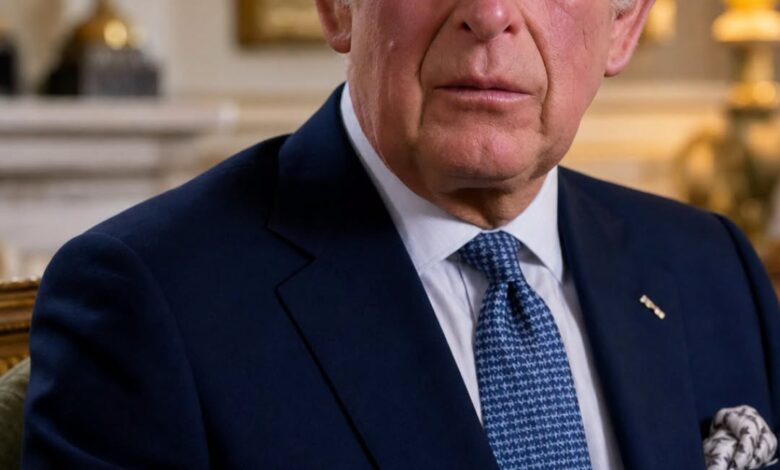
Behind palace doors, the mood is said to be very different from the carefully measured optimism presented to the public.
Official statements speak of “positive progress.”
The language is reassuring by design: treatment continues, duties are managed, and King Charles remains engaged with the work of the monarchy.
But according to the picture painted by those claiming knowledge of his inner circle, there is another reality running quietly alongside those assurances.
Preparation.
Not panic.
Not surrender.
Preparation.
The king’s cancer battle is reportedly taking a heavier toll than public appearances reveal, and the machinery that exists for the end of a monarch’s reign is no longer being treated as something belonging to an unimaginably distant future.
Its name is Operation Menai Bridge.
Every modern monarchy prepares for death. Such planning is not, by itself, evidence that death is imminent. A sovereign’s funeral and the transfer of constitutional responsibilities are simply too significant to improvise during grief.
But what makes the current atmosphere feel different, according to the reports surrounding Charles, is the level of attention now being paid to the details.
Routes.
Music.
Guests.
Ceremonial movements.
Symbolic gestures.
The choreography of national mourning.
Some elements are said to have received the king’s own attention and approval.
There is something deeply human about that image.
A man confronting illness while helping decide how the country will eventually say goodbye to him.
For the public, monarchy often appears designed to defeat uncertainty.
Everything has an order.
A procession follows a route.
A uniform carries meaning.
A bell rings a prescribed number of times.
People stand in designated places.
Even grief seems to arrive according to protocol.
But no amount of protocol can make the private reality easy.
Behind every operational name is a family.
A wife facing the possibility of losing her husband.
Children confronting the eventual death of their father.
Grandchildren whose understanding of what is happening will differ according to age.
Friends trying to remain hopeful while recognizing what serious illness can mean.
That is the tension now surrounding Charles.
Publicly, continuity.
Privately, uncertainty.
And increasingly visible within that continuity is Prince William.
The Prince of Wales has taken on a more prominent role, appearing where the institution requires stability and representing the future without publicly behaving as though that future has already arrived.
It is an extraordinarily delicate position.
William cannot appear eager.
He cannot appear frightened.
He cannot treat every engagement as preparation for kingship, even though every additional responsibility inevitably invites that interpretation.
He must simply work.
That is how monarchy handles transition before transition officially exists.
Not with an announcement.
With gradual visibility.
More duties.
More meetings.
More moments in which the heir stands where the sovereign once would have stood.
From the outside, it can look seamless.
That is the point.
The monarchy’s greatest institutional promise has always been continuity: one reign ends and another begins without the structure itself appearing to break.
“The King is dead. Long live the King” compresses an enormous human loss into constitutional certainty.
A son can lose his father and become king in essentially the same moment.
There is almost no space between grief and duty.
William knows that better than most.
He watched his grandmother’s death transform his father’s life instantly.
He saw mourning and accession occur simultaneously.
Now, as Charles undergoes cancer treatment, William lives with the knowledge that the same machinery will one day turn toward him.
But preparation should not be confused with prediction.
Funeral plans can be reviewed while a monarch continues living and working for years. Governments and royal households prepare precisely because waiting until a crisis would be irresponsible.
That distinction matters, particularly when anonymous reports begin producing dramatic conclusions about Charles’s condition.
There is a significant gap between saying plans are being refined and saying they will soon be required.
Only a very small number of people would genuinely know the king’s complete medical outlook.
Everyone else is interpreting fragments.
A reduced schedule.
A changed appearance.
An altered engagement.
A statement from the palace.
A responsibility taken on by William.
Those details can create a narrative, but they cannot provide a countdown.
Still, the emotional reality behind the planning is difficult to ignore.
If Charles is personally considering elements of his eventual farewell, then Operation Menai Bridge is more than a government document to him.
It concerns the final public chapter of his own life.
Which music should accompany him?
Which traditions matter?
What should be preserved?
What should be changed?
How should a monarch who waited most of his life to become king ultimately leave the stage?
Those are ceremonial questions.
They are also deeply personal ones.
For friends and relatives, that can create an almost unbearable contradiction.
Hope requires imagining recovery and more time.
Preparation requires acknowledging that time is finite.
Both can exist simultaneously.
A person can believe treatment is working and still put affairs in order.
A family can laugh over dinner and discuss frightening possibilities the following morning.
A palace can plan future engagements while officials quietly review funeral protocol.
That is not necessarily hypocrisy.
It is how people live beside uncertainty.
The danger comes when preparation itself becomes evidence for conclusions it cannot support.
A funeral plan does not tell the public when a funeral will happen.
An heir assuming more responsibilities does not reveal a private prognosis.
And an unnamed insider’s anxiety is not the same thing as a medical statement.
What can be seen, however, is a monarchy becoming increasingly conscious of transition.
Charles spent most of his life waiting.
William now occupies the position Charles knew for decades: close enough to the throne that every movement can be interpreted as preparation, while still required to remain firmly behind the sovereign.
That may explain why the current moment feels so fragile.
The institution keeps moving.
The king continues appearing.
William continues stepping forward.
Official statements continue emphasizing progress.
And somewhere behind all of it sits a plan with a name borrowed from a Welsh suspension bridge.
Menai Bridge.
A plan intended to carry the monarchy across the moment when one reign ends and another begins.
Eventually it will be used.
That much is inevitable.
What remains unknowable from outside the king’s medical circle is when.
Perhaps that is where the public discussion should stop.
Not because Charles’s health is irrelevant, but because serious illness does not become more understandable when speculation is disguised as certainty.
The palace can prepare.
William can prepare.
Charles himself can prepare.
And none of them necessarily knows the exact timetable.
For now, there is still a king.
Still work.
Still treatment.
Still public appearances.
Still hope.
But behind the ceremonial confidence is the reality every family eventually encounters, royal or otherwise:
loving someone does not prevent you from preparing to lose them.
It only makes the preparation hurt more.