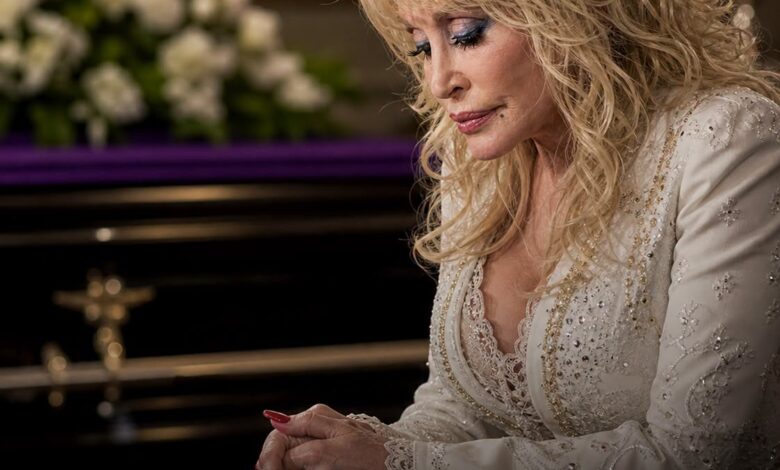
For a woman who had spent most of her life beneath rhinestones, stage lights, and the gaze of millions, Dolly Parton’s final goodbye was strikingly small.
No enormous spectacle seemed capable of explaining what she had meant to the world anyway.
So in the end, the story returned home.
Family.
Faith.
Music.
And Carl.
Dolly was laid to rest beside Carl Dean, the husband who had shared nearly sixty years of her life while somehow remaining outside most of the machinery of her fame.
That alone felt appropriate.
The world knew Dolly Parton.
Carl knew Dolly.
He had been there before she became an institution, before Dollywood, before generations of singers called her an influence, before her songs became part of American cultural memory.
Their marriage had always contained an unusual contrast.
She belonged, professionally, to everybody.
He belonged almost entirely to the private life she protected.
Dolly could walk onto a stage covered in sequins and command an arena. Carl preferred staying away from cameras. She became one of the most recognizable women on Earth; he remained the man whose absence from celebrity culture became part of their love story.
And somehow, it worked.
Not because they lived the same kind of life, but because they seemed to understand which parts of themselves belonged to the world and which did not.
That distinction followed Dolly all the way to her grave.
The plaque beside which she was laid carried none of the extravagance people might associate with her public image.
Instead, its details told a quieter story.
Two small houses.
Their wedding date.
Intertwined rings.
Simple symbols for an extraordinary amount of time.
The houses seemed especially fitting.
Dolly spent decades traveling between stages, studios, film sets, business meetings and public appearances, yet home remained one of the central ideas in her life.
Home was Tennessee.
Home was memory.
Home was family.
And, for nearly six decades, home was Carl.
Those two little houses carved into stone said something that a giant monument never could.
After all the places Dolly went, she knew where she belonged.
The intertwined rings said something similar.
Marriage was not the loudest part of Dolly Parton’s public identity, but it may have been one of the steadiest parts of her private one.
She wrote about love in countless forms—longing, betrayal, desire, sacrifice, heartbreak—but the relationship at the center of her own life was one she guarded fiercely.
That privacy wasn’t secrecy.
It was protection.
She understood that some things become more precious when they are not constantly performed.
Now, resting beside Carl, the separation between public Dolly and private Dolly seemed to disappear.
The superstar had come home to the man who had known the woman beneath all of it.
And then there was the music.
Of course there was music.
But the song associated with her farewell was not one of the enormous hits that made her famous.
Not “Jolene.”
Not “9 to 5.”
Not even one of the songs audiences might instinctively choose to summarize her career.
Instead came “If We Never Meet Again (This Side of Heaven).”
The choice reached much further backward than celebrity.
Back toward church.
Toward mountain gospel.
Toward voices joining together not because anyone expected applause, but because singing was how people expressed what ordinary speech could not hold.
That world had shaped Dolly long before Nashville polished her into a star.
Faith was woven through her childhood, her songwriting and the way she talked about life and death.
So a gospel hymn about separation and reunion felt less like a funeral selection than a return to the beginning.
Its central promise is simple.
People separate here.
They lose each other.
Time runs out.
But perhaps earthly goodbye is not the final goodbye.
For Dolly, that idea carried enormous emotional weight.
By the time her own farewell arrived, she had already lived through profound losses.
Family members.
Friends.
Musicians.
People who had helped build the world around her.
And, most painfully, Carl.
Age had gradually transformed the meaning of reunion.
When you’re young, heaven can feel abstract.
After enough people you love have gone ahead of you, it can begin to sound more like a destination populated by familiar faces.
That is what made the hymn so powerful.
It did not deny grief.
It answered grief with hope.
There was something deeply Dolly about that.
She had always possessed an unusual ability to acknowledge pain without surrendering completely to it.
Her brightest songs could contain hard truths.
Her saddest songs could still leave room for tenderness.
She understood that sorrow and hope do not cancel each other.
Sometimes they sit beside each other.
Like harmony.
That may also explain why turning her funeral into one final spectacular production would have felt wrong.
Dolly had already given the world the performances.
Thousands of them.
She had given interviews, television appearances, concerts, films, songs, jokes, costumes, stories and decades of herself.
She did not need death to become another stage.
The farewell could belong to the people who had loved her before “Dolly Parton” became something larger than a name.
And perhaps that is the most moving thing about imagining those final choices.
They do not seem designed to enlarge the legend.
They shrink it back down.
A wife beside her husband.
A family saying goodbye.
A gospel song carrying an old promise.
A stone marked with houses and rings.
After everything, simplicity.
The contrast is almost impossible to miss.
The hair.
The rhinestones.
The enormous personality.
The instantly recognizable voice.
The theme park.
The awards.
The songs heard around the world.
Then, at the end:
Carl.
A hymn.
Home.
Maybe that was always the truest shape of Dolly’s life.
The spectacle was real. She loved glamour and understood its power better than almost anyone.
But glamour was never the whole person.
Behind the carefully constructed image stood a woman whose deepest attachments were remarkably consistent.
She loved where she came from.
She loved her family.
She loved music.
She loved her faith.
And she loved Carl.
Fame expanded around those things.
It did not replace them.
Millions of people would naturally want some way to participate in losing her. They would replay songs, share photographs, tell stories, visit places connected to her and remember where they were when a particular Dolly song first entered their lives.
That is what happens when an artist’s work becomes threaded through generations.
But the intimacy of her farewell offers another lesson.
We can mourn public figures without pretending we possessed every part of them.
Some pieces belonged elsewhere.
Behind the stage.
Inside the family.
Beside Carl.
And perhaps the hymn provided the perfect final message precisely because it did not sound final.
If we never meet again on this side…
There is sadness in that idea.
But there is also another side.
Another meeting.
Another homecoming.
For a woman whose songs spent decades helping people survive departures, Dolly’s farewell carried the same grace she had so often offered through music.
Yes, separation hurts.
Yes, the empty place is real.
Yes, this life eventually asks us to release everyone we love.
But perhaps goodbye is not the last word.
And so Dolly Parton’s final image was not really one of a superstar disappearing into history.
It was something quieter.
A woman returning home.
A wife resting beside her husband.
Two small houses carved into stone.
Two rings intertwined.
And an old gospel promise rising where applause no longer needed to follow:
If we do not meet again here, perhaps we will meet somewhere beyond here.
After a lifetime spent giving the world unforgettable endings to songs, Dolly chose a farewell that wasn’t an ending at all.