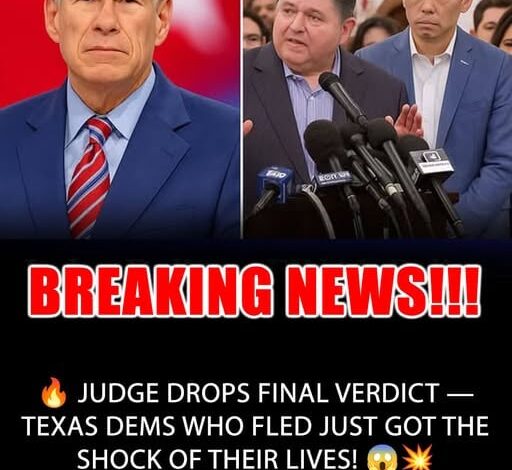
What began as a political walkout has evolved into something far larger and more consequential: a confrontation over the meaning of democracy itself, and over who ultimately gets to decide how far dissent is allowed to go before punishment begins.
At first, the standoff in Texas looked procedural.
Legislators leaving the state.
Quorum rules invoked.
Press conferences delivered from podiums lined with state flags.
To some observers, it resembled another episode in the increasingly theatrical style of modern American politics — dramatic, partisan, temporary.
But as the days stretched on, the conflict hardened into something more serious.
The fight was no longer only about legislation.
It became about power.
About obedience.
About resistance.
About whether elected officials can meaningfully oppose the majority once the machinery of punishment turns directly toward their livelihoods.
On one side stand state leaders framing the situation as a matter of institutional duty and constitutional order. Their argument is blunt and intentionally simple:
Legislators were elected to appear for work.
If they refuse to appear, consequences follow.
No work, no pay.
To supporters of this position, the penalties are not authoritarian but logical — a defense of process against political sabotage. They argue that allowing lawmakers to flee in order to block legislation undermines democratic governance itself by replacing debate and voting with procedural paralysis.
From that perspective, the majority sees itself not as oppressive, but as enforcing accountability.
Rules.
Attendance.
Obligation.
Yet on the other side, those who left Texas describe the situation in profoundly different terms.
To them, the empty chairs inside the legislature are not abandonment.
They are resistance.
A last procedural weapon available in a political environment where traditional minority influence has steadily eroded. The lawmakers who fled argue they are not obstructing democracy but attempting to protect it from policies they believe could fundamentally reshape access to voting and electoral fairness itself.
In their view, quorum-breaking is not dysfunction.
It is alarm.
An emergency tactic deployed because ordinary opposition no longer feels sufficient against legislation they believe threatens the integrity of future elections.
And so the conflict escalates.
Each withheld paycheck.
Each $500 daily fine.
Each public threat of further consequences.
None of it functions merely as administrative discipline anymore.
The penalties carry symbolic weight.
They are designed to send a message not only to absent lawmakers, but to anyone watching:
resistance has a cost.
Financial pressure becomes political pressure.
That distinction matters deeply.
Because once punishment targets economic survival directly, political conflict begins entering more intimate territory. The question shifts away from abstract constitutional arguments and toward something painfully practical:
Who can actually afford to dissent?
Many lawmakers involved are not independently wealthy despite public assumptions about political life. Families still rely on salaries, health insurance, mortgages, tuition payments, and ordinary financial stability. Extended political resistance becomes exponentially harder when every additional day carries personal economic consequences.
That reality transforms the walkout psychologically.
What began as symbolic protest gradually becomes endurance.
A test not only of political conviction, but of financial resilience.
And perhaps that is the deeper struggle emerging beneath the headlines.
Historically, democratic systems depend not only on elections, but on protected space for opposition itself. Minority parties lose votes, lose legislation, lose elections — yet they retain legitimacy as participants inside the democratic structure.
The danger arises when opposition begins carrying penalties severe enough to make participation economically unsustainable.
Critics of the punishments argue that tying financial survival to political compliance redraws the boundaries of acceptable dissent in ways that extend far beyond Texas. The concern is not simply about this particular legislative battle, but about precedent.
What happens when governments increasingly treat procedural resistance not as disagreement, but as punishable disobedience?
The implications stretch outward quickly.
Because democracies rely on more than laws and institutions alone.
They rely on norms.
On restraint.
On shared assumptions about how much pressure majorities should exert against minorities, even during intense political conflict.
When those norms weaken, democratic systems can remain technically functional while becoming psychologically coercive in subtler ways.
That is what unsettles many observers most about the Texas standoff.
Not simply the walkout itself.
But the expanding willingness to weaponize livelihood as leverage.
The message resonates far beyond Austin:
Challenge us, and we can make survival harder.
Supporters of the penalties reject that characterization entirely, arguing that elected officials should not receive taxpayer-funded salaries while intentionally preventing legislative business from occurring. To them, consequences are not political intimidation but enforcement of responsibility.
And yet even many neutral observers acknowledge the emotional and symbolic intensity of the moment.
Because the spectacle reveals a broader transformation occurring across American politics generally:
the collapse of distinction between political opposition and political enemy status.
Increasingly, rival parties no longer view each other merely as competitors with differing priorities. They see each other as existential threats whose victories would fundamentally damage the nation itself.
Once politics reaches that level of mutual distrust, compromise begins looking like surrender.
Punishment begins looking like necessity.
Institutional hardball becomes morally justified in the minds of those wielding it.
That escalation creates dangerous incentives.
Every new tactic establishes precedent for the next.
Every punishment normalizes harsher punishment later.
Every institutional escalation invites retaliation once power shifts again.
Meanwhile, ordinary citizens watching from outside government absorb another message entirely:
political participation itself appears increasingly punishing, unstable, and economically risky.
That perception matters because democracies require more than formal rights.
They require people willing to engage despite disagreement.
If public life becomes defined primarily by fear of retaliation, exhaustion, or economic vulnerability, participation narrows naturally toward those wealthy or protected enough to survive the costs.
And that may be the most unsettling question hidden beneath the Texas conflict:
not who is legally correct,
not which side wins the immediate standoff,
but whether democratic resistance remains meaningful when the price of maintaining it becomes unbearable for most people.
Because rights that exist only for those wealthy enough to endure punishment are not equally accessible rights in practice.
They become conditional.
The lawmakers who fled understand this intuitively.
So do the leaders imposing consequences.
That is why neither side frames the conflict as minor anymore.
Both understand the stakes reach beyond one legislative session.
This is about defining the future boundaries of acceptable political defiance inside modern American democracy.
How much disruption is legitimate?
How much punishment is justified?
At what point does enforcement become coercion?
Those questions do not end when lawmakers eventually return to the chamber.
They linger afterward inside institutions, public trust, and political culture itself.
And perhaps the deepest wound left by moments like this is not the immediate financial hardship or procedural deadlock.
It is the gradual normalization of a political environment where dissent increasingly feels less like a protected democratic function and more like a personal financial gamble few ordinary people could realistically survive for long.
Because once resistance carries a price tag large enough, democracy changes quietly.
Not through dramatic collapse.
Through narrowing participation until only the most insulated can afford to keep fighting.