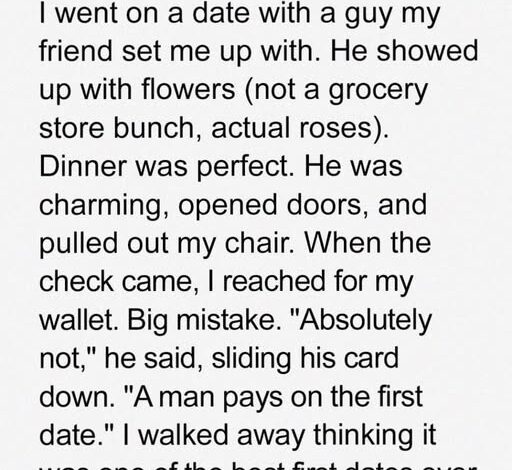
At first, the evening felt almost cinematic.
The restaurant glowed with soft light and expensive confidence. Wine arrived before glasses emptied. Flowers appeared at the table with the kind of timing that makes generosity seem effortless. He spoke carefully, listened closely, laughed at exactly the right moments. Every gesture carried the polished ease of someone who understood how to create an atmosphere where affection could bloom quickly and naturally. By the end of the night, I walked away thinking less about the cost of the evening than the rare feeling of being genuinely seen.
That illusion lasted until the email arrived.
At first glance, it almost looked professional — clean formatting, itemized sections, tidy calculations lined up with corporate precision. But the longer I stared at it, the stranger it became. Dinner expenses. Drinks. Flowers. Transportation. Even “emotional labor” appeared listed among the charges, as though kindness itself had been rented temporarily rather than freely offered between two people sharing an evening together.
What shocked me most was not the amount.
It was the philosophy hiding underneath it.
The message transformed every smile, compliment, and gesture from the date into retroactive negotiation. Suddenly the night no longer looked generous; it looked transactional. Every moment I thought had been mutual now felt audited.
People often say manipulation reveals itself slowly, but sometimes it arrives all at once in a single document.
The spreadsheet told me more about him than the entire evening ever had.
Because healthy affection does not keep score secretly.
Respect does not arrive attached to reimbursement policies.
And emotional connection cannot survive once one person starts treating intimacy like a business investment expecting guaranteed returns.
What disturbed me most was the inclusion of “emotional labor.”
That phrase lingered in my mind long after I stopped laughing at the absurdity of it. Listening during dinner. Showing interest. Being attentive. He had apparently categorized basic human decency as billable service. The implication underneath the humorless accounting was unmistakable: his attention was not freely given. It was something he believed created debt.
And debt creates power.
That realization shifted the entire memory of the evening.
Suddenly the carefully timed flowers looked less romantic and more strategic. The generosity no longer felt warm; it felt performative, almost contractual. Like he believed spending money automatically entitled him to emotional ownership afterward, and when the night failed to deliver whatever fantasy he had projected onto it, he attempted to reclaim control through accounting.
The invoice wasn’t really about recovering money.
It was about punishing rejection.
About transforming vulnerability into leverage before anyone else could wound his ego first.
At first, I felt embarrassed.
Humiliated, even.
Not because I owed him anything, but because moments I had experienced sincerely suddenly felt contaminated by calculation. There is something uniquely unsettling about realizing another person entered an interaction emotionally armed while you arrived honestly open. It makes you question your own instincts afterward. Were the compliments real? The kindness? The laughter? Or was everything simply part of a performance waiting to convert itself into resentment if expectations went unmet?
So I did what many people do when confusion becomes too heavy to process privately:
I sent the email to friends.
And almost instantly, shame transformed into laughter.
Not cruel laughter exactly.
Liberating laughter.
The kind that arrives when absurdity finally outweighs humiliation. My friends dissected the invoice like forensic investigators studying evidence from a failed psychological experiment. One friend nearly cried laughing at the phrase “emotional labor surcharge.” Another pointed out that the flowers technically depreciated immediately upon delivery and should therefore qualify as a sunk cost.
Then someone jokingly suggested sending a counter-invoice back.
That joke evolved quickly into something glorious.
Wasted time: $350.
Emotional whiplash: $500.
Listening politely to unsolicited monologues about himself: premium rate.
Exposure to unchecked narcissism: hazard fee.
Therapy required after opening spreadsheet: pending reimbursement.
What started as mockery gradually became reframing.
Because the counter-invoice exposed something important:
his behavior was not evidence that I had failed romantically.
It was evidence that he fundamentally misunderstood connection itself.
Healthy relationships are not negotiated through emotional bookkeeping. Nobody invoices affection sincerely unless they already view intimacy through the lens of transaction and control. The spreadsheet revealed someone terrified of vulnerability without guaranteed compensation — someone who interpreted generosity not as expression, but as investment expecting measurable return.
And underneath that mindset often lives profound insecurity.
People who truly feel secure in themselves rarely need to quantify what they gave emotionally. They do not demand reimbursement for kindness because kindness offered freely already contains its own value. But people desperate for control frequently transform generosity into obligation. It protects them psychologically from the risk of rejection. If affection becomes contractual, then disappointment can be reframed as financial injustice rather than emotional incompatibility.
When he discovered the mock invoice had circulated among friends, his reaction removed any remaining doubt about who he really was.
The charm disappeared instantly.
In its place came fury.
Long messages.
Defensive explanations.
Accusations.
Angry attempts to portray himself as misunderstood rather than manipulative.
Ironically, the rage accomplished exactly what the original invoice already suggested: beneath the polished confidence sat someone emotionally fragile enough to treat public embarrassment like catastrophic personal attack. He could not tolerate becoming the joke because his entire performance depended on appearing superior, composed, and in control at all times.
People reveal themselves most clearly when control slips away.
And his anger revealed far more truth than the spreadsheet ever could.
What struck me afterward was how quickly his language shifted from romance to entitlement. The same person who once spoke softly over candlelight now sounded transactional, resentful, almost offended that emotional access to me had not yielded the outcome he imagined he deserved.
That transformation clarified something important:
real affection cannot coexist with hidden accounting.
The healthiest relationships survive because both people give willingly without calculating exact repayment constantly. Care flows naturally. Sometimes unevenly. Sometimes imperfectly. But never with invoices waiting quietly in the background ready to convert disappointment into debt collection.
Once connection becomes transactional, intimacy collapses into negotiation.
And nobody feels emotionally safe inside negotiations they never knowingly entered.
So I blocked him.
Not dramatically.
Not vindictively.
Necessarily.
Because some people mistake access for ownership, and once someone begins itemizing emotional interactions financially, boundaries stop being optional. They become protection.
Looking back now, the evening itself feels almost symbolic of something larger about modern dating and emotional performance. So many people enter relationships carrying invisible ledgers — tallying attention, money, effort, validation, status, vulnerability — while pretending everything remains spontaneous and sincere. But hidden resentment always leaks eventually. Control always reveals itself eventually.
And when it does, the illusion collapses fast.
What remains afterward is clarity.
Love does not send invoices.
Affection does not require reimbursement.
Generosity given freely does not transform into debt because romance failed to unfold perfectly.
Real connection contains risk precisely because it cannot be fully controlled or guaranteed.
That uncertainty is the price of intimacy itself.
Anyone trying to eliminate that risk through manipulation, guilt, or transactional accounting is not protecting love.
They are protecting their ego from rejection.
And the only sane response to that kind of arrangement is exactly what I finally chose:
to walk away owing absolutely nothing.