The argument began before the plane even left the gate.
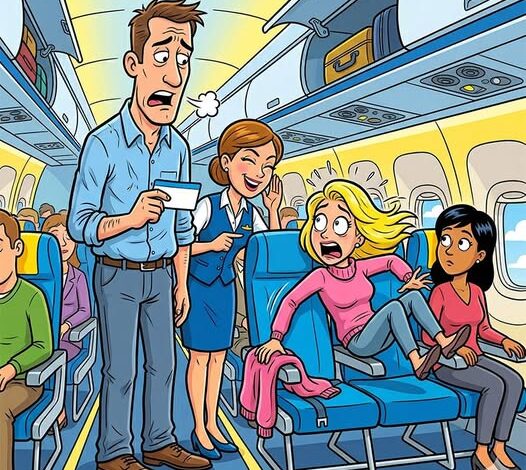
Passengers were still shoving carry-ons into overhead bins and apologizing as they squeezed down the aisle when the tension started building around Row 14. A blonde woman in a sharp white blazer had planted herself firmly in the aisle seat, legs crossed comfortably, headphones already on as if the discussion were over before it began.
The problem was simple:
that wasn’t her seat.
Her boarding pass clearly showed the middle seat between two strangers — Mr. Johnson by the window and a quiet businessman already waiting in the aisle nearby. But the moment the businessman politely explained the mistake, she barely glanced up.
“I don’t do middle seats,” she said flatly.
At first, everyone assumed it would resolve quickly.
It never did.
The businessman tried reasoning with her calmly. Mr. Johnson offered to help rearrange bags so she’d feel more comfortable. Another passenger even suggested switching rows if possible. But the blonde refused every solution with growing irritation, as though the rules of commercial flying were merely optional suggestions for other people.
“I booked this flight too,” she snapped at one point. “I deserve to be comfortable.”
Around them, the cabin slowly filled with that uniquely tense silence airplanes create when strangers become accidental witnesses to conflict. People pretended not to stare while listening to every word anyway. A child somewhere near the back asked loudly why the plane wasn’t moving yet. Flight attendants exchanged tired looks familiar to anyone who has worked customer service long enough to recognize entitlement before it fully erupts.
Mr. Johnson eventually stepped in himself.
He was a soft-spoken man in his sixties with the exhausted patience of someone who had spent a lifetime avoiding unnecessary drama. He explained gently that boarding delays affected everyone and that the crew simply needed passengers in their assigned seats before takeoff.
The blonde didn’t budge.
“I’m staying right here,” she said. “If they want me moved, they can make me.”
That sentence lingered heavily in the air.
Because suddenly the issue wasn’t really about legroom anymore.
It had become a test of will.
You could feel the entire row recognizing it simultaneously. The blonde wasn’t defending comfort now; she was defending pride. Moving after arguing for fifteen minutes would feel like losing publicly, and some people would rather prolong chaos than surrender even small amounts of control.
The flight attendants tried next.
One explained policy professionally.
Another warned the delay could affect departure.
Still nothing.
The blonde folded her arms tighter and stared straight ahead toward the runway lights glowing outside the window. Her expression carried the unmistakable confidence of someone convinced nobody could actually force her to comply.
That confidence fascinated Mr. Johnson more than the argument itself.
What made her so certain?
Did she think threatening legal action would work?
Was she expecting special treatment?
Did she simply enjoy confrontation?
By now, passengers nearby were openly whispering theories.
Someone muttered she’d probably be removed from the flight.
Another predicted police would board before takeoff.
A teenager quietly filmed part of the scene beneath his hoodie sleeve for social media.
Still, the blonde remained motionless.
Then the final flight attendant arrived.
Unlike the others, she didn’t sound irritated or authoritative. She crouched slightly beside the blonde’s seat and spoke so quietly only those closest could hear.
She smiled warmly.
Leaned in.
Whispered one sentence.
And everything changed instantly.
The blonde’s eyes widened.
“What?” she asked sharply.
The flight attendant repeated herself calmly.
Within seconds, the woman snatched her purse from the aisle seat, stood up abruptly, and slid into the middle seat without another word.
No protest.
No debate.
No final complaint.
Just immediate compliance.
The transformation was so sudden the cabin almost seemed confused by it. Passengers blinked at one another in disbelief while the businessman quickly settled into the aisle seat before she could reconsider.
Then something remarkable happened:
the entire plane exhaled together.
People laughed quietly.
Someone clapped once near the back.
Even the pilots finally announced departure preparations as normal conversation slowly returned around the cabin.
But Mr. Johnson couldn’t stop thinking about it.
The mystery bothered him the entire flight.
What could the attendant possibly have said?
He replayed the scene repeatedly while the plane crossed dark clouds toward New York. The woman had ignored logic, policy, embarrassment, and direct confrontation. Yet one soft sentence from a stranger shattered her resistance instantly.
It had to be serious.
Maybe a legal threat.
Maybe a security warning.
Maybe some airline rule ordinary passengers didn’t know existed.
The more he thought about it, the more curious he became.
Meanwhile, the blonde sat stiffly in the middle seat for the entire flight, unusually quiet now, staring forward with wounded dignity while pretending not to notice occasional glances from nearby passengers.
Mr. Johnson almost admired the flight attendant’s skill.
Almost.
Mostly, he was desperate to know the secret.
After landing, passengers shuffled slowly into the aisle collecting bags and stretching cramped legs. Mr. Johnson waited until most people had exited before approaching the flight attendant near the front galley.
“I have to ask,” he admitted with a laugh. “What on earth did you say to her?”
The attendant grinned immediately.
“That?” she said. “Oh, I just told her the aisle seat wasn’t going to New York.”
Mr. Johnson stared at her for a second.
Then the absurd simplicity hit him all at once.
There had been no threat.
No authority.
No hidden airline policy.
Just psychology.
The attendant understood something everyone else missed during the argument: the blonde wasn’t responding to logic because she no longer cared about fairness. She cared about preserving control. So instead of challenging her pride directly, the attendant redirected her fear.
The moment the blonde believed the aisle seat might somehow take her somewhere else, certainty collapsed instantly. Suddenly the argument wasn’t about winning anymore — it was about avoiding loss.
And fear almost always moves people faster than reason.
That realization stayed with Mr. Johnson long after the flight ended.
Because the incident revealed something strangely human beneath all the comedy.
People like to believe their decisions come from intelligence, stubborn principles, or rational thought. But often, confidence is surprisingly fragile. A few carefully chosen words can redirect behavior more effectively than endless arguments ever could.
The businessman failed because he challenged her publicly.
The passengers failed because they appealed to fairness.
The crew failed because they relied on authority.
But the final attendant succeeded because she understood perception matters more than confrontation.
The blonde didn’t suddenly become reasonable.
She became uncertain.
And uncertainty changes everything.
By the time Mr. Johnson left the airport, the story already felt larger than a petty argument over airplane seating. It had become a small lesson about ego, persuasion, and the strange shortcuts hidden inside human psychology.
Sometimes people resist truth endlessly.
Yet surrender instantly to the right illusion.
And all it takes to redirect certainty is one sentence spoken quietly enough to slip past pride before it realizes what happened.