What made the 44th Academy Awards feel historic wasn’t simply who won or lost that night. It was the strange, almost electric sensation that something deeper was breaking apart inside Hollywood itself. Beneath the tuxedos, diamonds, orchestral music, and polished smiles, there was a growing awareness that the old machinery of American cinema no longer fully understood the audience it was trying to entertain.
For decades, Hollywood had survived by manufacturing dreams.
The studio system sold glamour, certainty, romance, and heroic mythologies wrapped in beautiful lighting and carefully controlled endings. Even its tragedies were elegant. Even its rebels looked photogenic. The industry knew how to package emotion safely enough for mass consumption while protecting the illusion that America itself remained fundamentally stable, optimistic, and morally coherent.
But by 1972, the country no longer felt coherent.
Vietnam filled television screens with real blood and confusion.
Political distrust deepened daily.
Assassinations, protests, racial upheaval, and generational rebellion had shattered the postwar confidence Hollywood once depended on.
And suddenly audiences wanted films that reflected that fracture honestly.
That is why movies like The French Connection and The Last Picture Show landed with such force. They didn’t merely entertain viewers; they confronted them. The heroes were rougher, morally compromised, exhausted. The worlds onscreen felt dirty, lonely, cynical, unfinished. Violence no longer appeared glamorous. Desire no longer arrived neatly packaged with redemption. Even silence carried weight.
Compared to these films, much of old Hollywood suddenly looked artificial—almost embarrassingly disconnected from reality.
That tension filled the Academy Awards ceremony itself.
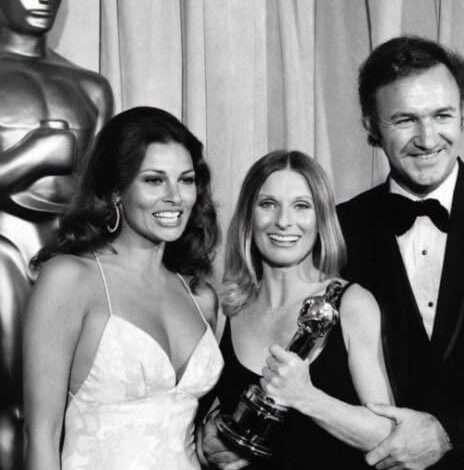
You can almost see it in the photographs from that night. The stars still looked immaculate outwardly, posed beneath chandeliers and camera flashes with practiced sophistication. Yet many faces carried something unsettled beneath the glamour, as though they sensed the cultural ground moving beneath their feet while pretending not to notice publicly.
Because the truth was impossible to ignore anymore:
the audience had changed faster than the gatekeepers.
Executives who once controlled every aspect of storytelling suddenly faced filmmakers willing to violate nearly every unwritten rule the industry depended on. Directors influenced by European cinema, documentary realism, and counterculture politics were pulling American movies into darker emotional territory. The old formulas no longer felt sufficient to younger viewers raised amid social unrest and institutional distrust.
People didn’t want polished fantasies anymore.
They wanted honesty.
Even ugly honesty.
Especially ugly honesty.
That frightened Hollywood as much as it excited it.
Because once audiences develop a taste for authenticity, even painful authenticity, manufactured optimism becomes harder to sell convincingly. The success of films like The French Connection signaled that viewers were willing to embrace stories filled with ambiguity, corruption, obsession, and unresolved endings. Cinema no longer needed to reassure people morally by the final scene.
Sometimes the hero could remain broken.
Sometimes institutions could fail.
Sometimes violence solved nothing.
That represented a profound shift not just artistically, but psychologically.
The Academy Awards became a strange collision point between two eras of filmmaking. Older stars, shaped by the classic studio system, suddenly found themselves standing beside younger actors and directors who embodied something rawer and more unpredictable. Glamour still existed, but rebellion had entered the building wearing expensive suits.
And rebellion looked good on camera.
That contradiction gives the event its lingering power decades later.
The photographs feel haunted because they capture people suspended between identities. You see polished movie stars smiling outwardly while carrying private awareness that the industry defining them was changing irreversibly around them. Some likely felt exhilarated. Others terrified. Many probably experienced both emotions simultaneously.
Because cultural revolutions rarely announce themselves cleanly while they happen.
At the time, few people fully understood they were witnessing the collapse of one Hollywood and the birth of another. Yet in retrospect, the signs feel obvious everywhere: the darker themes, the moral ambiguity, the willingness to portray alienation honestly instead of disguising it beneath spectacle.
Cinema had crossed a line it could never fully uncross.
After that era, audiences expected more psychological realism from films. Characters became messier. Endings became less certain. Directors gained greater creative control. The influence of New Hollywood reshaped not only filmmaking styles, but audience expectations about truth itself in storytelling.
And perhaps that is why people remain fascinated by 1972 specifically.
Not because it was the “best” Oscars ceremony.
Not because every film from that period aged perfectly.
But because the event accidentally exposed Hollywood’s own vulnerability.
For one brief moment, the industry seemed aware of its loss of innocence. The old confidence was cracking publicly. The ceremony still projected glamour, yet beneath the surface lived anxiety about relevance, control, and artistic legitimacy. The younger filmmakers were no longer asking permission politely. Audiences were rewarding them for tearing down conventions instead.
That realization unsettled the people who built careers preserving those conventions.
The old Hollywood machine suddenly looked less eternal than fragile.
And audiences sensed it too.
Looking back now, the ceremony feels almost like a cultural snapshot taken seconds before transformation became irreversible. Behind every smile hides uncertainty. Behind every applause line sits awareness that American storytelling itself was changing shape in real time.
The films honored that night reflected a country losing faith in simple narratives.
And Hollywood, perhaps unintentionally, admitted it.
That may be the real reason the world keeps returning to those images from the 44th Academy Awards.
Not merely for nostalgia.
Not only for cinematic history.
But because the photographs capture an industry confronting something terrifying and liberating at the same time:
the realization that truth, once allowed fully into art, cannot easily be pushed back out again.