He Had No Home, No Family—except for the Cat That Slept on His Chest Every Night. “she Chose Me,” He Said. “that’s All That Matters.”

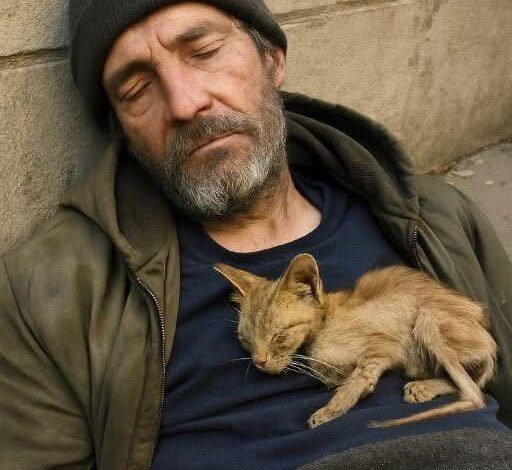
The first time I noticed him, snow was collecting silently along the edges of the sidewalk while everyone else walked faster, heads down, pretending not to see him there.
He always stayed near the closed pharmacy on 8th Street, tucked beneath the broken awning where the wind hit less brutally after midnight. Most people passed him the way cities train people to pass suffering: quickly, carefully, without eye contact. But every evening when I finished my shift at the diner, I saw the same thing waiting under those dim streetlights—
an old man,
a threadbare sleeping mat,
and a small orange cat curled tightly against his chest.
At first, I thought the cat belonged to someone nearby and simply wandered over for warmth.
Then I realized she never left him.
Not once.
Even during the worst weather, she stayed wrapped against him like the two of them had quietly agreed the world could reject them separately, but not together.
One night, I brought him coffee.
Not out of heroism.
Mostly guilt.
The temperature had dropped below freezing, and I couldn’t stop thinking about how impossible it must feel to survive a night outside in weather that physically hurt to breathe in.
When I handed him the cup, his eyes widened slightly like kindness itself surprised him.
“Thank you,” he said softly.
His voice was educated.
Gentle.
Not what people expect when they imagine homelessness.
The cat lifted her head immediately, suspicious of me at first, her green eyes sharp beneath the streetlight glow. But when he scratched behind her ears, she settled again.
“What’s her name?” I asked.
“Juniper.”
The way he said it made her sound like family instead of a stray.
“She yours?”
He smiled faintly.
“No,” he answered. “I think I’m hers.”
After that, bringing coffee became routine.
Sometimes soup.
Sometimes sandwiches left over from the diner.
Sometimes just conversation.
His name was Elias.
He had once taught literature at a community college before layoffs, medical debt, and a string of disasters he described without bitterness somehow reduced his life piece by piece until almost nothing recognizable remained.
“People think it happens all at once,” he told me one night while Juniper slept curled in his lap. “But losing your life usually happens slowly enough that you keep believing you can still fix it right up until you can’t.”
That sentence stayed with me.
Because he never sounded angry.
Just tired.
There’s something uniquely devastating about meeting someone who remains deeply kind after life has given them every reason not to be.
The city grew colder as winter settled in fully.
By December, even short walks outside burned your lungs. Wind sliced through clothing like fabric barely mattered anymore. Every morning the sidewalks glittered with frozen ice and people hurried past each other carrying coffees and shopping bags while Elias stayed beneath the awning with Juniper tucked inside his coat.
I started worrying constantly.
“You can’t stay out here when it gets worse,” I told him one evening.
He nodded calmly.
“I know.”
But he never moved.
The problem became obvious soon enough.
Most shelters didn’t allow animals.
Especially not unofficial strays with no paperwork or vaccinations.
“People tell me to leave her behind,” he explained quietly one night. “Like loyalty is something disposable once survival gets inconvenient.”
Juniper blinked slowly against his chest while he spoke.
“She stayed with me when I had nothing left,” he continued. “I won’t teach her abandonment in return.”
I stopped trying to argue after that.
Because the truth was painful:
I understood.
The coldest night came in January.
The kind of cold that silences entire streets.
The air itself felt dangerous. Even inside the diner, customers kept stamping snow from their boots and complaining about how unbearable it was outside. Every weather alert warned people not to remain exposed longer than necessary.
All night I kept glancing toward the windows thinking about Elias.
Finally, after closing, I filled two large coffees and wrapped extra food into paper bags before walking the six blocks toward the pharmacy.
I saw him immediately.
He was sitting upright instead of sleeping, his old coat wrapped entirely around Juniper while snow gathered across his shoulders and hair untouched. His hands were bare, red from cold, visibly shaking.
But the cat looked warm.
Protected.
When he noticed me approaching, he smiled weakly.
“She’s not used to this kind of weather,” he said softly, like his own suffering barely registered beside hers.
That nearly broke me.
I handed him the coffee quickly.
“You’re freezing.”
“I’ve survived worse.”
But his voice sounded thinner than usual.
That’s when the outreach van arrived.
White city lettering across the side.
Two volunteers inside.
Heated seats.
Emergency shelter placement.
I felt immediate relief.
Finally.
One of the workers stepped out and crouched beside him kindly.
“We’ve got room tonight,” she explained. “Warm bed. Hot shower. Meals.”
Elias listened carefully.
For the first time in weeks, genuine hope flickered across his exhausted face.
Then he looked down toward Juniper sleeping inside his coat.
“Can she come?”
The silence afterward lasted barely two seconds.
But it felt enormous.
The volunteer’s expression softened apologetically.
“I’m sorry,” she said. “Animals aren’t permitted.”
I watched something inside him close immediately.
Not dramatically.
Not angrily.
Quietly.
The way doors close in old houses when the wind shifts.
“She’s all I have,” he said.
“I understand,” the volunteer replied gently. “But those are the rules.”
Rules.
The word sounded unbearable standing there in the snow.
Elias looked at me then.
And I swear his eyes seemed clearer than I had ever seen them before.
Not confused.
Not defeated.
Certain.
“I won’t leave her,” he said softly.
The outreach workers tried again.
Explained warming centers.
Suggested animal control.
Promised temporary arrangements.
But every option required surrendering Juniper first.
And every time, he shook his head.
Finally, the van drove away.
Empty.
Snow kept falling quietly after the taillights disappeared.
I stood there beside him feeling helpless in a way that bordered on rage.
“There has to be somewhere,” I whispered.
He smiled faintly.
“There should be.”
That answer hurt more than blame would have.
I stayed another hour trying unsuccessfully to convince him to come with me somewhere, anywhere.
But I lived in a tiny apartment that didn’t allow pets either. Another stupid rule inside a city built from rules that somehow always punished the people with the least left to lose.
Eventually, Elias leaned back against the wall holding Juniper tighter inside his coat.
“You should go home,” he told me gently. “You’ve got work tomorrow.”
I didn’t want to leave.
But around three in the morning, with snow still falling endlessly and exhaustion pulling at my bones, I finally walked away.
Halfway down the block, I looked back once.
He was still there beneath the streetlight, curled protectively around the tiny orange shape hidden against his chest.
The next morning, I ran back before sunrise.
The sidewalk was empty.
No sleeping mat.
No shopping cart.
No coffee cups.
Just wind sweeping snow across bare concrete.
For one terrifying second, panic swallowed me entirely.
Then I saw it.
The faint outline where his mat had rested overnight pressed into the snow like a ghost imprint.
And beside it—
a single orange cat hair clinging stubbornly to the frozen pavement.
I stared at it for a very long time.
Elias was gone.
No body.
No explanation.
No note.
Just absence.
I searched shelters for weeks afterward.
Hospitals.
Soup kitchens.
Every block nearby.
Nothing.
Sometimes I still think I see him in crowds during winter—an older man in a heavy coat carrying something carefully against his chest.
But it’s never him.
The strange thing is, people often ask why the story still stays with me so deeply.
Maybe because of the ending.
Maybe because I never learned what happened next.
But honestly, it’s something else.
It’s because in a city where survival teaches people to abandon almost everything eventually—
comfort,
dignity,
possessions,
hope—
Elias refused to abandon love.
Not romantic love.
Not dramatic love.
Simple loyalty.
The kind that asks:
If someone stayed beside you through your worst suffering, how could you leave them simply because the world decided they were inconvenient?
Most people would call that irrational.
Maybe it was.
But every winter when the air turns sharp enough to hurt your lungs, I still remember him sitting there in the snow with frozen hands wrapped around a tiny orange cat, protecting her from the cold like her life mattered as much as his own.
And honestly?
I think that kind of devotion says something beautiful about what it means to remain human when the world gives you every excuse not to.