The invitation had been sitting on the kitchen counter for three days before my wife finally brought it up.
I barely looked at it.
I was answering emails on my phone while half-listening to whatever was happening around me—a habit she had complained about more than once.
“My high school reunion is next month,” she said, holding up the cream-colored envelope. “I was thinking about going.”
Without lifting my eyes from the screen, I shrugged.
“Really?”
She smiled a little.
“Yeah. It might be nice to see everyone again.”
That’s when I made the mistake.
The kind of mistake that seems harmless for exactly three seconds before it changes everything.
I laughed lightly and said, “I don’t know. Wouldn’t that be awkward now?”
She frowned.
“What do you mean?”
I finally looked up.
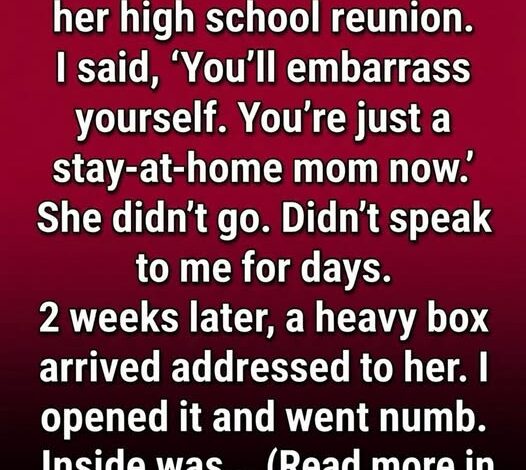
“You know… everyone will be talking about careers and accomplishments and stuff. You’re just a stay-at-home mom. It might be uncomfortable.”
The words came out casually.
Thoughtlessly.
Like I was commenting on the weather.
The moment they left my mouth, I knew something had shifted.
Her smile disappeared.
Not dramatically.
Not angrily.
It simply faded.
“Oh,” she said quietly.
Then she folded the invitation, placed it back inside the envelope, and set it on the counter.
“Maybe you’re right.”
That was all.
No argument.
No tears.
No lecture about respect.
Just those three words.
Maybe you’re right.
At the time, I thought the conversation was over.
I had no idea what I had broken.
Over the next two weeks, our house remained exactly the same.
And yet it felt completely different.
Breakfast appeared every morning.
The kids got to school on time.
Laundry was folded.
Dinner was ready.
Everything worked perfectly.
Too perfectly.
The warmth that usually filled our home seemed to disappear.
My wife still smiled.
She still asked about my day.
She still laughed at the kids’ jokes.
But something behind her eyes had dimmed.
Like a light switched off in a room I didn’t realize I depended on.
I noticed it.
Then ignored it.
Because admitting something was wrong would mean admitting I caused it.
So I convinced myself she was tired.
Stressed.
Distracted.
Anything except hurt.
Then the box arrived.
It showed up on a rainy Thursday afternoon.
A large cardboard box with my wife’s name printed neatly across the label.
I carried it inside and set it near the dining room table.
It was surprisingly heavy.
Not the weight of books.
Not exactly.
It felt heavier than that somehow.
Almost important.
My wife wasn’t home.
She had taken our daughter to piano lessons.
For nearly twenty minutes, I walked past the box.
Then curiosity won.
I opened it.
Inside were dozens of carefully organized folders.
Certificates.
Awards.
Photographs.
Letters.
Handwritten journals.
Programs from conferences.
Newspaper clippings.
Academic records.
Everything arranged with incredible care.
Resting on top was a folded note.
My wife’s handwriting covered every inch of the page.
I unfolded it slowly.
And began reading.
The first paragraph hit me like a punch.
“If you’re reading this, it means I’ve started forgetting who I am.”
I blinked.
Confused.
Then I kept reading.
She wrote about being class president.
About graduating near the top of her class.
About organizing community projects.
Leading volunteer programs.
Winning academic competitions.
Receiving scholarship offers.
Dreaming about starting her own nonprofit someday.
Page after page revealed a version of my wife I had somehow stopped seeing.
Not because she hid it.
Because I stopped looking.
One letter described how she stayed awake until three in the morning preparing a presentation that eventually earned her a statewide leadership award.
Another described mentoring younger students.
One newspaper clipping showed her standing on a stage accepting recognition for a community initiative she created at nineteen.
I sat down.
Then kept reading.
And reading.
And reading.
The journals affected me most.
They weren’t relics from the past.
They were current.
Recent.
Filled with ideas she still worked on after everyone else went to sleep.
Business concepts.
Community projects.
Book outlines.
Volunteer initiatives.
Dreams.
Plans.
Goals.
Entire worlds living quietly inside her while I walked around believing she was simply a stay-at-home mom.
My throat tightened.
Because suddenly I remembered all the moments I had overlooked.
The late-night writing.
The books stacked beside her bed.
The articles she saved.
The conversations I half-listened to.
The ideas I nodded through without really hearing.
I hadn’t just reduced her to a label.
I had reduced her to a role.
As if motherhood erased everything else.
As if choosing our family meant abandoning herself.
Near the bottom of the box, I found the reunion invitation.
Carefully tucked between two journals.
I stared at it for a long time.
Then I understood.
The reunion wasn’t about proving anything to old classmates.
It was about reconnecting with a part of herself.
And my careless comment had suggested that part no longer mattered.
The sound of the front door opening startled me.
My wife stepped inside carrying sheet music and our daughter’s backpack.
She froze when she saw the box open.
For a moment neither of us spoke.
Then she looked at me.
Not angry.
Not surprised.
Just tired.
I stood immediately.
“I’m sorry.”
Her expression softened slightly.
“I know I shouldn’t have opened it.”
“That’s not what you’re apologizing for.”
She was right.
I swallowed hard.
“No.”
I looked around at the papers scattered across the table.
The evidence of a life.
A mind.
A person I loved.
A person I had somehow simplified.
“I am so unbelievably sorry for what I said.”
Her eyes filled with emotion.
I continued before fear could stop me.
“When I called you ‘just’ a stay-at-home mom… I wasn’t seeing you. Not really.”
Silence filled the room.
“I saw the schedules. The lunches. The errands. The school pickups.”
My voice cracked.
“But I stopped seeing everything else.”
She sat down slowly.
I joined her.
For the first time in years, we talked without distractions.
Without television.
Without phones.
Without rushing toward tomorrow.
She told me about the fears she rarely voiced.
How easy it was to lose yourself inside caregiving.
How sometimes she wondered whether anyone remembered who she had been before motherhood.
How much she loved raising our children.
And how much it hurt when people assumed that choice meant she lacked ambition.
Then she smiled sadly.
“The box wasn’t really for you.”
“What do you mean?”
“It was for me.”
I looked at her.
She glanced toward the journals.
“Sometimes I need reminders too.”
Her voice grew quieter.
“Not because I regret staying home. I don’t.”
She shook her head.
“I chose this life. I’d choose it again.”
Then she placed her hand over mine.
“But sometimes I need proof that becoming a mother didn’t erase everything else.”
The words broke something open inside me.
Because she wasn’t asking for praise.
She wasn’t asking for recognition.
She was asking to be seen.
Truly seen.
Not as a wife.
Not as a mother.
Not as the person who made our lives run smoothly.
But as the complete human being she had always been.
That night, we stayed awake talking until nearly two in the morning.
About dreams.
Goals.
Plans.
About who we were before we met.
And who we still wanted to become.
A month later, she attended her reunion.
When she walked down the stairs that evening, dressed in a navy-blue dress she hadn’t worn in years, she looked radiant.
Confident.
Alive.
I handed her the invitation.
She smiled.
“You kept it?”
“No.”
I kissed her forehead.
“I rediscovered it.”
She laughed.
Then headed toward the door.
Before leaving, she turned around.
“You know,” she said, “being a stay-at-home mom is one of the things I’m proudest of.”
“I know.”
I smiled.
“And it’s only one chapter.”
For the first time in weeks, her smile reached her eyes.
Exactly where it belonged.
As I watched her leave, I realized something simple but profound:
Love isn’t just appreciating what someone does for you.
It’s remembering who they are.
Every version of them.
Especially the parts that become easy to overlook.
And from that day forward, I promised myself I would never again reduce the woman I loved to a single role when she contained an entire lifetime of stories, dreams, achievements, and possibilities.