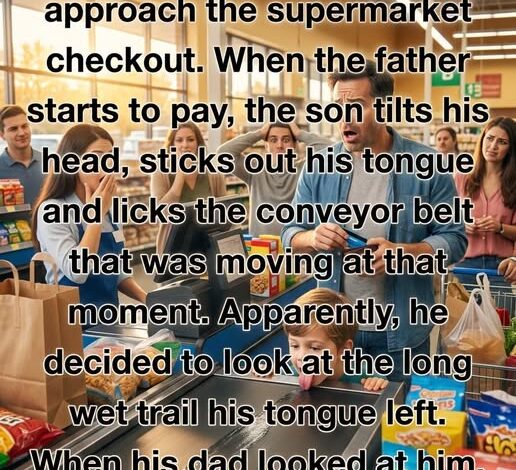
The first clue that my son was going to give me gray hair came at a supermarket checkout.
I was unloading groceries onto the conveyor belt when I noticed an unusual silence beside me. Parents know that’s rarely a good sign.
I turned just in time to see my seven-year-old son, Matei, lean forward, stick out his tongue, and drag it across the moving conveyor belt.
For a second, I was too shocked to react.
The belt kept moving.
Matei’s tongue did not.
A long wet streak stretched across the black rubber surface.
When he noticed me staring, he grinned proudly.
“Dad! My tongue won the race!”
“The race?” I asked.
“Against the groceries.”
The cashier nearly choked trying not to laugh.
The woman behind us covered her mouth and turned away.
Meanwhile, I stood there wondering whether I should laugh, cry, or immediately schedule a doctor’s appointment.
“Matei,” I said carefully, “you cannot lick public things.”
“But I wanted to see what would happen.”
“Now we know.”
“What happened?”
“You lost your mind.”
He laughed so hard he nearly fell over.
I wiped his tongue with three separate tissues and silently prayed the conveyor belt hadn’t introduced him to any new forms of life.
As ridiculous as it was, moments like that had become the soundtrack of our life together.
Because for the last three years, it had been just the two of us.
His mother left when he was four.
There wasn’t a dramatic fight.
No tragic event.
One morning she simply told me she wasn’t happy, packed two suitcases, and walked away.
At first I thought she’d come back.
Then I thought she’d call.
Then I stopped thinking about what she might do and started focusing on what I needed to do.
Raise my son.
Some days I managed it well.
Other days dinner was cereal and cartoons.
But somehow we kept moving forward.
We created routines.
Saturday pancakes.
Movie nights.
Bedtime stories that changed every time I told them because Matei never accepted the same ending twice.
Life wasn’t perfect.
But it was ours.
The morning after the supermarket incident, I found Matei sitting at the kitchen table drawing.
A giant heart covered most of the page.
Inside it was a smiling face.
Underneath, in uneven handwriting, were the words:
FOR MISS LIDIA.
“Who’s Miss Lidia?” I asked.
“My teacher.”
“The one who keeps sending notes home about your talking?”
Matei nodded.
“Tomorrow is her last day.”
I frowned.
“She’s leaving?”
“Her mom is sick. She has to move away and take care of her.”
He paused.
“She always helps me when I get nervous reading.”
I sat down beside him.
Miss Lidia had been patient with him from the beginning.
She never rushed him.
Never embarrassed him.
Never made him feel different.
“What are you making?”
“A goodbye card.”
He pointed to a small cake box sitting nearby.
“And that’s for her too.”
“You bought a cake?”
“With your money.”
“Of course.”
He smiled.
“Vanilla. Her favorite.”
The next morning we arrived at school early.
Miss Lidia was organizing books when we walked into the classroom.
Matei marched straight up to her carrying the cake.
“This is for you,” he said.
“And I hope your mom gets better.”
The teacher’s eyes immediately filled with tears.
She hugged him tightly.
“Thank you, sweetheart.”
Standing in the doorway, I realized something.
Matei noticed things.
Not just events.
People.
Their feelings.
Their struggles.
The small details most adults rushed past.
On the drive home, I asked him if he would miss her.
“Yeah.”
Then he shrugged.
“But people don’t stay forever.”
The answer caught me off guard.
“No,” I said quietly. “They don’t.”
“That’s why we should be nice while they’re here.”
I didn’t have a response to that.
Because he was right.
A few weeks later, he came home worried about a classmate named Nico.
Her father had recently left.
Her mother cried often.
And Nico had stopped smiling.
“Dad,” he said, “can we make banana bread?”
“Why?”
“For Nico.”
“Why banana bread?”
“Because nobody can be sad while eating banana bread.”
I wasn’t convinced the science supported that claim.
But we baked anyway.
The kitchen became a disaster zone.
Flour covered every surface.
Matei sang terribly the entire time.
And somehow the banana bread turned out perfect.
The next day he brought it to school.
That evening he announced proudly:
“Nico smiled today.”
I couldn’t stop thinking about that.
A simple loaf of banana bread.
A child noticing another child hurting.
A small act of kindness.
And suddenly someone’s day was better.
Then came the phone call.
The school informed me Matei had gotten into a fight.
When I arrived, I discovered he had punched a boy named Victor.
Apparently Victor had shoved Nico during recess.
Matei told him to stop.
Victor laughed.
Matei solved the problem with his fists.
As a parent, I knew I should be upset.
As a human being, I secretly understood.
Still, on the drive home I explained that violence wasn’t the answer.
“But talking didn’t work.”
“No.”
“So then what?”
That question stayed with me.
Later I met Victor’s parents.
They looked exhausted.
His father had recently lost his job.
Money was tight.
Stress filled their house.
Victor wasn’t a bad kid.
He was hurting.
The same way Nico was hurting.
The same way many people hurt.
They just showed it differently.
That weekend, Matei asked if we could make more banana bread.
“For Nico?”
“For Victor too.”
I stared at him.
“You want to give some to the kid who punched you?”
“He seems sad.”
Sometimes children understand things adults spend years trying to learn.
So we baked two loaves.
One for Nico.
One for Victor.
A month later, Victor invited Matei to play football during recess.
The fighting stopped.
The friendship started.
Life moved on.
School.
Work.
Bedtime stories.
Burned pancakes.
More banana bread than any household should reasonably consume.
Then, just before Christmas, something happened that neither of us expected.
A letter arrived.
An actual handwritten letter.
The envelope carried a name I hadn’t seen in years.
Matei’s mother.
My hands shook as I opened it.
Inside, she wrote about therapy.
About regret.
About mistakes.
About wanting to reconnect.
Not immediately.
Not dramatically.
Slowly.
Respectfully.
Carefully.
I read the letter three times.
Then I tucked it away.
A week later, I finally told Matei.
He listened quietly.
When I finished, he thought for a moment.
Then he asked:
“Can we bake something for her?”
I laughed despite myself.
“Why?”
“Because people should know they’re welcome.”
The simplicity of it nearly broke me.
Months later, the first meeting happened.
Then another.
Then another.
Nothing was perfect.
Nothing happened overnight.
But healing began.
Slowly.
Awkwardly.
Honestly.
By spring, both parents were sitting in the audience at Matei’s school play.
He still drew giant hearts.
Still asked impossible questions.
Still occasionally made decisions involving his tongue that concerned medical professionals.
But something had changed.
Not just in him.
In me.
For years I worried about whether I was enough.
Whether I was failing him.
Whether I could ever fill the space left behind.
Then one day I realized something.
Being a good parent isn’t about being perfect.
It’s about showing up.
Again.
And again.
And again.
Even when you’re tired.
Even when you’re scared.
Even when you’re making it up as you go.
And if you’re lucky, your child teaches you along the way.
Mine certainly did.
He taught me that kindness matters.
That second chances matter.
That people are often carrying battles we cannot see.
And that banana bread solves far more problems than anyone gives it credit for.
Most of all, he taught me that love isn’t measured by grand gestures.
Sometimes it’s a crayon heart.
A goodbye cake.
A shared loaf of banana bread.
Or a small boy who once licked a supermarket conveyor belt and somehow still grew into one of the kindest people I’ve ever known.
And honestly?
I think that’s enough.