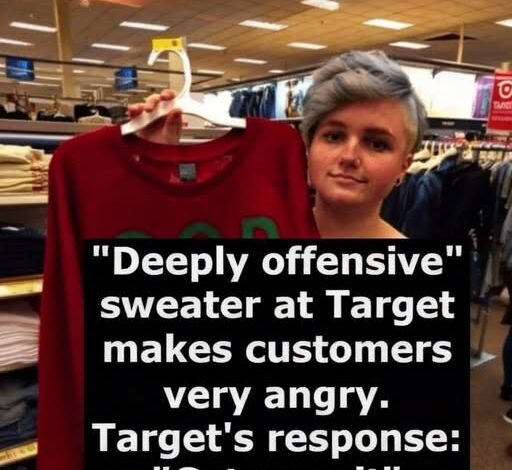
What began as an ordinary shopping trip quickly turned into a nationwide conversation about mental health awareness, product design, and the responsibility retailers have when choosing the messages displayed on their merchandise.
At the center of the discussion was a holiday sweater sold by Target that featured a phrase referencing obsessive-compulsive disorder, commonly known as OCD. While some shoppers viewed the design as harmless seasonal humor, others felt it raised important questions about how serious medical and mental health conditions are represented in popular culture.
The controversy started when a shopper named Reign Murphy noticed the sweater while browsing during the holiday season. Like many festive garments, the design used playful wording intended to capture holiday enthusiasm and perfectionism. However, Murphy believed the message crossed a line by using the term “OCD” in a casual and humorous way.
For Murphy, the issue was not simply about a sweater.
It was about how millions of people living with obsessive-compulsive disorder work every day to overcome misconceptions about the condition. OCD is often misunderstood as merely being overly organized, neat, or particular. In reality, mental health professionals describe it as a complex disorder that can significantly affect daily life through intrusive thoughts, compulsive behaviors, anxiety, and emotional distress.
Because of those realities, Murphy felt that turning the condition into a lighthearted holiday slogan risked minimizing the experiences of people who struggle with it.
After sharing concerns publicly, the issue quickly gained attention online.
As happens with many social media discussions, reactions were mixed.
Some individuals agreed with Murphy’s concerns. They argued that using medical or mental health conditions as punchlines can unintentionally reinforce stereotypes and contribute to misunderstandings about what those conditions actually involve.
Others, however, saw the situation differently.
Many people who identified themselves as living with OCD commented that they were not personally offended by the sweater. Some viewed the phrase as harmless humor rather than an attack on those affected by the condition. Others suggested that intent should be considered alongside impact, noting that they did not believe the retailer or designers had intended to mock anyone.
The variety of responses highlighted an important reality: people often interpret messages differently based on their personal experiences.
A phrase that feels dismissive to one person may seem harmless or even amusing to another.
As the discussion continued to spread, Target eventually responded.
Company spokesperson Jessica Carlson released a statement acknowledging the concerns raised by some shoppers. The company expressed regret that the product had made certain customers uncomfortable and emphasized that there was no intention to offend anyone.
At the same time, Target indicated that the sweater would remain available for purchase.
The retailer explained that while it respected differing opinions, the product had not been created with harmful intent. The decision reflected the difficult balance many companies face when responding to public criticism while also recognizing that customer reactions can vary widely.
The debate quickly expanded beyond the sweater itself.
Commentators began comparing the controversy to other discussions surrounding clothing and merchandise that feature potentially sensitive labels or stereotypes. Products using phrases such as “Bride,” “Mrs.,” “Trophy Wife,” or other identity-based slogans have often generated similar conversations about whether they are playful, outdated, empowering, or problematic.
In each case, reactions tend to depend heavily on personal perspective.
Some consumers see such items as harmless fun designed for entertainment and celebration. Others believe they can unintentionally reinforce stereotypes or diminish serious topics.
The discussion surrounding the holiday sweater also reflects a broader cultural shift.
Today’s consumers are often more attentive to language, symbolism, and representation than previous generations. Social media allows concerns to spread rapidly, giving individuals a platform to share their opinions and encouraging companies to respond more quickly to public feedback.
At the same time, these conversations reveal the complexity of navigating modern communication.
Intent, context, and impact do not always align perfectly.
A designer may intend humor.
A customer may perceive insensitivity.
Another customer may see nothing problematic at all.
All three perspectives can exist simultaneously.
Mental health advocates have long emphasized the importance of accurate representation and awareness. As public understanding of conditions such as OCD, anxiety disorders, depression, and other mental health challenges continues to evolve, discussions about language and cultural messaging are likely to become increasingly common.
For many advocates, the goal is not necessarily censorship but awareness—encouraging thoughtful consideration of how words and images may affect different audiences.
Meanwhile, others argue that context and intent should remain important factors when evaluating humor, creativity, and expression.
The Target sweater controversy ultimately became about far more than a single item of clothing.
It became a conversation about empathy, communication, and the challenges of balancing freedom of expression with sensitivity toward real-life experiences.
Whether people viewed the design as offensive, harmless, or somewhere in between, the discussion served as a reminder that words carry different meanings for different individuals.
In today’s interconnected world, even a simple holiday sweater can spark larger conversations about culture, identity, and understanding.
And perhaps that is the most significant lesson of all: meaningful dialogue often begins with small moments that encourage people to listen, reflect, and consider perspectives beyond their own.