My 12-Year-Old Son Carried His Wheelchair-Bound Friend on His Back During a Camping Trip So He Wouldn’t Feel Left Out – The Next Day, the Principal Called Me and Said, ‘You Need to Rush to School Now’

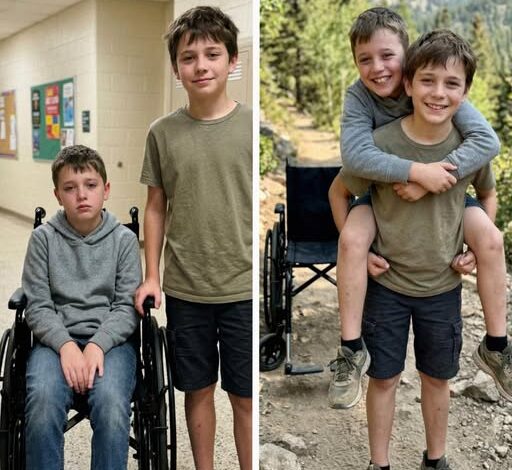
I didn’t think much about the school hiking trip at first. To me, it was just another permission slip buried beneath homework papers, grocery lists, and overdue bills on the kitchen counter. Life as a single mother rarely leaves room for lingering over ordinary things. Most days felt like survival stitched together hour by hour — wake the kids up, get through work, make dinner, help with homework, collapse into bed, repeat. So when Leo mentioned the trip weeks earlier, I signed the form almost automatically, grateful he seemed interested in something outside the quiet sadness he’d carried since his father died.
My son had changed after the funeral.
Not dramatically.
Not rebelliously.
He simply became quieter.
Leo was twelve then, but grief aged him in strange ways. He still smiled sometimes, still laughed at certain movies, still left socks everywhere no matter how many times I complained. But part of him had retreated inward after losing his dad three years earlier. He started thinking before speaking. Watching instead of participating. Carrying emotions silently because he believed protecting other people from his pain somehow made him stronger.
As his mother, I noticed every shift.
The way he lingered longer in doorways before entering rooms.
The way he stared out car windows without realizing it.
The way he kept his father’s old watch hidden in his backpack like a secret source of comfort.
So when he came home from school the week before the trip seeming lighter somehow, I noticed that too.
Not louder.
Not suddenly cheerful.
Just… brighter around the edges.
He dropped his backpack beside the kitchen counter and opened the fridge.
“Sam wanted to go too,” he said casually. “But they said he couldn’t.”
I looked up immediately.
“The hiking trip?”
He nodded.
Sam had been Leo’s best friend since elementary school — sharp, funny, obsessed with astronomy, and permanently in a wheelchair because of complications from birth. Over the years, I had watched the world quietly exclude him in ways adults pretended weren’t exclusion.
Birthday parties at inaccessible places.
Sports activities no one adapted.
Field trips requiring “special arrangements” schools rarely wanted to make.
Children notice unfairness differently than adults do. Adults rationalize it. Children simply recognize it.
“They said the trail would be too difficult,” Leo added quietly.
“And what did you say?”
He shrugged, staring into the refrigerator longer than necessary.
“Nothing.”
Then after a pause:
“But it’s not fair.”
I remember almost responding with something practical about liability, safety regulations, and difficult terrain.
Instead I simply said:
“No. It isn’t.”
Then life moved on.
Or so I thought.
Saturday evening arrived cold and windy. Parents gathered in the school parking lot waiting for buses to return from the overnight hiking trip. Everyone chatted casually while checking phones and drinking coffee from paper cups.
Then the buses pulled in.
And the second I saw Leo stepping down from the last bus, my stomach dropped.
He looked exhausted.
Not ordinary tired.
Destroyed.
His clothes were streaked with dirt and sweat. His shoulders sagged under his backpack like every muscle in his body had stopped cooperating hours ago. Even from across the parking lot, I could see his legs trembling slightly when he walked.
I rushed forward immediately.
“Leo—what happened?”
He looked up at me, eyes glassy with exhaustion but strangely calm.
“We didn’t leave him.”
I frowned.
“What?”
Before he could answer, another parent nearby touched my arm gently.
“The trail was over six miles,” she explained carefully. “Steep terrain too.”
I still didn’t understand.
“And your son…” She shook her head in disbelief. “He carried Sam. Almost the entire way.”
The words didn’t register properly at first.
“Carried him?”
She nodded slowly.
“He refused to leave him behind.”
I stared at Leo.
Really stared.
His arms hung stiffly at his sides. Mud covered his sneakers. The exhaustion on his face looked almost painful.
“How?” I whispered.
Leo shrugged weakly.
“We switched sometimes,” he admitted quietly. “A few other kids helped near the end.”
But even he looked like he knew the truth:
he had carried most of the weight himself.
Then his teacher, Mr. Dunn, approached looking visibly stressed.
“Mrs. Carter,” he began sharply, “your son ignored direct instructions.”
My protective instincts immediately flared.
“What happened exactly?”
“The students were specifically told that anyone unable to complete the main trail would stay behind at the visitor center. Your son decided to take an alternate route through rough terrain with Sam anyway.”
Leo lowered his eyes immediately.
“It was dangerous,” Mr. Dunn continued. “If one of them had fallen—”
“I understand,” I said quietly.
And I did understand.
The risk was real.
The rules existed for reasons.
But standing there looking at my exhausted son barely able to hold himself upright, another feeling rose stronger than fear or frustration.
Pride.
Not because he broke rules.
Because compassion mattered more to him than convenience.
That night after dinner, Leo barely touched his food before falling asleep on the couch halfway through a movie. I covered him with a blanket and carried his backpack upstairs, noticing for the first time how incredibly heavy it felt.
Only later did I fully grasp what his body must have endured all day.
I assumed the story would end there.
I was wrong.
The next morning, my phone rang just after 8 a.m.
The school.
Immediately, panic flooded me.
“Hello?”
“Mrs. Carter,” the principal said tightly, “we need you to come in as soon as possible.”
My heart stopped.
“What happened? Is Leo okay?”
There was a strange pause.
“Yes. He’s fine physically.”
Physically?
“What’s going on?”
“There are… people here asking for him.”
My hands instantly started shaking.
By the time I reached the school, my imagination had already created ten worst-case scenarios.
Then I walked inside and froze.
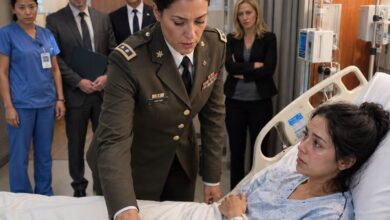
Five uniformed military officers stood outside the principal’s office.
Perfectly still.
Serious expressions.
Decorated uniforms.
For one horrifying second, I genuinely thought something catastrophic had happened.
The principal hurried toward me.
“They’re here about Leo,” she whispered.
Inside the office, Leo stood near the desk pale as paper.
The second he saw me, his face crumpled.
“Mom,” he blurted. “I didn’t mean to cause trouble.”
I crossed the room immediately.
“You’re not in trouble,” I said automatically, though I wasn’t fully convinced myself yet.
“They said I broke safety rules,” he whispered. “I won’t do it again.”
Then, in a voice so small it shattered me:
“Please don’t let them take me.”
I pulled him against me instantly.
“No one is taking you anywhere.”
One of the officers stepped forward then.
His expression softened dramatically.
“Mrs. Carter,” he said gently, “we’re not here to discipline your son.”
The tension in the room shifted slightly.
“We’re here because of what he did.”
Before I could ask another question, the office door opened again.
Sam’s mother walked in.
Her eyes were red like she’d been crying, but there was warmth in her expression too — something almost impossible to describe.
“When I picked Sam up yesterday,” she said quietly, “he couldn’t stop talking.”
Leo looked down immediately.
“He told me everything.”
The room fell silent.
“He told me what you said to him on the trail.”
Leo’s cheeks turned red.
She swallowed hard.
“You told him, ‘As long as we’re together, I’m not leaving you behind.’”
I physically felt something tighten in my chest.
One of the military officers spoke again.
“We knew Sam’s father.”
I looked at him carefully.
“We served together overseas.”
Everything suddenly became clearer.
Sam’s father had died years earlier during military service. I knew pieces of the story but never the full depth of it.
The officer glanced toward Sam’s mother before continuing.
“He carried Sam everywhere when he was little,” he said quietly. “Never let anyone tell that boy he couldn’t do something.”
Sam’s mother nodded through tears.
“After he passed away… some experiences just became harder.”
She looked at Leo.
“But yesterday Sam came home happier than I’ve seen him in years.”
The room became painfully emotional all at once.
Another officer stepped forward.
“What your son did wasn’t just physically impressive,” he said. “It showed character.”
Leo stared silently at the floor.
“When things became difficult,” the officer continued softly, “you stayed.”
Leo finally spoke.
“I just didn’t want him to feel left behind.”
No dramatic speech.
No attempt to sound heroic.
Just simple honesty.
The officer smiled slightly.
“I know.”
Then he opened a small presentation box.
Inside rested a military patch alongside official paperwork.
“We created a scholarship fund in your son’s name,” he said.
I stopped breathing.
“What?”
“It won’t cover everything forever,” he explained, “but we wanted his future recognized by people who understand what loyalty and courage actually look like.”
Leo looked completely stunned.
Then the officer carefully placed the patch on Leo’s shoulder.
“You earned this.”
The room blurred through tears instantly.
“And I can promise you,” the officer added quietly, “Sam’s father would’ve been incredibly proud of you.”
That’s when I finally broke completely.
I pulled Leo into my arms while crying harder than I had in years.
“Your dad would be proud too,” I whispered into his hair.
Outside the office, Sam waited near the hallway.
The second he saw Leo, his entire face lit up.
Leo immediately ran toward him.
“I thought I was in serious trouble,” he admitted breathlessly.
Sam grinned.
“Still worth it?”
Leo laughed tiredly.
“Yeah,” he said. “Definitely.”
That night, long after the house became quiet, I stood outside Leo’s bedroom doorway watching him sleep.
The military patch rested on his desk beneath soft lamplight.
Mud-stained hiking boots sat beside the bed.
His arms still looked sore even in sleep.
And suddenly I realized something every parent hopes for but can never fully control:
you don’t get to decide who your child becomes.
You can guide them.
Protect them.
Teach them.
But eventually, life places them in moments where nobody is watching closely enough to tell them what kind of person to be.
And in those moments, they choose for themselves.
My son chose kindness over convenience.
Loyalty over comfort.
Compassion over obedience.
He chose not to leave someone behind simply because the world made exclusion easier.
And standing there in the dark listening to him breathe softly in his sleep, I felt overwhelmed by one simple truth:
sometimes the greatest privilege of being a parent is not shaping your child—
but witnessing the goodness they discover entirely on their own.