The rain had stopped before sunrise, leaving the fields quiet, silver, and heavy with water.
By the time Thomas stepped outside, the world smelled of wet soil and green stems. At sixty-four, he knew that smell well. He had spent most of his life walking rows after storms, reading the land the way other men read newspapers. A flooded low spot could mean trouble. Standing water could damage roots. A drainage issue ignored today could become a ruined section of crop tomorrow.
So he pulled on his boots and walked into the soybean field.
At first, nothing seemed unusual.
The rows were damp.
Small puddles shimmered in the low areas.
Mud clung to the soles of his boots.
The morning was still, broken only by the distant call of birds and the soft sucking sound of each step through the wet ground.
Then, near a shallow rain pool, Thomas noticed something strange.
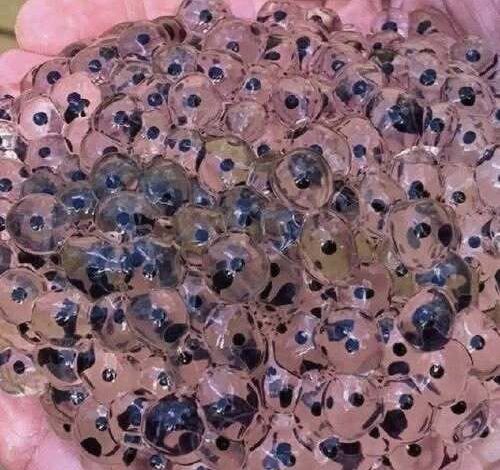
Just beneath the surface of the soil, clustered together in the damp earth, was a small group of clear, jelly-like eggs.
He stopped immediately.
They were not bird eggs. They were too soft, too transparent, too fragile-looking. They were not insect cocoons either. Thomas had seen plenty of strange things in his fields over the years, but this was different.
The tiny spheres glistened in the morning light, suspended in a clear jelly mass like drops of glass.
For a moment, he simply stared.
Many people might have poked them with a stick.
Some might have scraped them away.
Others might have dismissed them as something unpleasant or dangerous.
Thomas did none of those things.
He crouched carefully, took several clear photographs, and left the cluster exactly where he found it.
Then he called someone who would know.
By afternoon, a local biologist had reviewed the pictures and agreed to visit the field. What had begun as a routine check after rain had suddenly turned into something far more interesting.
When the biologist arrived, Thomas led him through the rows to the shallow pool. The water was temporary, formed by the overnight rainfall in a slight depression in the field. To a farmer, it looked like a drainage concern. To an amphibian, it may have looked like a nursery.
The biologist knelt beside the eggs, studied them closely, and smiled.
“They’re frog eggs,” he said.
Most likely, they belonged to a gray tree frog or a closely related species.
Thomas looked back at the soybean rows around him.
“Here?” he asked.
The biologist nodded.
“Here.”
That single word changed the way Thomas saw the field.
For years, he had thought of the land primarily in terms of soil, rain, yield, weeds, machinery, and harvest. He knew wildlife passed through. He had seen deer tracks pressed into mud, birds feeding along the edges, snakes sliding into ditches, turtles near drainage areas, and insects everywhere.
But frog eggs?
In a soybean field?
That surprised him.
The biologist explained that temporary rain pools can be extremely important for amphibians. These shallow patches of water may last only a few days or weeks, but during that brief window, they can become vital breeding spaces. Because they are temporary, they often contain fewer fish and other predators than permanent ponds, giving frog eggs and tadpoles a better chance of survival.
What looked like a puddle to Thomas was, for a short time, habitat.
A place where new life could begin.
The idea stayed with him.
That small wet patch had been easy to overlook. It was not marked. It was not protected by a fence or sign. It had no obvious importance. Yet hidden in the mud and water was a fragile beginning, one that depended entirely on the conditions holding long enough for the eggs to hatch.
The discovery revealed something larger.
Nature is always adjusting.
Animals search constantly for opportunity. They respond to rain, temperature, shelter, food, and safety. As landscapes change because of farming, development, shifting weather patterns, and human activity, wildlife must either adapt or disappear from certain places.
In this case, a rain-filled depression in a working field had become useful to a frog.
Not permanently.
Not dramatically.
But enough.
The field had not become a wetland. It remained farmland. Yet within it existed a tiny pocket of biodiversity, a temporary refuge created by weather and noticed only because one farmer chose to look closely.
That choice mattered.
If Thomas had scraped the eggs away or driven through the pool without noticing, the story would have ended there. Instead, his curiosity protected something small and vulnerable.
The biologist encouraged him to leave the area undisturbed as long as possible. If the water remained, the eggs might hatch into tadpoles. If conditions stayed favorable, some could eventually become young frogs. If the pool dried too soon, many might not survive.
That was the risk of temporary water.
It offered opportunity, but never certainty.
Still, even uncertain life has value.
Thomas found himself returning to the spot over the next few days. He checked from a distance, careful not to disturb the muddy edge. The eggs remained where they had been, shining faintly beneath the water.
The field felt different now.
Not less practical.
Not less his.
But more alive than before.
He began noticing other things: the insects rising from damp grass, the small tracks near the ditch, the birds searching the rows, the way water collected and moved across the land. The farm had always been busy with life, but now he understood that much of it had been happening below his usual line of attention.
The lesson was simple, but powerful.
Wonder does not always arrive loudly.
Sometimes it appears after rain.
Sometimes it hides in a puddle.
Sometimes it waits beneath the soil until someone slows down enough to see it.
Farmers, gardeners, hikers, and homeowners encounter small outdoor mysteries all the time. Strange eggs. Unfamiliar tracks. Odd plants. Unexpected animal behavior. Not every discovery is rare, but many are meaningful. Each one can teach something about the land we share with other living things.
Thomas’s cluster of jelly-like eggs was not dangerous.
It was not a pest problem.
It was not something to fear.
It was the beginning of life.
Fragile, temporary, and easily missed.
By choosing patience instead of panic, and curiosity instead of destruction, Thomas helped reveal a quiet story of survival unfolding in the middle of an ordinary field.
And from that morning on, he never looked at a rain pool the same way again.