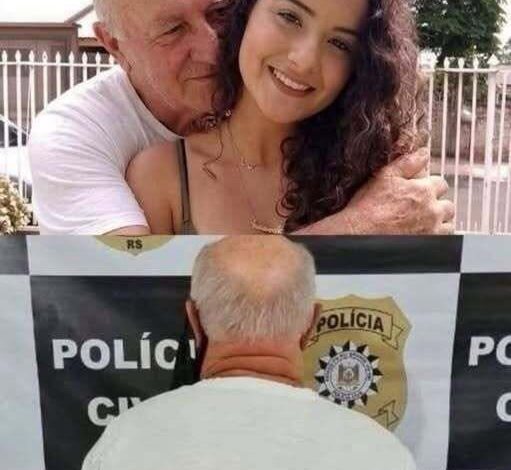
What unfolded at the small roadside motel did not remain a simple local disturbance for long.
Within hours, it became something larger—an uneasy lesson in how quickly uncertainty can spread when a community sees just enough to worry, but not enough to understand.
It began with the kind of scene that makes people stop what they are doing.
Police vehicles outside a modest motel.
Officers moving with purpose.
Sections of the property blocked off.
Residents watching from across the road, from parked cars, from behind motel curtains.
Then came the moment everyone remembered most: an elderly man being calmly escorted away by authorities.
He did not appear to resist.
He did not make a dramatic scene.
There was no shouting, no obvious struggle, no public explanation.
Just a quiet figure guided away while officers secured the area behind him.
To the people watching, the silence was almost worse than chaos.
Something serious had clearly happened.
But what?
That question spread faster than any confirmed answer.
Police began their work methodically. They restricted access to parts of the motel, spoke with people nearby, and treated the location with the care of an active investigation. But beyond those visible actions, officials released very little information at first.
No full explanation.
No clear timeline.
No detailed statement about what had occurred.
For investigators, that caution may have been necessary.
For the public, it felt like a blank space.
And blank spaces rarely stay empty for long.
By evening, speculation had already taken over online discussions. Local social media pages filled with posts from people asking questions, offering theories, and repeating things they had “heard from someone.” Some claimed to know exactly what happened. Others added details that had not been verified by anyone. Each new comment seemed to pull the story further away from what was known and deeper into what was imagined.
The more people talked, the more certain they sounded.
A rumor became a possibility.
A possibility became a claim.
A claim became, in some minds, a fact.
And all of it happened before investigators had publicly confirmed the basic details.
This is how confusion grows.
Not always through bad intentions, but through impatience, fear, and the human need to make sense of frightening events. When people do not have answers, they create them. When information is limited, imagination fills the gaps. When a community feels unsettled, even the smallest detail can be given enormous meaning.
But behind the scenes, the real work looked nothing like the noise online.
Investigators were not guessing.
They were building.
They reviewed surveillance footage, frame by frame, searching for movements, timestamps, and interactions that could help establish the sequence of events. They interviewed witnesses, knowing that memory can be imperfect and that every account must be compared against others. They collected evidence carefully, documented the scene, and checked each statement against what could be proven.
That kind of work is slow by design.
Every detail matters.
A time must be confirmed.
A claim must be tested.
A witness statement must be weighed against physical evidence.
A single assumption, if accepted too early, can distort an entire investigation.
To outsiders, this pace can feel frustrating. People want answers immediately, especially when something happens close to home. They want to know whether they are safe. They want to know who was involved. They want someone to explain the police tape, the officers, the man being escorted away, and the sudden tension surrounding a place that had seemed ordinary only hours before.
That desire is understandable.
Uncertainty is uncomfortable.
But investigations are not meant to satisfy curiosity in real time. They are meant to uncover truth carefully enough that the truth can survive scrutiny.
That is why silence from authorities does not always mean nothing is happening. Often, it means the opposite. It means investigators are still sorting through facts, protecting evidence, and avoiding public statements that could damage the case or mislead the community.
Premature conclusions can cause real harm.
They can wrongly attach suspicion to innocent people.
They can pressure witnesses.
They can spread fear.
They can make it harder for investigators to separate what actually happened from what people later convinced themselves they saw.
And once a false story takes root, correcting it becomes difficult.
That is why patience matters, even when it is hard.
In moments like this, a community faces a choice. It can chase the loudest theory, or it can wait for the clearest evidence. It can treat rumor as entertainment, or it can remember that real people are involved—people whose lives may be permanently affected by what happened and by what is said afterward.
The small motel became a reminder of that responsibility.
Because the truth is rarely as simple as the first version of a story shared online. It usually emerges slowly, through careful work, verified evidence, and the discipline to admit what is not yet known.
The sight of an elderly man being escorted away may have raised questions.
The police presence may have stirred fear.
The silence may have invited speculation.
But none of those things, by themselves, provided the full story.
Only evidence can do that.
Only facts can do that.
Only careful investigation can separate what happened from what people think happened.
In the end, the most reliable answers are rarely the fastest ones. They do not come from the loudest posts, the most confident rumors, or the version repeated most often.
They come from patience.
From proof.
From the quiet, demanding work of finding what can actually be known.
And until that work is complete, the wisest thing any community can do is resist the urge to turn uncertainty into certainty before the truth has had time to speak.