The discovery happened on an ordinary spring morning.
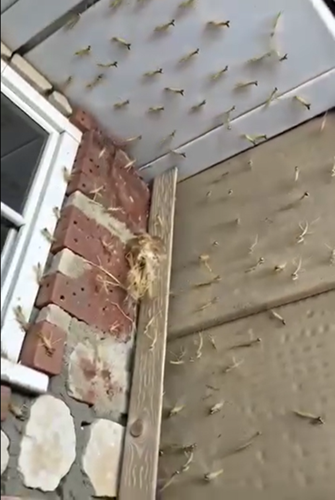
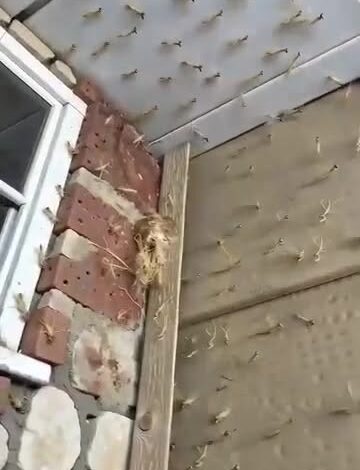
I opened my front door expecting nothing more than fresh air and sunshine. Instead, I was greeted by dozens of tiny green creatures moving across my doorstep like living threads brought to life.
At first, I couldn’t quite understand what I was seeing.
The insects were incredibly small—no larger than my pinky finger—and scattered in every direction. Some climbed the nearby brick wall. Others carefully navigated cracks in the pavement. A few remained perfectly still, as though gathering the courage to begin their journey.
When I crouched for a closer look, realization hit me.
They were baby praying mantises.
Suddenly, my quiet morning felt extraordinary.
The wall beside my front door seemed alive with movement. Tiny mantises clung to the surface, their delicate legs gripping the brick while others ventured toward nearby flowers and shrubs. The air was calm and still, yet the scene carried an undeniable sense of wonder.
Somewhere nearby, hidden in plain sight, an entire generation of mantises had just entered the world.
As I searched the area, I discovered the source.
Attached to a corner near the doorway was a small, hardened structure resembling dried foam.
It was an ootheca—the protective egg case created by a female praying mantis.
Months earlier, without my noticing, a mother mantis had carefully deposited dozens of eggs inside this remarkable nursery. After laying her eggs, she covered them in a frothy secretion that quickly hardened into a durable casing capable of protecting them from cold temperatures, rain, predators, and environmental stress.
Throughout the winter, the eggs remained safely hidden inside.
Then, as temperatures warmed and spring arrived, the tiny mantises emerged almost simultaneously, spilling into the world around them.
What amazed me most was the realization that this entire process had unfolded only inches from my daily routine.
For months, I had walked past that doorway without ever noticing the small case attached beside it.
Nature had been quietly preparing an incredible event right outside my home.
The newly hatched mantises were known as nymphs—miniature versions of adult mantises. Unlike butterflies and many other insects that undergo dramatic transformations, mantises develop gradually.
There is no cocoon stage.
No dramatic metamorphosis.
Instead, they grow through a series of molts, shedding their exoskeleton repeatedly as they mature.
Even at this early stage, they already possessed many of the features that make praying mantises so recognizable.
Their triangular heads.
Their large, watchful eyes.
Their folded front legs that resemble hands clasped in prayer.
Everything was there—just on a much smaller scale.
Watching them disperse was fascinating.
Some climbed upward toward sunlight.
Others disappeared into nearby plants.
A few paused frequently, as though cautiously evaluating their new surroundings before moving again.
Their journey would not be easy.
Young mantises face countless dangers. Birds, spiders, ants, and other predators hunt them. Even other mantises can become a threat when food is scarce.
The survival rate for newly hatched mantises is surprisingly low.
That reality made the sight even more meaningful.
Each tiny insect represented possibility.
Each one was beginning a fight for survival that would determine whether it reached adulthood.
Praying mantises are among nature’s most efficient predators.
Their specialized front legs contain sharp spines designed for gripping prey with astonishing speed and precision.
When an insect wanders too close, a mantis can strike in a fraction of a second.
Their vision is equally impressive.
Large compound eyes provide a wide field of view, while their heads can rotate significantly, allowing them to monitor their surroundings without moving the rest of their bodies.
Even the tiny nymphs on my doorstep displayed this remarkable design.
It was like seeing miniature hunters preparing for life in the wild.
Despite their fearsome reputation among insects, mantises play an important role in maintaining ecological balance.
They feed on flies, mosquitoes, aphids, caterpillars, moths, beetles, and many other insects.
For gardeners, they are often welcome visitors because they naturally help control pest populations without the need for chemical pesticides.
Unlike synthetic pest control methods, mantises contribute to healthy predator-prey relationships within ecosystems.
They are not selective hunters—they will happily eat beneficial insects alongside harmful ones—but their presence generally supports biodiversity and natural balance.
Looking at the dozens of tiny mantises surrounding my doorstep, I couldn’t help imagining them becoming future guardians of the garden, quietly patrolling plants and flowers throughout the summer.
Experts generally recommend leaving mantis hatchlings alone if you encounter them.
At this stage, they are fragile.
Handling them can easily cause injury.
Instead, the best approach is simple observation.
Providing nearby vegetation, avoiding pesticides, and allowing natural habitats to remain undisturbed gives them the best chance of survival.
Over the coming months, the hatchlings would molt repeatedly, growing larger with each stage.
By late summer, the survivors would develop wings and reach adulthood, continuing a life cycle that has existed for millions of years.
What struck me most that morning wasn’t the rarity of the sight.
It was the lesson hidden within it.
The entire event happened quietly.
No dramatic announcement.
No spectacle.
Just dozens of tiny lives beginning their journey.
It reminded me how much of nature’s activity unfolds unnoticed.
While we focus on schedules, deadlines, and daily responsibilities, countless cycles of birth, growth, and renewal continue around us.
The mantises had been developing just outside my door for months without my awareness.
Yet their emergence transformed an ordinary morning into something unforgettable.
Across many cultures, praying mantises carry symbolic significance.
They are often associated with patience, mindfulness, awareness, and careful observation.
Their ability to remain perfectly still before striking has long been viewed as a lesson in focus and discipline.
Watching the hatchlings move through the world reinforced those ideas.
They did not rush.
They paused.
Observed.
Adjusted.
Then continued forward.
There was wisdom in their tiny movements.
As the sun climbed higher into the sky, the scene gradually changed.
One by one, the mantises disappeared into nearby plants, shrubs, and patches of grass.
Within an hour, most were gone.
The doorstep looked ordinary again.
Anyone arriving later would never have known what had happened there.
But I knew.
And I carried that memory with me.
The experience served as a reminder that some of nature’s most remarkable events occur quietly, hidden within familiar places we rarely examine closely.
Sometimes wonder doesn’t arrive through grand adventures or distant destinations.
Sometimes it waits patiently on your own doorstep.
All it takes is slowing down long enough to notice.
And when you do, even the smallest creatures can reveal profound lessons about resilience, patience, renewal, and the endless cycle of life that continues all around us every single day.