My Daughter Chopped Off Her Hair — And When I Learned the Reason, I Confronted My Husband Immediately

That Saturday morning felt completely ordinary.
The aroma of fresh coffee mixed with warm cinnamon toast drifted through the house, filling the kitchen with a sense of comfort that made the weekend feel peaceful and predictable.
I stood by the counter in my robe, cradling a steaming mug while listening to my daughter Nicole sing one of her made-up songs somewhere down the hallway.
It was the kind of morning when nothing dramatic was supposed to happen.
Nicole was six years old, and if there was one thing she loved more than anything, it was her hair.
Her thick dark curls reached almost to her waist, and she treated them like a treasure.
Strangers constantly noticed them.
At grocery stores, parks, and school events, people often stopped to admire them.
“Is that all her natural hair?” they would ask.
I always smiled proudly.
“Every bit of it.”
Each morning began with the same ritual.
Nicole would climb onto a stool in the bathroom while I carefully brushed out the tangles.
Sometimes she squirmed.
Sometimes she complained.
“Mama, that hurts.”
“I know, sweetheart. I’m trying to be gentle.”
Even on difficult mornings, when every curl seemed determined to fight back, she never once suggested cutting it shorter.
Her hair was part of who she was.
That morning she wandered into the kitchen wearing bright unicorn pajamas and carrying her favorite stuffed rabbit.
“Mama, can I work on an art project in my room?”
“What kind of project?”
“Paper and stickers. Maybe glitter too.”
I laughed.
“Fine. But keep the glitter on the desk and use only the kid scissors.”
“Okay!”
She skipped away happily.
I watched her disappear down the hall before turning toward the window.
Outside, autumn had begun transforming the neighborhood.
Golden leaves drifted from the maple tree in the yard, and the sight stirred that strange seasonal sadness I always felt this time of year.
Lately, other things had been bothering me too.
My husband hadn’t been acting like himself.
Nothing dramatic.
Nothing obvious.
Just small changes.
He stayed up later than usual.
He spent more time alone.
Sometimes he stepped into the garage to answer phone calls and closed the door almost completely behind him.
A few nights earlier, I finally asked about it.
“Everything okay?”
“Yeah,” he replied quickly. “Work’s just been stressful lately.”
Something about his answer felt incomplete.
But marriage teaches you that constantly pushing for answers can sometimes create even more distance.
So I let it go.
Then there was his mother.
For reasons I couldn’t quite explain, she had suddenly become much more involved in our lives.
She showed up carrying casseroles.
Folded laundry without being asked.
Offered to babysit.
Organized cabinets.
Volunteered to help with tasks that nobody had requested help with.
“You look exhausted,” she told me one afternoon.
“Honestly, I’m okay.”
She simply smiled and hummed softly, clearly unconvinced.
I also noticed something else.
Whenever she received phone calls, she often stepped into the hallway and lowered her voice.
If I approached, the conversation usually ended.
It struck me as odd.
But life was busy.
Work.
Bills.
School schedules.
Homework.
Appointments.
There was always something demanding attention.
A week earlier, Nicole had asked a question that briefly caught me off guard.
“Mama, is Daddy sad?”
I looked up from loading the dishwasher.
“Why would you ask that?”
She shrugged.
“He just seems different.”
I kissed her forehead.
“He’s fine, sweetheart. He’s just tired.”
At the time, I thought nothing more about it.
That memory returned to me as I sat down with a second cup of coffee and unfolded the newspaper.
From her bedroom, I could hear Nicole humming again while she worked on her project.
Then I heard a faint sound.
Snip.
A few seconds later.
Snip.
I smiled to myself.
“She must be cutting construction paper,” I thought.
Then came another snip.
And another.
This time, something about the sound made the hairs on the back of my neck stand up.
I lowered the newspaper.
The house suddenly felt too quiet.
The humming had stopped.
Another snip echoed faintly down the hallway.
My stomach tightened.
“Nicole?” I called.
No answer.
I set down my coffee mug and stood.
The hallway seemed longer than usual as I walked toward her room.
“Nicole?”
Still nothing.
When I reached her partially open bedroom door, I pushed it wider.
For a moment, my brain refused to understand what I was seeing.
Dark curls covered the floor like fallen leaves.
Nicole sat cross-legged in front of her mirror.
The child-safe scissors were in her hand.
One side of her beautiful hair was gone.
Jagged strands hung unevenly around her shoulders.
My heart dropped.
“Nicole!”
She looked up immediately.
Her eyes filled with tears.
“I’m sorry, Mama.”
The scissors slipped from her hand.
I stared at the hair scattered across the carpet.
Months.
Years.
Of careful brushing, braiding, washing, and growing.
Gone in minutes.
“Sweetheart,” I said carefully, forcing myself to stay calm. “Why did you do this?”
Her chin trembled.
At first, she could not answer.
Then she pointed toward her desk.
A folded piece of paper sat there.
I picked it up.
Inside was a crayon drawing.
Two little girls stood holding hands.
One had long curly hair.
The other had almost none.
Above them, in uneven childlike handwriting, were the words:
ME AND EMMA.
My chest tightened.
“Emma?” I asked softly.
Nicole nodded.
“The girl in my class.”
The tears began falling harder.
“She cries sometimes.”
I sat beside her.
“Why?”
“Because she’s sick.”
My breath caught.
Emma.
The little girl who had been absent so often lately.
The child whose mother occasionally picked her up early from school.
Nicole wiped her nose with the back of her hand.
“She told me her medicine made her hair fall out.”
Silence filled the room.
“She said she hates looking in the mirror.”
My eyes burned.
Nicole glanced down at the curls surrounding her.
“So I wanted her to know she’s still pretty.”
I could not speak.
“I thought if I looked more like her, maybe she wouldn’t feel so sad.”
The room blurred through tears.
Every ounce of frustration vanished.
In its place came something much bigger.
Pride.
Heartbreak.
Love.
The kind of overwhelming emotion that leaves you speechless.
I pulled her into my arms.
“Oh, sweetheart.”
She buried her face against my shoulder.
“Are you mad?”
“No.”
My voice broke.
“Not even a little.”
That afternoon we took her to a salon to repair the uneven haircut.
The stylist listened quietly while Nicole explained why she had done it.
By the end of the appointment, the woman was crying.
So was I.
So was the receptionist.
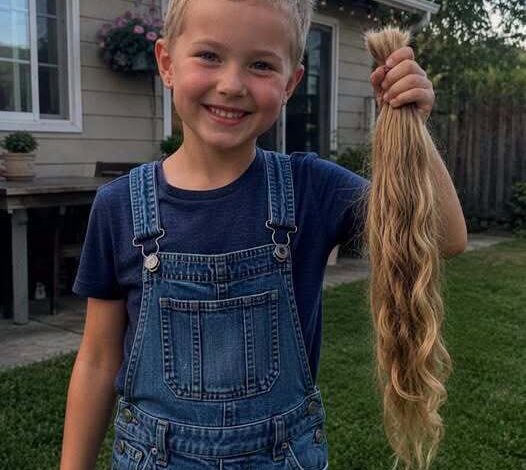
A week later, Nicole walked into school with her new short haircut.
Emma smiled when she saw her.
Then she hugged her.
Children often understand things adults complicate.
They do not worry about appearances, politics, or explanations.
They see pain.
And sometimes they simply decide to share it.
That evening, when my husband came home, I told him what happened.
He sat silently for a long time.
Then he looked at our daughter.
“You did that for your friend?”
Nicole nodded.
His eyes filled.
For the first time in months, whatever burden he had been carrying seemed to disappear.
He pulled her into his lap and held her tightly.
Later that night, after Nicole had fallen asleep, he finally told me the truth.
The secret phone calls.
The stress.
The strange behavior.
His company had announced major layoffs.
He had spent weeks terrified he would lose his job.
He had hidden it because he didn’t want to scare us.
We sat together in the quiet kitchen.
Neither of us spoke for a while.
Then he said something I will never forget.
“Today our six-year-old reminded me what courage looks like.”
I thought about the curls on the bedroom floor.
About the drawing.
About Emma.
About kindness so pure it never stopped to calculate the cost.
And I realized he was right.
Sometimes the bravest person in a family is not the parent carrying responsibilities.
Sometimes it is the child who sees someone hurting and decides they should not hurt alone.
Nicole lost her long hair that day.
But she gained something far more important.
The understanding that compassion is not measured by words.
It is measured by what we are willing to give for someone else.
And every time I look at the photographs from that year, I do not miss the curls nearly as much as I thought I would.
Because when I see that short haircut, I remember the reason behind it.
And I see something far more beautiful than hair.
I see a little girl with a very big heart.