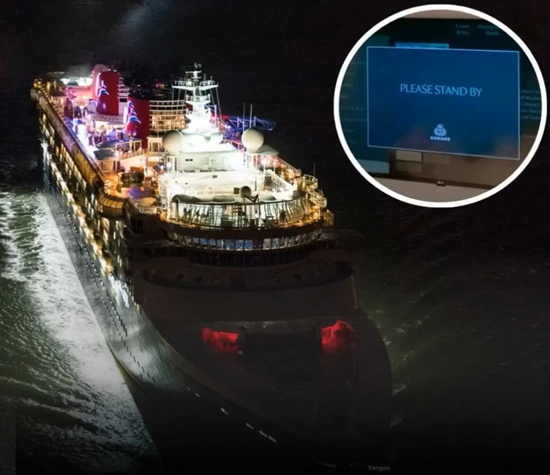
For most passengers aboard the Queen Anne, the voyage felt like the fulfillment of a lifelong dream.
The magnificent Cunard liner was in the midst of her maiden 111-night world cruise, carrying thousands of travelers across oceans, continents, and cultures. Every day brought new destinations, elegant dining experiences, and the timeless romance of life at sea. Guests spent their evenings sipping cocktails beneath glittering chandeliers, enjoying live performances, or strolling along open decks beneath endless stars.
It was exactly the kind of journey people imagined when they booked a luxury world cruise.
Then one evening, everything changed.
The transformation was subtle at first.
There was no storm. No alarm. No visible danger lurking on the horizon.
The sea was calm.
The ship moved steadily through the dark waters of Southeast Asia, specifically the region between Indonesia, Malaysia, and the Philippines known as the Sulu-Celebes Sea.
Most passengers were preparing for dinner when an unexpected announcement echoed through the vessel’s public-address system.
The captain’s voice was calm and professional, but the instructions immediately captured everyone’s attention.
Passengers were asked to switch off unnecessary cabin lights.
Curtains were to remain closed.
Exterior deck access would be restricted overnight.
Guests were encouraged to remain inside after dark.
For a brief moment, confusion spread throughout the ship.
People exchanged puzzled looks.
Some assumed there had been a technical issue. Others wondered whether severe weather was approaching.
The explanation that followed was far more surprising.
The Queen Anne had entered waters historically associated with piracy.
Suddenly, what had moments earlier felt like a luxurious vacation seemed to take on the atmosphere of a suspense novel.
Whispers traveled through dining rooms and lounges.
“Pirates?”
“Did he really say pirates?”
The word alone was enough to ignite imaginations.
For many travelers, piracy belonged in history books and adventure films, not modern cruise itineraries.
Yet maritime professionals knew otherwise.
While modern piracy is far less common than popular culture suggests, certain regions of the world still require heightened security precautions. The Sulu-Celebes Sea has long been considered one of those areas.
Years earlier, the region had experienced incidents involving maritime kidnappings, armed robberies, and attacks on commercial vessels. Various militant groups had operated in the area, creating challenges for shipping companies and maritime authorities alike.
Although security efforts by neighboring nations dramatically reduced such incidents, shipping operators continued to treat the area with caution.
For the captain and crew of the Queen Anne, precaution was not optional.
It was standard practice.
Still, knowing there was a rational explanation did little to eliminate the eerie atmosphere that settled over the ship that night.
One by one, passengers closed their curtains.
Lights disappeared from cabin windows.
Exterior promenades emptied.
The brightly illuminated vessel that had spent weeks glowing across the oceans gradually faded into darkness.
Videos later shared online captured the unusual scene.
Normally vibrant decks appeared deserted.
Corridors seemed quieter than usual.
The familiar glow visible from outside was gone.
The transformation was dramatic.
Many passengers described feeling as though they had stepped into another era—a time when ships crossed dangerous waters under the cover of darkness, relying on vigilance and caution rather than technology alone.
Yet despite the unsettling instructions, there was no panic.
The captain’s calm demeanor reassured passengers that the measures were purely preventative.
No direct threat had been identified.
No suspicious vessels had been detected.
The ship was simply following established maritime safety procedures.
Behind the scenes, however, preparations intensified.
Crew members increased security patrols.
Monitoring systems received additional attention.
Emergency response plans were reviewed.
Reports later indicated that defensive measures such as high-pressure water systems and security equipment were prepared according to standard protocols used during transit through higher-risk regions.
The goal wasn’t confrontation.
It was deterrence.
Large cruise ships like the Queen Anne are exceptionally difficult targets.
Unlike smaller commercial vessels, modern cruise liners possess advanced surveillance technology, sophisticated communication systems, and extensive security infrastructure.
Their sheer size alone presents significant challenges for anyone considering an attack.
Even so, maritime operators understand that complacency can be dangerous.
Preparation remains one of the industry’s most effective tools.
As darkness deepened outside, life aboard the ship continued in an unusual but surprisingly orderly fashion.
Restaurants remained open.
Entertainment programs continued.
Guests gathered in lounges to discuss the situation.
For some, the experience became a source of fascination rather than fear.
Many travelers admitted that the announcement added an unexpected layer of excitement to the voyage.
Conversations shifted from sightseeing plans and dinner reservations to maritime history, security procedures, and stories of famous pirate encounters.
Social media quickly amplified the moment.
Passengers posted photographs and videos documenting the blackout conditions.
Comments poured in from viewers around the world.
Some expressed surprise that piracy remained a modern concern.
Others shared experiences from previous cruises that had implemented similar precautions while passing through high-risk waters.
A few joked about unexpectedly finding themselves starring in their own sea adventure.
Yet beneath the humor was genuine appreciation for the professionalism displayed by the crew.
The more passengers learned about maritime operations, the more they understood the reasoning behind the precautions.
The world’s oceans remain vast and unpredictable.
Even in an age of satellites, radar systems, and international cooperation, certain regions demand additional vigilance.
That reality became tangible aboard the Queen Anne that night.
Hours passed without incident.
No alarms sounded.
No emergencies occurred.
The ocean outside remained dark and quiet.
Eventually, dawn arrived.
As sunlight spread across the sea, restrictions were gradually lifted.
Curtains reopened.
Passengers returned to exterior decks.
The familiar atmosphere of luxury cruising returned almost instantly.
The ship continued its world voyage exactly as planned.
For many travelers, however, the experience remained unforgettable.
Not because they had faced danger.
But because they had briefly glimpsed a side of maritime life that most passengers never consider.
Cruise vacations often create the illusion that the ocean is simply a scenic backdrop.
The events aboard the Queen Anne served as a reminder that the sea remains a powerful and sometimes unpredictable environment.
Every voyage involves careful planning, risk assessment, and constant awareness by the professionals responsible for safely transporting thousands of people across vast distances.
The evening blackout became one more story in the ship’s growing history.
A story passengers would share long after returning home.
Years later, many may struggle to remember every port they visited or every meal they enjoyed.
But they will likely remember the night their luxury cruise slipped quietly into darkness.
The night drawn curtains, dimmed lights, and whispered conversations transformed an ordinary evening at sea into something far more memorable.
Not because anything happened.
But because everyone aboard was reminded that preparation, caution, and professionalism are often the very reasons nothing happens at all.
And in the end, that quiet, uneventful passage through historically dangerous waters became one of the voyage’s most remarkable moments—a reminder that even on the most luxurious journeys, the ocean still commands respect.