For three years after Martha died, Arthur Pendelton existed in a kind of emotional winter that never seemed to end. The seasons changed outside his windows — leaves fell, snow gathered, spring rain returned — but inside the house, time remained frozen in the moment the hospital called to tell him his wife was gone.
The silence became its own living thing.
It waited for him in every room.
In the mornings, it sat across from him at the kitchen table while black coffee cooled untouched beside the newspaper. In the evenings, it followed him through dim hallways where framed photographs still showed Martha laughing in gardens, flour dusting her cheeks in the kitchen, clay smeared across her hands inside the pottery shed she once loved more than any room in the house.
Arthur stopped moving through life with intention after her death.
He moved through it mechanically instead.
Wake up.
Drink coffee.
Ignore the phone.
Watch television without hearing it.
Sleep badly.
Repeat.
Neighbors described him kindly but cautiously:
“Quiet.”
“Polite.”
“Still grieving.”
But grief was too soft a word for what happened to Arthur.
Grief suggests movement eventually.
Healing eventually.
Some path forward.
Arthur felt abandoned by motion itself.
He no longer expected joy.
Did not trust hope.
And avoided attachment because attachment had become synonymous with loss.
Martha’s death had not simply broken his heart.
It had altered his understanding of safety permanently.
The worst part was the house itself.
Every object inside carried memory:
her gardening gloves near the back door,
half-finished pottery sketches tucked into kitchen drawers,
the lavender soap she always bought still resting unopened beneath the bathroom sink.
People often say memories keep loved ones alive.
They rarely discuss how memories can also trap someone in place.
Arthur became trapped there for years.
Then, one rainy afternoon in October, the dog appeared.
At first, Arthur barely noticed it.
A small terrier.
Mud-streaked fur.
One ear bent awkwardly downward.
Thin enough that its ribs showed beneath soaked hair.
It stood near the porch trembling violently while cold rain hammered the gutters overhead.
Arthur looked at it through the window for several seconds before pulling the curtain shut again.
He told himself firmly:
No.
No responsibility.
No attachment.
No living thing depending on him again.
He had already buried too much.
But the next morning, the dog remained there.
Curled beneath the porch steps now, shivering quietly beside a rusted flowerpot Martha once painted yellow.
Arthur ignored it again.
By the second night, guilt began replacing resistance.
The dog never barked.
Never begged aggressively.
It simply waited.
Watching him with cautious, exhausted eyes that somehow felt painfully familiar.
Finally, Arthur opened a can of soup, tore pieces of bread beside it, and carried the bowl outside.
“There,” he muttered awkwardly. “Eat.”
But instead of devouring the food immediately, the terrier did something strange.
It picked up pieces gently in its mouth.
Then trotted away.
Arthur frowned.
The dog disappeared around the side yard toward the back of the property.
Curiosity overcame irritation slowly.
So Arthur followed.
Rain soaked quickly through his sweater as he moved carefully across wet grass. The terrier wasn’t wandering randomly. It moved with purpose — carrying food directly toward the rear corner of the yard.
Toward Martha’s shed.
Arthur stopped walking instantly.
The shed stood partly hidden behind overgrown hedges and wild ivy. Years earlier, it had been Martha’s sanctuary. She spent entire afternoons there shaping clay beneath soft jazz records while sunlight poured through dusty windows.
The place once smelled like:
paint,
earth,
coffee,
and warm ceramic dust.
After her death, Arthur locked it permanently.
He could not bear entering a room still carrying so much of her unfinished life.
Now fresh scratches covered the weathered door.
Arthur’s stomach tightened.
The terrier disappeared beneath the back steps carrying food with it.
For several long seconds, Arthur simply stared.
Then he turned around and walked back inside the house.
But he could not stop thinking about the scratches afterward.
Or the way the dog kept returning.
Each night, the same pattern repeated:
the terrier appeared,
accepted food,
and carried pieces toward the shed.
Sometimes Arthur noticed soft scratching sounds after midnight coming from the backyard.
Not animal scratching exactly.
Rhythmic.
Intentional.
As though something inside wanted desperately to be heard without making too much noise.
Arthur tried dismissing it logically.
Probably raccoons.
Maybe injured wildlife.
The dog nesting somewhere nearby.
But deep down, unease continued growing.
Then came the sixth night.
Wind battered the windows violently after sunset. Rain flooded the gutters hard enough to shake loose old leaves across the driveway. Arthur sat half-asleep in his recliner when sudden frantic scratching erupted against the front door.
Not the shed.
The front door.
The terrier whined loudly outside.
Arthur opened it halfway.
The dog immediately spun toward the backyard, then rushed back toward him again, whining harder now.
“What’s wrong with you?” Arthur muttered.
The terrier darted away again.
Returned again.
Whining desperately.
Something about the behavior felt different this time.
Urgent.
Fear-driven.
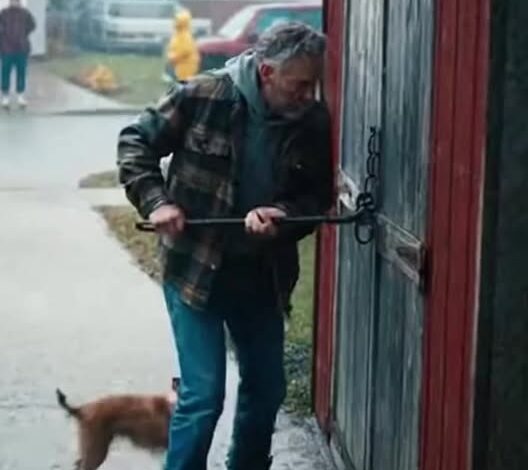
Arthur grabbed an old flashlight and the rusted crowbar hanging beside the garage door.
“I’ve officially lost my mind,” he muttered while stepping into the storm.
The terrier sprinted ahead through rain-soaked grass directly toward the shed.
And for the first time in three years, Arthur approached Martha’s old sanctuary.
The scratching intensified immediately as they neared.
Not from outside.
From inside.
Arthur froze.
The door showed signs of repeated impact from within. Fresh cracks spread near the frame. Something — or someone — had been trapped there long enough to weaken the wood itself.
“Jesus Christ…”
For one terrible moment, Arthur thought:
animal.
Then another sound came.
A cough.
Human.
Weak.
Painful.
Barely audible beneath the storm.
Arthur swung the crowbar hard against the lock.
Once.
Twice.
The old mechanism finally snapped apart.
The door creaked inward slowly.
Cold damp air spilled out carrying mildew, dirt, and the faint lingering scent of Martha’s old clay supplies beneath years of neglect.
Arthur swept the flashlight across the room.
Then stopped breathing.
In the far corner, wrapped in torn blankets beside stacks of dusty pottery shelves, lay a teenage girl.
Thin.
Injured.
Barely conscious.
The terrier immediately rushed to her side.
The girl weakly curled one shaking hand into its fur.
Arthur stood frozen in shock.
The shed suddenly felt impossibly surreal:
Martha’s pottery wheel still covered in cloth nearby,
unfinished ceramic bowls gathering dust,
and now this half-starved child hidden among ghosts of his wife’s abandoned life.
The girl’s lips moved faintly.
“Don’t… call police…”
Arthur knelt beside her carefully.
“What happened to you?”
Her eyes fluttered open briefly.
Fear exploded across her face instantly.
“He’ll find me,” she whispered weakly.
“If you call… he’ll know…”
Then she lost consciousness again.
Arthur carried her into the house while the terrier followed inches behind every step.
The girl burned with fever.
Bruises darkened one side of her ribs.
And deep panic lingered beneath even unconsciousness itself.
Arthur called the only person he still trusted completely:
Dr. Elias Thorne.
Elias arrived thirty minutes later carrying emergency medical equipment in battered black cases. Years earlier, he had been one of the region’s best trauma surgeons before abruptly leaving medicine after losing his wife and son in a highway accident.
Grief recognized grief immediately between men like Arthur and Elias.
Neither asked unnecessary questions anymore.
Elias examined the girl carefully beneath kitchen lights while rain thundered outside.
“She’s severely dehydrated,” he said quietly.
“Possible cracked rib. Infection risk. And she needs a hospital.”
The girl regained consciousness briefly while Elias adjusted bandages.
“My name is Lily,” she whispered painfully.
Then:
“Lily Keller.”
Arthur and Elias exchanged immediate glances.
Everyone knew that name.
Thomas Keller was county police chief.
Powerful.
Respected.
Untouchable.
Or so most people believed.
“My father killed my mother,” Lily whispered.
“And he covered it up.”
The room went completely silent.
Lily’s trembling fingers clutched desperately toward her jacket pocket.
“There’s a USB drive,” she whispered. “Proof.”
Then headlights flooded across the front windows.
Multiple vehicles.
Arthur looked outside and felt his stomach drop.
Police cruisers.
Chief Keller himself stepped from the lead vehicle.
Rain rolled down his dark coat while officers spread quietly across the property behind him.
The front door rattled beneath a hard knock.
“Mr. Pendelton,” Keller called sharply. “My daughter is mentally unstable and missing. Open the door immediately.”
Arthur looked back toward Lily trembling on the couch.
Then toward the terrier sitting protectively beside her.
And suddenly something shifted inside him.
For three years after Martha died, Arthur felt emotionally absent from his own life.
But standing there now, watching a terrified child brace herself for danger while a stray dog refused to abandon her…
purpose returned all at once.
“No,” Arthur answered through the door.
Silence followed.
Then Keller’s voice hardened.
“You are interfering with a police investigation.”
Arthur stared directly through the rain-streaked glass.
“No,” he said quietly.
“I think I’m finally seeing one clearly.”
Minutes later, another vehicle arrived separately.
Officer David Miller stepped out alone.
Younger than the others.
Nervous.
Alert.
Arthur had managed to text him quietly earlier after recognizing Keller’s name.
Now Miller approached carefully while activating his body camera.
“What exactly is happening here?” he asked.
Keller answered too quickly.
“My daughter is delusional and dangerous. This man is harboring her illegally.”
But the story no longer aligned with what Miller saw:
a terrified injured girl,
a respected widower protecting her,
and a police chief visibly desperate to control the situation before outside authorities arrived.
Then Lily whispered from behind Arthur:
“He killed her because she found out about the money laundering.”
Keller’s face changed instantly.
And Miller noticed.
“You need to step back from the property, Chief,” Miller ordered carefully.
Keller moved forward aggressively.
“I gave you an order.”
“No,” Miller replied steadily now.
“You gave me a version of events.”
Then red and blue lights flooded the road again.
State investigators.
Someone higher up had already been alerted quietly through channels Keller could not control anymore.
The confrontation ended there.
Not dramatically.
Not violently.
Just with the slow collapse of authority built on fear and silence.
Keller was taken into custody pending investigation.
Lily was transported for emergency treatment.
And Arthur stood in his rain-soaked yard watching decades of buried corruption begin unraveling beneath flashing lights.
Six months later, everything looked different.
The old shed was gone.
Arthur demolished it himself after Lily left rehabilitation. In its place stood a small garden filled with lavender, marigolds, and ceramic stepping stones crafted from Martha’s unfinished clay pieces.
A memorial.
Not to grief —
but to continuation.
Lily survived.
Recovery was brutal.
Multiple surgeries.
Physical therapy.
Nightmares.
But she survived.
Arthur eventually became her legal guardian officially after the investigation exposed years of abuse, corruption, and financial crimes tied to Keller’s department.
The house slowly changed too.
Silence disappeared first.
Then came music.
Laughter.
Arguments about homework.
The smell of soup cooking again.
And always, the terrier — now officially named Buddy — remained beside Lily constantly, sleeping at the foot of her bed each night like a guardian who understood exactly what he had rescued.
One evening, nearly a year after the storm, Arthur sat on the porch beside Lily while sunset spread gold across the garden.
“You know,” Lily said quietly, “Buddy saved both of us.”
Arthur looked toward the dog sleeping peacefully nearby.
Then toward Martha’s flowers moving gently in evening wind.
And for the first time in years, grief no longer felt like the end of his story.
Just part of it.
Because sometimes life does not return through grand miracles or dramatic revelations.
Sometimes it arrives quietly.
Cold.
Wet.
Shivering beneath a porch.
And if you are lucky enough to follow it,
it may lead you back not only to another person’s survival —
but to your own as well.