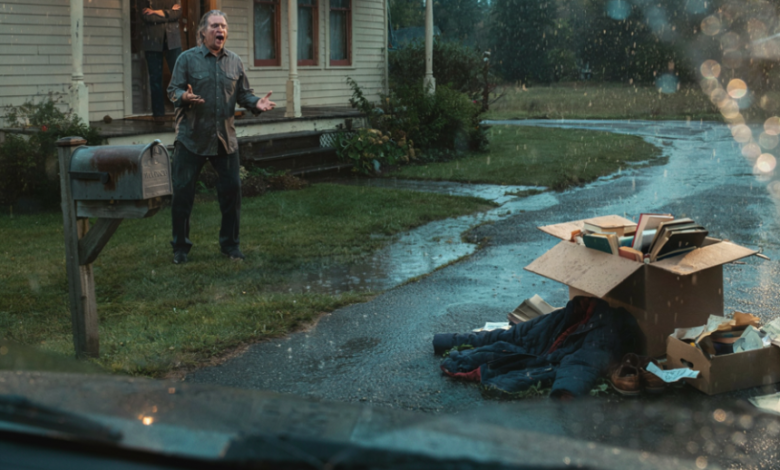
The storm had already turned the gravel driveway into a ribbon of mud by the time Adele Fairbanks reached her childhood home. Headlights swept across the yard, and for one disorienting moment she thought the wind had blown debris everywhere.
Then she realized the debris belonged to her.
Boxes split open under the rain. Family photo albums floated in shallow puddles. Books she had collected over decades lay soaked and warped. Her favorite wool coat, the one she had worn every winter since starting her business, was trampled into the mud beside the front walk.
She sat frozen behind the steering wheel.
The front door opened.
Her father, Warren, stepped onto the porch without bothering to shield himself from the rain. He folded his arms and stared at her with an expression that held no anger anymore—only satisfaction.
As though he had finally gotten rid of a burden.
Her mother, Elaine, lingered behind him in the warm glow of the hallway light. She neither smiled nor frowned. She simply watched.
Then Warren raised his voice.
“You said your company failed,” he barked. “That sounds like your problem—not ours. We’re not carrying you.”
Behind him, Adele caught sight of her younger sister, Brinn.
Brinn’s lips curled into a tiny, smug smile.
That smile hurt more than anything Warren had said.
Three weeks earlier, Adele had finalized the sale of Birchwood, the forensic accounting firm she had built from absolutely nothing, for seven million dollars.
No one in her family knew.
Birchwood had begun in a cramped office above an old hardware store where the floors creaked and the heater barely worked. Adele had furnished the space with secondhand desks, mismatched chairs, and filing cabinets bought from bankrupt businesses. She survived on convenience-store coffee, twelve-hour workdays, and an unwavering belief that honesty still had value.
Her specialty was untangling financial deception.
She found hidden accounts, uncovered fraud, and followed complicated trails of numbers until the truth surfaced.
Clients trusted her because she never stopped digging.
Ironically, she had spent years uncovering strangers’ lies while ignoring the ones inside her own family.
Whenever Birchwood reached a milestone, Warren proudly introduced Adele as his successful daughter.
Whenever relatives admired her accomplishments, Elaine smiled as though she’d always believed in her.
Whenever Brinn wanted a vacation, help with bills, or another fresh start after quitting a job, Adele quietly wrote another check.
She wasn’t loved because she was Adele.
She was appreciated because she was useful.
After the sale of Birchwood, one question refused to leave her mind.
If the money disappeared…
…would her family still choose her?
She invented a story about financial collapse. She told them Birchwood had failed, that she had lost everything, and that she might need somewhere to stay until she figured out her next steps.
She had hoped—perhaps foolishly—that someone would simply hug her.
Instead, they threw her life onto the lawn.
The answer had come faster than she expected.
Standing in the rain, Adele walked silently across the yard.
She ignored Warren’s continued lecture about responsibility and consequences.
She didn’t defend herself.
Didn’t argue.
Didn’t cry.
She simply gathered what the storm hadn’t already destroyed.
One box contained a framed photograph of her grandmother, Vivian.
The wooden frame was caked with mud, but the photograph inside remained untouched.
Adele gently wiped the glass with her sleeve.
Years earlier, when Birchwood had existed only as a dream, Vivian had slipped twenty dollars into Adele’s hand along with a handwritten note.
“Build it anyway.”
It wasn’t much money.
It was everything she needed.
That single act of belief had carried her through years when almost nobody else believed she would succeed.
The next morning, everything changed.
The sale of Birchwood became public.
News traveled quickly through business circles, then across town.
Adele’s phone erupted.
Warren called.
Then Elaine.
Then Brinn.
By lunchtime, thirty-five missed calls covered her screen.
Voicemails suddenly sounded warm.
“We need to talk.”
“There’s been a misunderstanding.”
“We’re family.”
Not one message mentioned the boxes in the rain.
Before Adele decided whether to respond, another call appeared.
“Ms. Fairbanks?” an older man asked. “My name is Theodore Brandt. I handled your grandmother Vivian’s estate.”
His voice carried none of the forced sweetness filling her voicemail inbox.
“I believe you should come see me tomorrow morning,” he continued. “The farmhouse has been listed for sale, and there’s something your grandmother specifically intended for you.”
Theodore’s office occupied the second floor above an abandoned insurance agency downtown.
It was modest, lined with shelves overflowing with legal volumes that looked older than Adele herself.
He slid a property listing across his desk.
Vivian’s farmhouse.
Listed for six hundred forty thousand dollars.
Then he placed a sealed envelope beside it.
Elegant handwriting stretched across the front.
For Adele…when she’s ready.
Her hands trembled as she opened it.
Inside lay trust documents, recorded deeds, notarized instructions, and detailed estate records.
Eight years earlier, Vivian had quietly transferred ownership of the farmhouse into a protected trust—with Adele as its sole beneficiary.
One document stopped Adele cold.
Elaine’s signature.
She had acknowledged in writing that the property did not belong to her and could never legally be sold by the family.
Yet Warren and Brinn had still signed paperwork connected to the attempted sale.
They hadn’t misunderstood.
They had knowingly tried to profit from property that was never theirs.
Theodore remained calm.
“We’re going to document everything.”
Together they organized every piece of evidence.
Screenshots of threatening texts.
The flood of missed calls.
Photographs of Adele’s ruined belongings.
Copies of the real estate listing.
Transfer records.
Signed acknowledgments.
Within days, Theodore halted the sale through the title company, secured the property’s ownership records, and ensured no mortgage or financial maneuver could threaten Vivian’s wishes.
“If they continue,” he said, “we’re prepared for court.”
A week later, Adele returned to the farmhouse.
This time she wasn’t alone.
Theodore stood beside her.
A locksmith carried a toolbox toward the front porch.
Warren stormed outside the moment he saw them.
“You’re choosing money over your own family!”
His voice echoed across the yard.
Months earlier, those words might have shattered her.
Now they barely reached her.
Adele looked directly at him.
“No,” she answered quietly. “You chose money the day you believed I had none.”
Silence settled between them.
For the first time in her life, she didn’t feel compelled to explain herself.
She didn’t apologize for succeeding.
She didn’t apologize for protecting herself.
She simply accepted the keys from the locksmith.
One lock after another clicked into place.
Each turn sounded less like an ending…
…and more like freedom.
Over the following month, Adele restored the farmhouse room by room.
She repaired the weathered porch where Vivian had once shelled peas every summer.
She planted fresh flowers beneath the front windows.
She installed a new mailbox.
Inside, she hung Vivian’s photograph in the front room where morning sunlight spilled across the walls each day.
The frame still carried one faint streak of dried mud.
She could have polished it away.
Instead, she left it there.
Not because she wanted to remember the betrayal.
Because she wanted to remember the truth it revealed.
Love that disappears when your fortune changes was never love at all.
Vivian had understood that long before Adele did.
Years ago, she had offered a frightened young woman twenty dollars and four unforgettable words.
Build it anyway.
Adele had built a company.
She had built a future.
Now she was building something even stronger—a life where loyalty couldn’t be bought, guilt couldn’t control her, and family would finally be defined not by blood, but by those who chose to stand beside her when there was nothing left to gain.
This time, what she built would belong entirely to her.
And no lie, forged signature, or convenient apology would ever take it away again.