Gang finds unusually spiky creatures in nest – takes a closer look and jaws drop when they realize what kind of animals they are – OMG

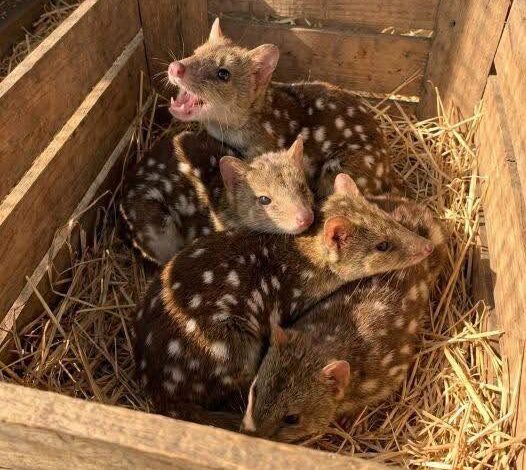
Against the vast red landscapes of Western Australia, the tiny western quoll joeys may seem almost insignificant.
Barely larger than a person’s hand, they shuffle uncertainly through the dust with bright eyes, oversized ears, and cautious curiosity. Their first unsteady steps are easy to overlook against the immense wilderness surrounding them.
Yet for conservationists, those tiny footprints represent something extraordinary.
They are proof that a species once pushed toward disappearing forever is beginning to reclaim the land it once called home.
Every playful tumble, every quiet growl, and every successful hunt tells the same remarkable story: sometimes nature can recover when given the opportunity.
For decades, the western quoll—also known as the chuditch—faced relentless challenges. Habitat loss steadily reduced the places where it could safely live, while introduced predators such as feral cats and foxes devastated already fragile populations. As numbers declined, the animal vanished from much of its historic range, becoming increasingly rare across Australia.
Its future appeared uncertain.
Many feared the western quoll would become another heartbreaking example of a native species disappearing from the landscape.
But conservation is often built on persistence rather than certainty.
At Mt Gibson Wildlife Sanctuary, dedicated ecologists spent years creating the conditions needed for the species to return.
The work extended far beyond simply releasing animals into the wild.
Habitats had to be carefully protected and restored.
Predator populations required constant management to reduce the threat posed by invasive species.
The landscape itself needed to become a place where western quolls could once again find shelter, hunt successfully, and raise their young.
Every stage demanded patience.
Every success came only after countless hours of careful planning, monitoring, and fieldwork.
Among those leading these efforts is ecologist Georgina Anderson, who has watched the sanctuary’s gradual transformation with both scientific precision and genuine admiration.
For her and her colleagues, the appearance of healthy joeys is far more than an exciting observation.
It is one of the strongest signs that years of conservation work are beginning to achieve their ultimate goal.
The young quolls are doing what every wildlife recovery program hopes to see.
They are adapting naturally.
They explore burrows.
They learn to hunt.
They establish territories.
Most importantly, they are surviving long enough to begin creating the next generation.
That is the true measure of a successful reintroduction.
Wildlife recovery is never just about releasing animals.
It is about reaching the point where those animals no longer need constant human intervention to sustain their population.
Every litter born within the sanctuary represents another step toward that future.
Still, no one working at Mt Gibson assumes the battle has been won.
Life in the Australian outback remains challenging.
Feral cats and foxes continue to threaten vulnerable native wildlife wherever they gain access.
Changing climate conditions bring periods of intense heat, drought, and shifting food availability that can place additional pressure on recovering populations.
Even inside carefully managed sanctuaries, nature offers no guarantees.
The western quoll’s future will depend on continued protection, ongoing research, and long-term commitment.
Conservation rarely follows a straight path.
Progress often comes in small victories separated by years of difficult work.
That is precisely why these tiny joeys matter so much.
They represent more than individual animals.
They symbolize resilience.
They demonstrate that species once thought to be slipping away can begin to recover when ecosystems are restored and persistent conservation efforts remain in place.
For Australia, their return carries a meaning that extends well beyond one sanctuary.
The western quoll has become a powerful reminder that extinction is not always the inevitable ending to a wildlife story.
Sometimes populations can recover.
Sometimes damaged habitats can heal.
Sometimes decades of dedication quietly produce the breakthrough that many people believed might never come.
Watching a young western quoll emerge cautiously from its burrow at dusk may not seem like a dramatic event to the casual observer.
Yet for the scientists who have devoted years to protecting this remarkable marsupial, it is an unforgettable sight.
Each tiny set of tracks pressed into the red earth tells a story of survival.
Each bright pair of eyes reflects a future that once appeared impossible.
The work is far from finished.
Challenges remain.
But every healthy joey proves that hope, backed by careful science, determined conservation, and unwavering patience, can achieve remarkable things.
In the end, the return of the western quoll is about far more than one species.
It is a reminder that even after years of decline, nature can still surprise us.
Given protection, time, and the opportunity to recover, life has an extraordinary ability to find its way back.
And sometimes, the greatest conservation success stories begin with nothing more than tiny footprints crossing the red dust beneath the Australian sky.