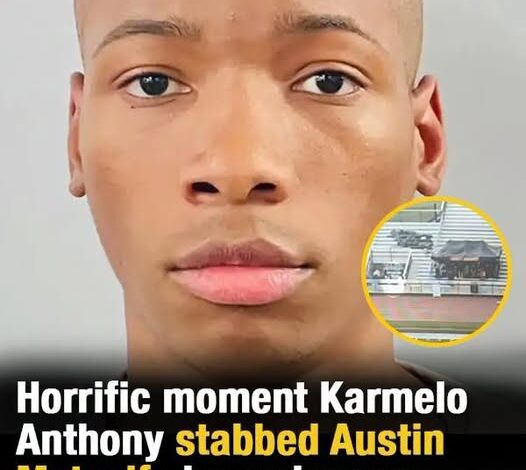
Twelve seconds can destroy more than one life.
That was all it took for a dispute beneath a school team tent to become something permanent. A few words. A flash of anger. A decision made faster than anyone could stop it.
Then everything changed.
What began as a small territorial argument—something that might have ended with a coach stepping between two teenagers, a warning from an adult, or nothing more than bruised pride—became a tragedy with consequences no courtroom could ever fully repair.
On that day, anger outran judgment.
Pride hardened into violence.
And two families were pushed into futures they never imagined.
Austin Metcalf lost his life.
Karmelo Anthony lost the life he had been building.
The surveillance footage does not simply show an incident. It captures the precise moment when ordinary teenage conflict crosses a line it can never uncross. At first, the scene looks almost familiar: students gathered beneath a tent, the energy of a school event, movement, noise, and the kind of tension that can flare quickly among young people.
Then the atmosphere shifts.
Bodies jolt backward.
Faces change.
Confusion spreads before understanding arrives.
Some people move on instinct, scrambling away from danger. Others freeze, unable to process what their eyes have just witnessed. In seconds, the space beneath that tent transforms from a place of routine school activity into the center of a trauma that will follow everyone who stood there.
That is the cruelty of sudden violence.
It leaves no time for preparation.
No time for intervention.
No time for anyone to say the one sentence that might have stopped everything.
By the time the crowd understood the seriousness of what had happened, the moment had already become irreversible.
For Austin’s family, the loss is beyond measurement.
A son, a brother, a teammate, and a young man with a future was gone before anyone had time to comprehend it. His name became part of legal proceedings and public discussion, but to those who loved him, he was never a case.
He was Austin.
He had a laugh they knew.
A voice they expected to hear again.
Habits, memories, and plans that belonged to a life still unfolding.
Most painfully, he had a twin who must now carry a kind of absence few people can truly understand.
A twin is not only a sibling.
A twin is often a first companion, a mirror, a witness to the earliest chapters of life. To lose that person is not simply to lose someone loved. It is to lose someone who shared the beginning with you in a way no one else ever could.
There will be birthdays when the missing place feels unbearable.
Graduations where one name is spoken and the other is remembered.
Holidays where joy sits beside grief.
Ordinary afternoons when the silence becomes suddenly heavy.
Austin’s absence will not remain inside a courtroom or a news report.
It will follow his family home.
It will live in photographs, bedrooms, traditions, conversations, and every milestone that should have included him.
For Karmelo, the consequences are different, but they are also lifelong.
Before that day, he was a student athlete with a future still unwritten. He had choices ahead of him. Possibilities. A path not yet defined.
Now, one act has become the center of his story.
He will spend years replaying the seconds beneath that tent, forced to live with the knowledge that a decision made in anger ended another person’s life and changed his own forever.
The legal system can impose punishment.
It can deliver a verdict.
It can assign years, restrictions, and consequences.
But no sentence can fully capture the inner weight of knowing that one moment became the defining point of everything that followed.
Whatever Karmelo was before that day will always be measured against what happened there.
That is part of the devastation.
Violence does not end with the person harmed.
It spreads.
It moves through families, classrooms, teams, neighborhoods, and communities. It leaves witnesses with images they cannot forget. It leaves parents imagining how easily any argument can spiral. It leaves students trying to understand how a school event became the setting for irreversible loss.
Two families walked into the same courtroom.
Neither left whole.
One family left without their son.
The other left knowing theirs would spend a significant part of his life behind bars.
Those griefs are not the same.
They should not be treated as equal.
But pain still surrounds both sides.
It reaches everyone connected to the case and forces a community to ask the hardest question of all:
How did something so small become so final?
There is no satisfying answer.
That may be what makes the tragedy so difficult to bear.
If the conflict had been larger, perhaps people could have made sense of the outcome more easily. If there had been time, if there had been distance, if someone had stepped in sooner, maybe the mind could find a place to rest.
But the truth is far more brutal.
A life ended over a moment that should never have mattered enough to become fatal.
That is the unbearable contrast at the heart of the case.
The cause was small.
The consequence was enormous.
And nothing can balance that equation.
A courtroom can speak in sentences and verdicts, but it cannot undo what happened. It cannot return Austin to his family. It cannot restore his twin’s other half. It cannot give Karmelo back the boy he was before anger made a permanent choice.
No punishment can rewind those seconds.
No apology can reverse them.
No number of years can make the outcome feel complete.
All that remains is the lesson no one wanted to learn.
That anger, when left unchecked, can become destiny.
That one impulsive act can outlive the emotion that caused it.
That pride can cost more than anyone imagines in the moment.
And that some choices last long after the person who made them wishes they had done anything else.
What happened beneath that tent will be remembered not only because of its violence, but because of its speed.
The suddenness.
The finality.
The terrible reminder that childhood can end in an instant.
For Austin’s family, life will now be divided into before and after.
For Karmelo, one moment will follow him through every year ahead.
For the witnesses, the memory will remain fixed in the mind like a scene they never wanted to see.
And for the community, the question will linger long after the courtroom empties.
What could have stopped it?
Maybe a calmer word.
Maybe an adult stepping closer.
Maybe one second of hesitation.
Maybe nothing.
But that is the agony of irreversible moments.
They leave everyone searching for the door that closed before anyone realized it was there.
In the end, the tragedy cannot be reduced to a verdict, a sentence, or a headline.
It is the story of one teenager who never came home and another who will spend a lifetime living with the reason why.
A few seconds beneath a tent.
A burst of anger.
A permanent absence.
And a grief that will keep echoing long after the world moves on.