THE TRUMP T1 PHONE HAS OFFICIALLY LAUNCHED BUT A HILARIOUS DESIGN DISASTER HAS THE INTERNET MOCKING THE GOLD PLATED DEVICE

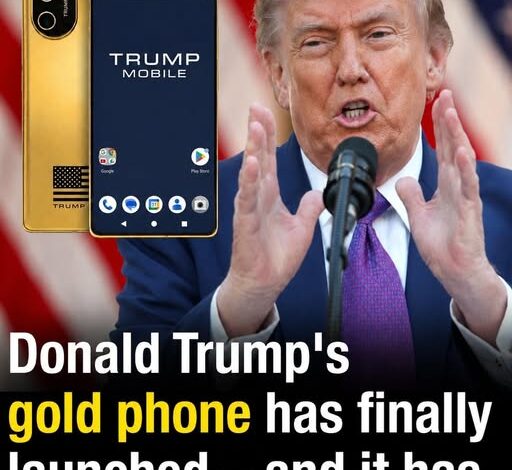
The Trump Mobile T1 smartphone was supposed to arrive as more than just another gadget entering an already crowded market. From the beginning, it was framed as a statement — a glossy, gold-plated symbol of patriotism, independence from “big tech,” and a promise that American manufacturing and conservative branding could merge into a luxury consumer product. Supporters described it as a long overdue alternative for customers tired of Silicon Valley politics, while critics dismissed it immediately as another licensing venture built more around image than engineering. Months before the phone ever shipped, it had already become a cultural object rather than a simple piece of hardware.
That made its chaotic rollout all the more damaging.
After nearly nine months of delays, shifting release dates, vague production updates, and mounting skepticism from both the tech industry and political commentators, the T1 finally began arriving in customers’ hands. But instead of launching with triumphant reviews and patriotic fanfare, the debut immediately collapsed into internet ridicule over a mistake so strangely basic that many people initially assumed the images circulating online had to be fake.
The American flag stamped across the back of the phone contained only eleven stripes.
Not twelve.
Not a stylized reinterpretation.
Eleven.
For a product marketed almost entirely around national symbolism, American pride, and “traditional values,” the omission landed like a self-inflicted parody. The thirteen stripes on the U.S. flag are not obscure historical trivia. They are one of the most universally recognized national symbols in the country, representing the original thirteen colonies and appearing in classrooms, government buildings, military ceremonies, and textbooks from childhood onward.
And yet somehow, on a $499 “patriotic” smartphone promoted as a rejection of careless globalized branding, two stripes simply vanished.
The internet reacted exactly how modern internet culture always reacts to symbolic hypocrisy:
mercilessly.
Screenshots spread across social media within hours.
Memes appeared almost instantly.
Users joked that inflation had apparently reached the colonies.
Others sarcastically speculated that budget cuts forced the removal of Delaware and New Jersey.
Political opponents seized on the mistake as evidence of performative patriotism detached from actual attention to detail. Even some conservative supporters expressed embarrassment, not because the phone existed, but because the error felt so avoidable. Critics argued that when patriotism becomes primarily aesthetic — gold finishes, slogans, flags, branding — symbols eventually stop being treated with care and become decorative props instead.
The deeper humiliation came when observers realized the inconsistency extended beyond the physical device itself.
Promotional videos released by Trump Mobile appeared to show multiple different versions of the flag entirely. Some graphics displayed eleven stripes. Others appeared to show ten. One circulating screenshot seemed to feature only nine visible stripes depending on the angle and lighting. Instead of looking like a carefully managed product launch, the branding began resembling disconnected mockups assembled by separate marketing teams without centralized oversight.
That inconsistency fed directly into broader criticism already surrounding the project from the beginning:
that Trump Mobile functioned more as a branding exercise than a genuine technology venture.
Tech analysts had raised questions months earlier about the feasibility of the company’s original claims. Early advertisements heavily implied the device would represent an American-made smartphone alternative built domestically with patriotic manufacturing principles. In a market dominated by Asian supply chains and multinational production networks, the idea immediately attracted attention because fully U.S.-manufactured smartphones are extraordinarily difficult and expensive to produce at scale.
But over time, the language quietly changed.
“Made in the USA” slowly softened into phrases like:
“designed with American values in mind”
and
“assembled in the United States.”
That distinction mattered enormously.
Because modern electronics manufacturing depends on deeply global supply chains involving semiconductors, display panels, battery systems, processors, camera modules, and chassis components sourced across multiple continents. Tech experts immediately noticed that the T1’s specifications, dimensions, and hardware layout looked suspiciously familiar.
Eventually analysts from outlets including iFixit and independent hardware reviewers pointed toward what many suspected:
the device appeared strikingly similar — nearly identical in some respects — to the HTC U24 Pro, a Taiwanese-manufactured mid-range smartphone released in 2024.
To critics, the revelation confirmed their worst assumptions.
The “American revolution” in smartphone technology increasingly looked like imported hardware covered in gold-colored coating and wrapped in nationalist marketing language. Instead of representing a bold domestic manufacturing breakthrough, the T1 began appearing more like a rebranded foreign device preloaded with ideological identity.
That perception hit especially hard because the phone’s marketing had leaned so heavily on authenticity, patriotism, and opposition to globalized corporate culture. Consumers willing to pay premium pricing expected something unique, distinctly American, or technologically ambitious. Discovering similarities to existing overseas hardware made the branding feel less visionary and more cosmetic.
And then came the customer complaints.
People who placed deposits months earlier reported confusion trying to track orders through the Trump Mobile website. Some users claimed shipment notifications failed to update properly. Others said they could not even confirm whether their devices had actually shipped at all. Forums filled with screenshots of unanswered support emails, unclear timelines, and contradictory customer service responses.
The disorder surrounding fulfillment only reinforced the broader impression that the rollout lacked professional coordination.
For tech startups, delays and logistical problems are not uncommon. Hardware launches are notoriously difficult. Manufacturing bottlenecks, software bugs, supply shortages, and shipping complications derail even established companies regularly. But in Trump Mobile’s case, the technical problems collided with political branding in ways that amplified every mistake into symbolic commentary.
The phone was never being judged purely as hardware.
It was being judged as a statement.
And statements built around strength, competence, patriotism, and anti-establishment confidence invite particularly harsh backlash when execution appears sloppy.
Democratic lawmakers quickly escalated scrutiny further by calling for potential Federal Trade Commission review regarding marketing claims tied to manufacturing origin and product representation. While formal investigations remain uncertain, the public discussion itself added another layer of reputational damage. Questions shifted from whether the phone was impressive to whether aspects of its branding crossed into misleading territory.
Meanwhile, loyal supporters defended the device aggressively online.
Some argued critics were obsessing over trivial details because of political bias. Others insisted that sourcing components internationally is unavoidable in modern electronics and that the symbolic mission behind the product mattered more than technical manufacturing purity. A number of customers reported satisfaction with the phone’s basic functionality, praising battery life, conservative-oriented apps, and the broader concept of alternatives to mainstream tech ecosystems.
That divide highlights something deeper about the T1 itself:
the phone functions less as a neutral consumer product and more as a cultural identity object.
People are not merely buying hardware.
They are buying affiliation.
Aesthetic alignment.
Political symbolism.
Modern branding increasingly works this way across industries. Products become extensions of worldview rather than simple tools. Sneakers signal politics. Coffee companies market ideology. Streaming platforms become tribal markers. Smartphones, perhaps more than anything else, already occupy intimate emotional space in daily life. Turning one into an explicitly political object guarantees that reactions will extend far beyond processor speed or camera quality.
And perhaps that is why the eleven-stripe mistake resonated so powerfully.
Because symbols matter most when they are used as central selling points.
Had the same error appeared quietly on generic packaging from an unrelated budget electronics company, few people would have cared. But when patriotism itself becomes the product identity, mistakes involving national symbols stop looking accidental and start looking revealing.
Critics interpreted the missing stripes as metaphor:
a flashy performance of nationalism disconnected from substance, detail, or craftsmanship underneath.
Supporters viewed the backlash as proof that political opponents were desperate to humiliate anything connected to Trump branding, no matter how minor the issue.
Both reactions say something revealing about modern American culture.
We increasingly consume politics through aesthetics and products rather than policy alone. Branding, identity, and symbolism now shape public perception almost as much as legislation or governance. A smartphone launch becomes national discourse because political loyalty itself has merged with consumer culture so completely that people experience products emotionally and ideologically.
In the end, the T1 phone may still function adequately as a device. Most users will likely use it for the same ordinary tasks people use every smartphone for:
texts,
photos,
calls,
videos,
social media.
But its chaotic journey to market has already cemented something larger than its technical specifications.
The phone became a case study in modern branding itself:
how image can outrun execution,
how patriotism can become aestheticized into merchandise,
and how internet culture weaponizes visible contradictions instantly and permanently.
Because once the public saw that eleven-striped flag, the symbolism became impossible to separate from the device.
A patriotic product unable to reproduce one of the country’s most basic national emblems correctly.
A supposedly American manufacturing triumph linked closely to foreign hardware.
A premium launch overshadowed by delays, confusion, and inconsistency.
The T1 may be gold-colored.
It may carry slogans about American values.
It may still attract loyal buyers.
But for much of the internet, the damage happened before the phone ever fully powered on.
Not because the device failed mechanically.
Because credibility — like branding — depends on details.
And in the age of viral scrutiny, missing even two stripes can make an entire product feel like a metaphor for something much larger unraveling underneath.