Fear changes architecture.
A familiar apartment can become hostile in seconds. Hallways stretch longer. Doorways stop feeling neutral. Shadows gather personality. Ordinary silence begins sounding intentional, as though the entire room is waiting with you for something terrible to move.
That was exactly what happened the moment I saw it on the bathroom floor.
At first glance, it didn’t even look real.
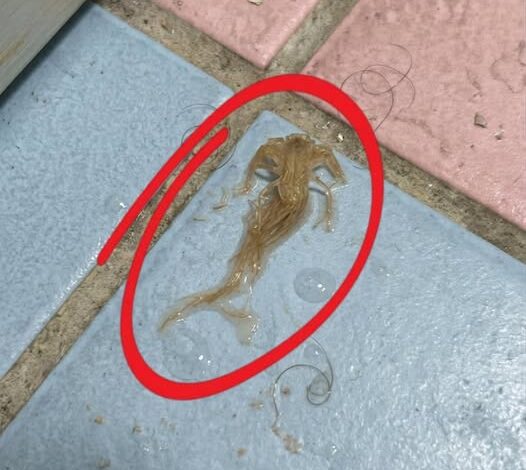
Just a twisted shape lying near the baseboard beneath the sink — pale, segmented, thin enough to seem fragile yet jagged enough to trigger immediate revulsion. One side curled inward unnaturally while delicate, spidery limbs fanned outward like something crushed halfway through transformation.
I froze instantly.
Not dramatic movie freezing.
Real freezing.
The kind where your body quietly suspends itself between fight, flight, and disbelief while your brain scrambles desperately to identify whether the threat in front of you is alive.
For several seconds, I genuinely could not process what I was seeing.
My apartment sat completely silent around me except for the faint hum of the bathroom exhaust fan and the distant traffic drifting through partially open windows from the street below. But suddenly every tiny sound felt amplified:
pipes settling inside the walls,
the refrigerator motor clicking on,
fabric shifting when I breathed.
Fear sharpens ordinary noise into warning.
I took one slow step backward automatically.
Then another.
The bathroom doorway itself became psychologically charged after that, transformed from simple entrance into border. Crossing it suddenly felt dangerous in a way that made no rational sense yet felt completely convincing emotionally.
Because that is the frightening thing about fear:
the body reacts long before logic catches up.
My first coherent thought was absurdly immediate:
I cannot live here anymore.
Not:
What is it?
Not:
Maybe I should investigate.
No.
Straight to:
I should move.
And honestly, in that moment, the idea felt entirely reasonable.
People love laughing afterward about irrational fear, but while fear is happening, it rarely feels irrational internally. The nervous system does not distinguish neatly between imagined danger and confirmed danger at first. It simply floods the body with urgency:
heart racing,
vision sharpening,
muscles tightening,
adrenaline preparing survival pathways before evidence fully exists.
Standing there staring into the bathroom, I became deeply aware of how vulnerable adulthood actually is.
No matter how independent people become, most still carry ancient instincts beneath modern routines. You can pay taxes, answer work emails, own furniture, and still suddenly revert emotionally into a frightened child because something unfamiliar appeared on the floor near your toothbrush.
I grabbed my phone from the kitchen counter almost defensively.
Not to call anyone.
To zoom in.
Which, looking back, feels like an incredibly modern survival instinct:
if danger exists, record it first.
I stood safely outside the bathroom doorway using the camera zoom instead of approaching physically. My hands trembled slightly while I enlarged the image on-screen.
The creature somehow looked worse digitally.
The flashlight glare from my phone distorted every detail into something more alien:
thin translucent legs,
split ridges,
strange hollow sections along the body.
At one point I became fully convinced it had moved.
I physically gasped and stumbled backward into the hallway wall hard enough to hurt my shoulder.
Looking back now, I’m almost certain the movement was nothing more than shadows shifting when the phone angle changed.
But fear interprets ambiguity aggressively.
That’s another thing people underestimate:
the imagination becomes frighteningly efficient once uncertainty enters the room.
Suddenly every horror story I’d ever absorbed resurfaced simultaneously.
Venomous insects.
Parasitic creatures.
Things crawling into ears while people slept.
Infestations hidden inside walls.
The human brain is astonishingly talented at constructing catastrophe from incomplete information.
Especially in isolation.
Living alone intensifies this phenomenon dramatically because there’s nobody nearby to interrupt the escalating narrative forming inside your head. No calm second opinion. No one saying:
“That’s probably nothing.”
Instead, your thoughts loop internally gaining momentum.
I remember standing in the kitchen actually searching online:
“dangerous house bugs translucent legs”
while refusing to reenter the bathroom.
The search results did not help.
Internet algorithms are built to maximize engagement, not emotional stability. Within minutes I had convinced myself I was possibly dealing with some horrifying invasive species capable of multiplying behind walls and poisoning pets I didn’t even own.
One article included close-up photographs far worse than anything actually lying in my bathroom.
I closed the phone immediately.
Then reopened the camera anyway because I couldn’t stop checking whether the thing had moved.
It hadn’t.
That should have comforted me.
Instead, somehow it became creepier.
Because motionless things can feel more threatening than moving ones. Motion at least suggests understandable behavior. Stillness creates mystery.
Eventually curiosity began competing with panic.
Not bravery exactly.
More like exhaustion.
Fear becomes tiring after long enough. The body cannot sustain high alert indefinitely without eventually wanting answers badly enough to risk approaching the source.
So I prepared myself like someone entering combat.
Flashlight.
Shoes on.
Broom within reach.
Phone ready.
Ridiculous, honestly.
But psychologically necessary.
The hallway leading back toward the bathroom suddenly felt much longer than normal. Every step required negotiation with myself:
closer,
pause,
breathe,
closer again.
The flashlight beam shook visibly across the tile floor while I crouched near the doorway trying to maintain safe distance.
And slowly, details sharpened.
The thing looked…
lighter than expected.
Not solid.
Not wet.
Not fleshy.
Empty.
That realization arrived quietly at first.
Then all at once.
I leaned closer.
The “limbs” weren’t limbs exactly anymore. They looked brittle. Hollow. Delicate enough that a single breath might crush them.
And suddenly the shape became recognizable.
Not a monster.
A shell.
A shed exoskeleton from a house centipede.
I stared at it silently for several seconds while my nervous system recalibrated itself in real time.
The emotional whiplash was immediate and almost dizzying.
Relief first.
Huge relief.
Then embarrassment flooding right behind it.
I laughed so suddenly and loudly the sound startled me.
Not polite laughter either.
The kind that escapes after adrenaline has nowhere else to go.
There I stood in my own apartment armed with a broom and flashlight after nearly convincing myself I’d discovered some mutant nightmare creature — and the entire crisis turned out to be nothing more than the empty shed skin of a harmless house centipede that had long since disappeared somewhere else entirely.
Which, admittedly, was not comforting in every possible way.
But still.
Not danger.
Not infestation apocalypse.
Not reason to abandon my lease overnight.
Just evidence that something small had outgrown itself and moved on.
The more I studied the shell afterward, the more fascinating it became.
House centipedes shed their exoskeletons as they grow, leaving behind ghostly replicas of themselves so intact they can appear alive at first glance. The translucent body, the delicate legs, even the antennae remain preserved temporarily like abandoned costumes.
Nature creates strange things.
And fear transforms them into stories instantly.
That realization stayed with me long after I swept the shell carefully into a dustpan and threw it away.
Because what frightened me most that night was never really the centipede skin itself.
It was uncertainty.
The gap between seeing something unfamiliar and understanding it.
Inside that gap, imagination rushed aggressively to fill the empty space with worst-case scenarios.
And honestly, people do this constantly — not just with insects.
With relationships.
With silence.
With illness.
With unanswered texts.
With unfamiliar sounds in the middle of the night.
The human mind hates ambiguity so deeply that it often prefers terrifying explanations over incomplete ones.
At least fear feels definite.
Later that evening, I found myself walking back into the bathroom repeatedly almost amused by how ordinary it looked again. Same towels. Same sink. Same tile floor.
Nothing had changed physically.
Only interpretation.
That fascinated me.
A few minutes of understanding completely transformed the emotional atmosphere of the room. The danger existed almost entirely inside the story I constructed before facts arrived.
And yet —
while the fear was happening,
it felt absolutely real.
That’s important too.
People often shame themselves for irrational fear afterward, forgetting the body cannot always distinguish immediately between imagined threat and genuine risk. Fear evolved to protect human beings long before perfect information existed. Sometimes it overreacts because overreaction historically kept people alive more effectively than hesitation.
Of course, modern apartments rarely contain prehistoric predators.
But nervous systems don’t always update elegantly.
Now, whenever I think about that crumpled translucent shell on the bathroom floor, I remember something unexpectedly comforting:
most monsters shrink dramatically once illuminated properly.
Not all, unfortunately.
Some dangers are very real.
But many fears survive primarily through distance,
darkness,
and incomplete understanding.
The closer I moved toward the thing terrifying me, the less power it actually possessed.
And maybe that is true far beyond insects and empty shells.
Maybe half the horrors haunting people quietly every day are simply unanswered questions wearing the shape of certainty in dim light.
Waiting for someone brave enough —
or tired enough —
to finally step closer and see them clearly for what they really are.