A CEO Fell Asleep on a Stranger’s Shoulder — When She Woke Up, What Was in His Hand Left Her Speechless

Victoria Hale did not believe in fate.
She believed in contracts, leverage, preparation, and control.
She believed that luck was what people blamed when they had failed to plan properly. She believed that weakness was expensive, emotion was inefficient, and trust was something to be earned slowly—if it was earned at all.
By thirty-eight, those beliefs had made her one of the most powerful women in the defense technology world.
They had also made her completely alone.
The flight from San Diego to Washington, D.C. was supposed to be nothing more than another inconvenience in a life built around impossible schedules and high-stakes decisions. Victoria had spent the day in a secure conference room arguing with Navy officials about next-generation autonomous drone systems, answering technical questions, defending cost projections, and navigating the careful politics of military procurement.
By the time she left the base, her head throbbed.
By the time her assistant called to say the company jet had a mechanical issue, her patience was gone.
“Commercial?” Victoria had repeated, standing beside her car with one hand pressed to her temple.
“I’m sorry, Ms. Hale,” her assistant said. “It was the only option that gets you to D.C. tonight.”
Victoria stared at the darkening California sky.
“Business class?”
A pause.
“Economy.”
For three seconds, Victoria said nothing.
Then she closed her eyes.
“Book it.”
That was how Victoria Hale, CEO of Hale Dynamics, builder of a billion-dollar defense empire, ended up in seat 14A of a commercial aircraft, wedged against the window with her laptop balanced on a tray table barely large enough to hold a cup of coffee.
She hated everything about it.
The cramped space.
The noise.
The lack of privacy.
The passenger in front of her reclining two inches too far.
The child several rows back kicking a seat.
The smell of airport coffee and reheated cabin air.
Her tailored black suit, chosen that morning for a Pentagon-level negotiation, felt absurd among hoodies, travel pillows, and sneakers. Still, Victoria refused to surrender to discomfort. She opened her laptop, pulled up a contract revision, and began working before the plane even left the gate.
Work was familiar.
Work was safe.
Work did not ask her how long it had been since she had slept properly.
Work did not notice that she had eaten nothing but coffee and half a protein bar since dawn.
Work did not ask why her hands sometimes trembled when no one was watching.
Victoria had built her entire life around forward motion. Since graduating valedictorian from MIT at twenty-one, she had climbed with ruthless precision. Her father, a defense contractor himself, had taught her early that the industry did not forgive softness.
“Sentiment gets people killed,” he used to say. “Control keeps them alive.”
She had believed him.
She had become exactly what he trained her to become.
Sharp.
Brilliant.
Untouchable.
Her company designed artificial intelligence systems for military applications. Her name appeared in classified briefings, financial magazines, and whispered conversations in rooms most people would never enter. Generals took her calls. Investors feared disappointing her. Competitors watched her like a storm on the horizon.
Victoria Hale had won.
And yet, sitting in 14A while the plane taxied toward the runway, she could not remember the last time winning had made her feel anything.
Beside her, the man in 14B sat completely still.
At first, Victoria barely noticed him.
She noticed people only when necessary.
But as the plane lifted into the evening sky, something about him began to draw her attention despite herself.
He was not scrolling through his phone.
Not watching a movie.
Not fumbling with earbuds.
Not complaining about the flight.
He simply sat with his eyes closed, hands resting loosely on his knees, breathing slowly as if the cramped cabin were the quietest place on earth.
Victoria found it irritating.
Then fascinating.
He wore jeans, boots, and a plain dark T-shirt beneath a worn jacket. Nothing about him announced wealth or importance. But his posture did. His back remained straight despite the tight seat. His shoulders were relaxed but ready. His face was calm in a way Victoria almost never saw in adults.
Not passive.
Not careless.
Controlled.
His hands were rough and scarred, the hands of someone who had done more than type, sign, point, and shake. A thin white line crossed one knuckle. Another scar disappeared beneath his sleeve.
Military, Victoria thought.
She knew the signs.
Her company sold to the military. Briefed the military. Built tools for the military.
But she rarely sat next to the kind of person who actually carried the cost.
She turned back to her laptop.
The plane hit turbulence twenty minutes later.
It came without warning.
The aircraft dropped hard enough to wrench gasps from half the cabin. A drink spilled across the aisle. Someone cursed. A flight attendant grabbed the back of a seat to steady herself.
Victoria’s laptop lurched forward.
Her tablet slid off the tray table and shot toward the aisle.
Before she could react, the man beside her moved.
His hand snapped out and caught the tablet cleanly, calmly, almost lazily, as if he had known where it would fall before it fell.
He handed it back to her.
“Careful,” he said.
His voice was low and steady.
Victoria took the tablet, annoyed by how badly the turbulence had startled her.
“Thank you.”
“Rough flight,” he said.
She exhaled sharply. “Apparently.”
He looked toward the aisle, then back at her.
“They usually smooth out.”
“You sound sure of that.”
A faint smile touched his mouth.
“Not sure. Just experienced.”
There was something about the answer that made her pause.
Most people filled silence because they were uncomfortable inside it.
This man seemed to live there.
Victoria gave a polite nod and returned to work.
She told herself that was the end of the conversation.
It was not.
The flight eventually steadied. The cabin lights dimmed. Outside the window, night swallowed the sky until the glass reflected only Victoria’s own face—paler than she liked, sharper than she remembered, with shadows beneath her eyes no concealer had fully hidden.
She answered emails.
Reviewed budget models.
Marked up a weapons integration proposal.
Then, slowly, something began to happen.
The engine hum softened into a steady vibration.
The pressure of the day loosened its grip.
The lack of signal prevented new emergencies from arriving every few seconds.
For the first time in months, maybe years, Victoria had nowhere to go and nothing immediate to control.
Her eyelids grew heavy.
She straightened.
Focused harder.
Read the same paragraph three times.
Her fingers stopped moving.
The laptop screen blurred.
She told herself she would rest her eyes for ten seconds.
Just ten.
The next thing she knew, she was warm.
Still.
Unusually peaceful.
She opened her eyes to a darkened cabin and the quiet breathing of sleeping passengers.
A blanket had been draped over her lap.
It was not hers.
For one disoriented moment, she did not understand where she was.
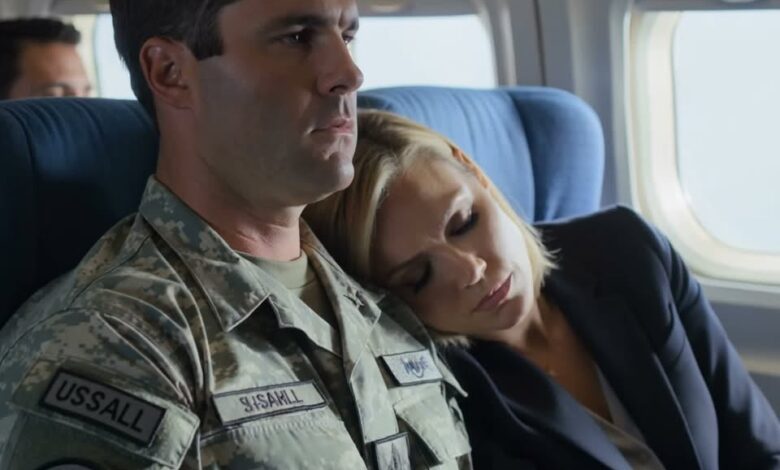
Then she realized her head was resting on the shoulder of the stranger in 14B.
Victoria shot upright.
“Oh my God,” she whispered. “I’m sorry.”
The man turned his head slightly.
“You’re fine.”
“I didn’t mean to—”
“You needed the sleep.”
Her face burned.
Victoria Hale did not fall asleep on strangers.
Victoria Hale did not lose control of her body in public.
Victoria Hale did not display vulnerability at thirty thousand feet in economy class.
She smoothed her hair, straightened her jacket, and checked her watch.
She had slept nearly three hours.
Three hours.
She could not remember the last time she had slept three uninterrupted hours anywhere.
“You should have woken me,” she said.
“You looked like someone who hadn’t rested in a long time.”
The words were gentle.
That somehow made them worse.
Victoria looked away.
“I was working.”
“I noticed.”
His tone held no judgment, only observation.
That made her laugh unexpectedly—a small, startled sound that escaped before she could stop it.
“Yes,” she said. “I suppose that was obvious.”
He smiled.
“You were dreaming about spreadsheets.”
This time she laughed for real.
The sound surprised her.
It felt unfamiliar in her chest.
“I probably was.”
Then she noticed the photograph in his hand.
It was old, softened at the edges from being carried often. In it, a younger version of the man beside her stood in Navy dress blues, smiling with one arm around someone who looked almost exactly like him.
A twin.
Both men wore uniforms.
Both looked proud.
Both looked impossibly young.
Victoria’s gaze lifted from the photograph to his face.
“You served.”
He looked down at the picture, and something passed through his expression so quickly she almost missed it.
Pain.
Then control.
“Yes.”
“Navy?”
He nodded.
“SEALs.”
In Victoria’s world, men loved saying things like that loudly. They used military service as currency, as intimidation, as proof of authority in rooms filled with civilians.
This man said it as if stating the weather.
“You don’t seem like the type to brag about it,” she said.
His eyes remained on the photograph.
“People who brag usually weren’t there.”
Silence settled between them.
For once, Victoria did not rush to fill it.
“I’m Victoria,” she said after a moment. “Victoria Hale.”
She extended her hand automatically, the gesture polished by thousands of business introductions.
He took it.
His grip was firm but not performative.
“Evan Marks.”
The name stirred something in her memory.
Marks.
Evan Marks.
She had seen it somewhere.
A briefing? A report? A line buried in a classified document?
“You sound familiar,” she said.
He slipped the photograph back into his jacket.
“I doubt that.”
“I remember names.”
“I’m not anyone important.”
Victoria studied him.
The response was too fast.
Too practiced.
Too final.
Before she could press further, the plane jolted again.
This turbulence was worse.
The aircraft dropped sharply, then rocked sideways.
A scream came from the rear cabin.
Overhead bins rattled.
One latch burst open above the aisle.
A heavy briefcase tumbled out.
Victoria saw it falling in slow motion toward a seated passenger.
Evan moved before anyone else even shouted.
He unbuckled, rose, caught the briefcase mid-fall, pivoted with the motion of the aircraft, and braced himself against the seatback without stumbling. The entire movement took less than three seconds.
Controlled.
Silent.
Exact.
The nearest passengers stared.
The flight attendant froze halfway down the aisle.
Evan handed the briefcase to its shaken owner.
“You should keep that latched,” he said mildly.
Then he sat down and buckled his seat belt again.
Victoria stared at him.
“That was not normal.”
He shrugged.
“Old habit.”
“What are you doing now?”
He looked out the window into the darkness.
“Consulting.”
“That’s a vague word.”
“It’s a vague business.”
She waited.
He seemed to understand that she would not stop waiting.
After a moment, he said, “Private recovery work. Search and rescue. Sometimes extraction.”
“Extraction?”
“People get lost. Kidnapped. Trapped. Forgotten. Sometimes official channels move too slowly.”
“And you go in?”
“When it matters.”
The phrase stayed with her.
When it matters.
Victoria spent her life surrounded by people who talked about value.
Market value.
Strategic value.
Shareholder value.
Military value.
No one ever said it like that.
When it matters.
The remainder of the flight unfolded in a way Victoria did not know how to categorize.
She did not reopen her laptop.
She did not check her documents.
She did not rehearse the next day’s meeting.
Instead, she talked to Evan Marks.
Or rather, she asked, and he answered only when the answer mattered.
He told her about his twin brother, Ryan, the man in the photograph. Also a SEAL. Also stubborn. Also brave. Killed during an operation off the coast of Yemen that official reports summarized in sterile language but Evan still carried in his bones.
He told her about leaving the Navy and discovering that civilian life could be louder than combat in its own way.
Too many choices.
Too many empty conversations.
Too many people asking if he was “adjusting” while not really wanting to hear the answer.
He told her that rescue work gave him purpose without requiring him to become numb.
Victoria listened.
Really listened.
It was harder than she expected.
At some point, she asked, “How are you so calm?”
Evan looked at her for a long moment.
“I’m not always calm.”
“You seem calm.”
“That’s different.”
She accepted the correction.
He leaned back slightly.
“You learn that control is limited. You can prepare. You can train. You can make good decisions. But you can’t control everything.”
Victoria almost smiled.
“That sounds inefficient.”
“It is,” he said. “Until you realize trying to control everything costs more than failure.”
The words landed too close.
She looked toward the sleeping cabin.
“I built everything by staying in control.”
“And what did it cost you?”
The question was not cruel.
That made it harder to answer.
Victoria thought of her apartment with its perfect furniture and empty refrigerator.
Her calendar booked from dawn until midnight.
Her father’s voice in her head.
Her assistant knowing her schedule better than any friend knew her heart.
The birthdays missed.
The relationships that never survived her availability.
The silence waiting for her at the end of every victory.
“More than I admit,” she said.
Evan did not push.
That, too, was unfamiliar.
By the time the captain announced their descent into Washington, D.C., Victoria felt as though the flight had lasted both minutes and years.
As the wheels touched down, she looked at Evan and felt something dangerously close to regret.
“I’ve sat in rooms where men in suits talk about SEALs like they’re assets,” she said quietly. “Chess pieces. Strategic units. Useful bodies.”
Evan nodded once.
“We’re not pieces.”
“No,” Victoria said. “I understand that now.”
Passengers stood. Overhead bins opened. The cabin filled with the usual post-flight impatience.
At baggage claim, Victoria’s driver waited with a sign.
Her old life was right there.
Waiting to collect her.
Schedule her.
Return her to herself.
But she lingered.
Evan lifted a worn canvas duffel from the carousel. No designer luggage. No polished tags. Just a bag that looked like it had survived harsh weather and worse places.
“Evan,” she called.
He turned.
“Do you have a card?”
He studied her.
“For what?”
Victoria almost gave a business answer.
Potential partnership.
Future consulting.
Defense integration opportunity.
Instead, she surprised herself by telling the truth.
“I don’t know,” she said. “Maybe I owe you coffee for letting me sleep on your shoulder. Or maybe I just need to remember what calm looks like.”
Evan considered that.
Then he pulled a small notebook from his pocket, tore out a page, wrote something down, and handed it to her.
There was no phone number.
No email.
Just an address.
Marks Tactical Recovery.
Annapolis, Maryland.
Below it, in smaller letters:
If it matters, we’ll find it.
When Victoria looked up, Evan had already disappeared into the crowd.
For the next week, she tried to forget him.
She failed.
In meetings, she heard his voice.
We’re not pieces.
In investor calls, she thought about Ryan Marks and the young face in the photograph.
During a Pentagon discussion about autonomous lethal decision-making, she watched generals debate removing human judgment from battlefield systems and felt, for the first time in her career, deeply unsettled.
Normally, she would have thrived in that room.
The technical challenge was enormous.
The financial reward even larger.
But as officials spoke about efficiency, risk reduction, tactical advantage, and acceptable thresholds, Victoria found herself asking a question she had avoided for years.
What exactly are we building?
After the meeting, she got into her car and called her assistant.
“Clear my afternoon.”
“Ms. Hale?”
“I’m going to Annapolis.”
“For what meeting?”
Victoria looked at the folded paper in her hand.
“I’m not sure yet.”
The address led her to a modest building in an industrial part of Annapolis, tucked between a marine repair shop and a warehouse. The sign above the door was simple.
Marks Tactical Recovery.
Private Search and Rescue Services.
Military Veterans. Discreet Operations. Global Reach.
Victoria parked her black luxury sedan between two mud-spattered Jeeps and immediately felt overdressed, despite having traded her usual suit for jeans, boots, and a dark jacket.
Evan was outside loading equipment into the back of a vehicle.
When he saw her, he smiled as if he had expected her eventually.
“I wondered if you’d come.”
Victoria stepped closer.
“You said you find things that matter.”
“We try.”
“I think I lost something.”
His expression softened.
“What?”
She looked at the building, the worn vehicles, the people moving with quiet purpose inside.
Then she answered honestly.
“Perspective.”
Evan laughed.
It was a warm sound.
Real.
“Then you came to the right place.”
Inside, Victoria met his team.
Marcus, a former Army Ranger who handled logistics and communications.
Sarah, an Air Force pararescue veteran who managed medical planning.
David, another former SEAL who coordinated field operations and rarely spoke unless necessary.
They were not polished in the way her executives were polished.
They did not perform confidence.
They possessed it.
Maps lined the walls. Screens displayed weather systems, satellite images, route plans, and active case files. One mission involved a missing climber in Nepal. Another involved a journalist trapped near a conflict zone. A third concerned an aid worker whose family had stopped receiving proof of life.
Victoria stood in the center of the operations room and felt the strange discomfort of entering a place where every decision was immediate, human, and impossible to hide behind.
“How do you fund this?” she asked.
Marcus glanced at Evan.
“We charge people who can afford us,” Sarah said. “Then we use that money to help people who can’t.”
“That’s not a scalable business model.”
“No,” Evan said. “It’s a moral one.”
Victoria had no answer to that.
Over coffee in Evan’s small office, she found herself talking more than she intended.
About Hale Dynamics.
About the pressure of running a company where every choice affected contracts, employees, soldiers, and shareholders.
About being the youngest woman in rooms full of older men waiting for her to make one mistake.
About the unsettling realization that her company claimed to protect lives while increasingly building tools designed to make killing cleaner, faster, and more distant.
“I used to believe efficiency was the same as progress,” she said.
Evan listened without interrupting.
Now she understood why people told him things.
He did not rush to rescue someone from silence.
“What would you build if you weren’t afraid of the board?” he asked.
Victoria looked up.
No one had ever asked her that.
Not what was profitable.
Not what was strategic.
Not what could win the next contract.
What would you build?
“I’d build technology for people like you,” she said slowly. “Search drones. Disaster-zone communications. Portable medical systems. Tools for extraction teams, rescue crews, aid workers. Things that help people get home alive.”
“Then build them.”
She gave a humorless laugh.
“You make it sound simple.”
“It’s not simple. But it is clear.”
“I have shareholders.”
“You’re the CEO.”
“I have obligations.”
“You have power.”
Victoria looked away.
The word stung because it was true.
She had spent years accumulating power, then convinced herself she could not use it for anything that might make powerful people uncomfortable.
Evan leaned forward.
“Courage isn’t doing hard things when everyone applauds. It’s doing them when people who benefit from the old version of you start getting angry.”
That sentence changed something.
Not loudly.
Not instantly.
But permanently.
Three months later, Hale Dynamics announced a new internal division focused on humanitarian and rescue technology.
The board hated it.
Her CFO called it financially reckless.
Two investors demanded private meetings.
A senior executive told her, carefully and condescendingly, that she was allowing emotion to compromise strategy.
Victoria listened to all of them.
Then she moved forward anyway.
She brought Marks Tactical Recovery on as field consultants. Not symbolic advisors. Real ones. Evan’s team tested prototypes, tore apart bad assumptions, rejected anything that looked impressive in a presentation but failed in mud, smoke, darkness, or fear.
The first drone design failed because its battery housing cracked in freezing conditions.
Sarah sent it back with one note: People do not get rescued in ideal weather.
A portable communications device overheated during field testing.
Marcus called it “a very expensive brick.”
David rejected a medical kit because no one with gloves on could open it quickly under pressure.
Victoria loved them for it.
Her engineers did not at first.
Then they started building better.
Six months later, the first real test came.
A medical team had become trapped by fighting overseas. Official channels called the situation too politically complex, too dangerous, too unstable.
Evan’s team called it urgent.
Victoria watched from the operations center as Marks Tactical Recovery deployed with equipment Hale Dynamics had built.
Drones mapped hostile streets.
Encrypted communication units connected the trapped doctors to the rescue team.
Portable thermal imaging located civilians sheltering in a damaged clinic.
For seventy-two hours, Victoria barely slept.
This time, exhaustion felt different.
It was not the emptiness of corporate warfare.
It was fear with purpose.
When Evan’s voice finally crackled through the speaker, calm despite the chaos around him, Victoria stopped breathing.
“Package secure. All twelve accounted for. Moving to extraction.”
The room erupted.
Victoria pressed a hand to her mouth.
Tears blurred the screens.
She had negotiated billion-dollar contracts without crying.
She had fired executives without flinching.
She had faced senators, generals, and shareholders with ice in her veins.
But hearing that twelve people who had been written off as impossible were alive because of something her company built broke something open inside her.
Or maybe it healed something.
A year after the flight, Victoria stood in her corner office overlooking the city and understood that her empire had not collapsed because she changed direction.
It had changed with her.
Defense contracts still existed.
Profits still mattered.
The board still argued.
But now, part of Hale Dynamics existed for something beyond lethality and leverage.
Rescue teams used their drones in earthquake zones.
Aid organizations used their communications systems where infrastructure had vanished.
Medical crews used their portable field units in places where hospitals were rubble.
Victoria was still feared in boardrooms.
But now she was also respected for reasons that felt different.
Better.
Her relationship with Evan became harder to define.
They were business partners, technically.
Friends, undeniably.
Something else, perhaps, though neither rushed to name it.
They had dinner every Thursday in Annapolis at a small restaurant where no one cared who she was. Evan ordered coffee too late at night. Victoria complained about it. He ignored her.
One evening, he studied her across the table.
“You’re different.”
She raised an eyebrow.
“Careful.”
“I mean it.”
“Different how?”
“Less like you’re bracing for impact.”
Victoria smiled faintly.
“I think I spent most of my life trying to become impossible to hurt.”
“And now?”
“Now I’m learning that armor gets heavy.”
Evan lifted his coffee cup.
“To taking it off.”
She tapped her glass against his.
“To finding what matters.”
Two years after the flight, Victoria made the announcement that everyone in the industry said would damage her legacy.
Half of Hale Dynamics would continue defense work under stricter ethical guidelines focused on soldier protection and human oversight.
The other half would become Hale Humanitarian Systems, dedicated entirely to rescue technology, disaster response, and field support for organizations operating in the world’s most dangerous places.
The stock dropped fifteen percent in a day.
Three board members resigned.
One competitor publicly called her naive.
Victoria read the headlines from Evan’s operations center while his team coordinated the extraction of a kidnapped aid worker using Hale equipment.
She felt strangely calm.
That night, a message arrived from Evan.
Another successful extraction. Your gear saved three lives today.
Then:
Drinks?
Victoria smiled.
You’re buying.
His reply came quickly.
Why am I buying?
She typed:
Because I fell asleep on your shoulder and changed your life.
A pause.
Then:
Pretty sure I changed yours.
She laughed softly in her empty apartment.
For once, the silence did not feel lonely.
Before leaving, she glanced at the photograph on her desk. It had been taken months earlier in the operations center. She and Evan stood side by side, focused on a screen during a rescue mission. Neither was posing. Neither seemed aware of the camera.
Victoria barely recognized herself.
The hard edges were still there, but softened.
The posture still strong, but less rigid.
The woman in the picture looked tired, yes.
But alive.
She grabbed her coat and stepped into the night.
As she rode the elevator down, she thought about the woman she had been on that flight from San Diego.
The woman who believed control was strength.
The woman who mistook isolation for discipline.
The woman who built an empire without asking what it was for.
Then she thought of Evan’s shoulder beneath her cheek, the worn photograph in his hand, and the sentence that had followed her ever since.
We’re not pieces.
Just people.
Victoria Hale was still a CEO.
She still negotiated with generals.
Still challenged board members.
Still commanded rooms full of powerful people.
But now, when she made decisions, she saw faces behind the numbers.
Soldiers.
Doctors.
Aid workers.
Hostages.
Families waiting by phones.
People who mattered.
And perhaps that was the greatest transformation of all.
Not that she had become softer.
But that she had finally become strong enough to care.
Some meetings are planned months in advance.
Some are arranged by assistants, calendars, and security protocols.
And some happen because a private jet breaks down, an exhausted woman boards a commercial flight, turbulence shakes a tablet loose, and a stranger with steady hands catches it before it falls.
Victoria once thought destiny was a word for people who feared responsibility.
Now she was not so sure.
Because everything that mattered most in her life had begun in the most unlikely place.
Not in a boardroom.
Not in a Pentagon briefing.
Not behind the locked doors of power.
But in seat 14A.
On a delayed flight.
In economy class.
With a stranger who taught her that true strength was not controlling everything.
Sometimes, true strength was trusting enough to rest.
And sometimes, the life you are meant to build begins the moment you finally let yourself stop running.