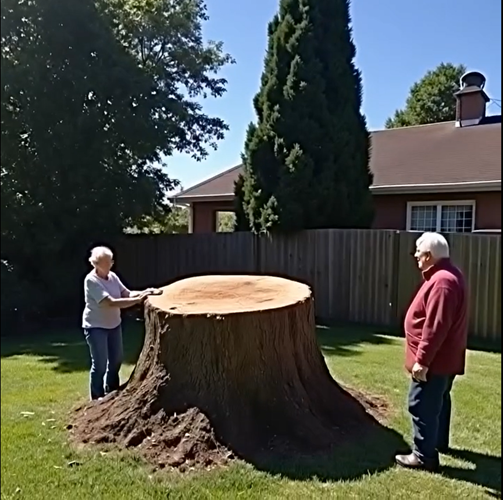
After coming back from our trip, we noticed something strange—one of our ancient trees was gone, and the truth behind it shocked us…


The morning sun rose over the harbor exactly as it had for generations.
Fishing boats rocked gently against the docks. Seagulls circled overhead, their cries mixing with the rhythmic crash of waves against the shoreline. Along the waterfront, shop owners unlocked their doors, swept their sidewalks, and prepared for another ordinary day in a town where life had always moved at its own steady pace.
For most people, it was just another morning.
For the Carter family, it felt like the beginning of a storm.
The Harbor Café sat near the edge of the waterfront, its weathered wooden sign swaying softly in the breeze. The building wasn’t impressive by modern standards. The paint had faded over the years. The floors creaked. The tables carried scratches left behind by thousands of customers.
But to the people of the town, it was irreplaceable.
Every corner held memories.
Fishermen gathered there before sunrise for coffee and conversation.
Tourists returned year after year for homemade pies and fresh seafood chowder.
Retired locals spent entire afternoons discussing weather forecasts, fishing conditions, and stories that seemed to grow larger with every retelling.
The café wasn’t just a business.
It was part of the town’s identity.
And nobody understood that better than Margaret Carter.
At seventy-two years old, she still arrived before dawn every morning.
She brewed the first pot of coffee.
Turned on the lights.
Opened the front door.
The routine had remained unchanged for more than twenty years.
Her late husband had built the café with his own hands.
Every beam.
Every window.
Every table.
Together, they had transformed a struggling waterfront building into the heart of the community.
Even after his passing, Margaret continued running the business.
Not because it made her wealthy.
Because it kept his memory alive.
One afternoon, that routine was interrupted.
A black luxury SUV parked outside the café.
Several people in business suits stepped out.
Margaret immediately knew they weren’t tourists.
They looked around carefully before entering.
One of them introduced himself as Daniel Prescott.
A representative from Coastal Horizon Development.
The name had already become familiar throughout town.
For months, rumors had circulated about a massive redevelopment project planned for the waterfront.
New restaurants.
Boutique shops.
Luxury apartments.
Entertainment venues.
To some residents, it sounded exciting.
To others, it sounded like the end of everything they loved.
Daniel ordered coffee.
Made polite conversation.
Then eventually came to the real reason for his visit.
“We’d like to discuss your property.”
Margaret’s smile faded slightly.
The conversation she had been expecting had finally arrived.
Over the following weeks, similar meetings occurred throughout the waterfront district.
Developers approached business owners.
Property assessments were conducted.
Offers were discussed.
Some owners listened eagerly.
Others refused immediately.
The town slowly divided into two camps.
Those who saw opportunity.
And those who feared loss.
The Carter family found themselves trapped somewhere in the middle.
Margaret wanted to preserve the café.
Her son David understood why.
But he also understood numbers.
Business costs were rising.
Property taxes had increased significantly.
Maintenance expenses continued growing.
The café still survived, but barely.
One evening, after closing, the family gathered around a corner table.
The same table where countless decisions had been made over the years.
“We need to be realistic,” David said carefully.
Margaret stared out the window toward the harbor.
“We built this place.”
“I know.”
“Your father built this place.”
“I know that too.”
The silence that followed was heavy.
David wasn’t arguing against the café.
He loved it as much as anyone.
But he also worried about the future.
His daughter Emily, recently graduated from college, sat quietly listening.
She understood both sides.
Her grandmother saw history.
Her father saw sustainability.
Neither was wrong.
That was what made the decision so painful.
Weeks later, the developers returned with a formal offer.
The proposal was substantial.
Financial compensation.
Relocation assistance.
Support for reopening elsewhere in town.
Legal protections.
Transition planning.
Everything was carefully prepared.
Daniel Prescott placed the documents on the table.
“We want this to benefit everyone.”
Margaret studied the papers.
For a long time, she said nothing.
Then she looked up.
“Do you understand what you’re buying?”
Daniel seemed surprised.
“The property.”
Margaret slowly shook her head.
“No.”
Her eyes moved toward the café around them.
“The property is just wood and concrete.”
She pointed toward the front window.
“What’s outside that window matters.”
Then toward the kitchen.
“So does what’s happened in here.”
Finally, toward the customers filling nearby tables.
“And so do they.”
Daniel followed her gaze.
For the first time, he seemed to understand.
The offer wasn’t simply about land.
It was about identity.
Community.
History.
Things that couldn’t easily be assigned a monetary value.
The negotiations continued.
Lawyers became involved.
Independent property evaluations were conducted.
Town meetings grew increasingly crowded.
Residents voiced concerns.
Arguments emerged.
Passions flared.
Some believed redevelopment would save the local economy.
Others feared it would erase the town’s character forever.
Neither side completely trusted the other.
Yet amid the conflict, something unexpected happened.
The Carter family began documenting the café’s history.
Old photographs emerged from storage boxes.
Newspaper clippings.
Handwritten recipes.
Customer letters.
Stories collected over decades.
People contributed memories.
One woman shared a photograph of her parents’ first date at the café.
A fisherman described how Margaret’s husband had helped him during a difficult winter.
An elderly man recalled celebrating every birthday there for nearly twenty years.
The collection grew rapidly.
What began as preparation for a possible goodbye became something larger.
A record of community itself.
One evening, Emily stayed late organizing photographs.
As she sorted through boxes, a realization struck her.
The future didn’t necessarily require abandoning the past.
Maybe preservation and progress weren’t enemies.
Maybe they simply needed better communication.
The next morning, she shared an idea.
What if the new development incorporated the café’s history?
What if relocation didn’t mean disappearance?
What if the Carter story remained part of the waterfront’s future?
At first, everyone dismissed the idea.
Then they considered it.
Then discussions began.
Slowly, attitudes shifted.
Developers listened.
Town leaders participated.
New proposals emerged.
Compromises formed.
Months later, a revised agreement was reached.
The original café property would become part of the waterfront redesign.
But the Carter family would receive a prominent new location nearby.
The new café would preserve original design elements, photographs, recipes, and historical displays documenting its legacy.
The business would continue.
The history would remain visible.
The waterfront would evolve.
Not everyone was completely satisfied.
Change rarely produces universal happiness.
But for the first time, most people felt heard.
The final day in the original building arrived sooner than anyone expected.
Customers filled every table.
Stories flowed endlessly.
Photographs were taken.
Tears were shed.
Laughter echoed through the rooms.
Margaret stood quietly near the counter.
Watching.
Remembering.
As evening approached, the crowd slowly dispersed.
Eventually, only family remained.
The harbor outside glowed beneath the setting sun.
Margaret walked through the empty café one final time.
Touching tables.
Running her hand along familiar walls.
Pausing beside old photographs.
When she reached the front door, she stopped.
David stood beside her.
“You okay?”
Margaret smiled.
Not sadly.
Not happily.
Something in between.
“This place gave us a good life.”
David nodded.
“Yes, it did.”
She looked one last time at the room.
Then turned toward the future.
The next chapter wouldn’t look the same.
But perhaps it wasn’t supposed to.
Because resilience isn’t about refusing change.
It’s about carrying forward what matters most.
Months later, the new Harbor Café opened.
Customers returned.
Old photographs lined the walls.
The original recipes remained unchanged.
The conversations continued.
And through the large windows overlooking the water, the harbor still greeted every morning exactly as it always had.
The Carter family’s journey became more than a story about business or property.
It became a reminder that communities are not defined by buildings alone.
They are defined by people.
By memories.
By shared experiences passed from one generation to the next.
And sometimes the strongest foundations aren’t made of concrete at all.
They’re built from the stories people refuse to let disappear.