Dad who won battle to give baby ‘banned name’ responds to registrar’s threat that ‘nobody would ever hire him’

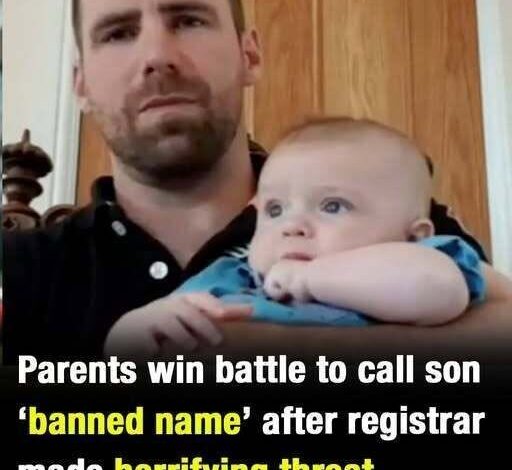
For Dan and Mandy Sheldon, it should have been one of the happiest errands of their lives.
Just days earlier, they had welcomed their newborn son into the world. Like many new parents, they were exhausted, emotional, and still adjusting to the miracle that had suddenly transformed their lives. Every tiny movement their baby made felt extraordinary. Every glance reminded them that the child they had imagined for months was finally here.
Now they had come to complete one of the final steps of that journey: making his name official.
It seemed simple enough.
They had chosen the name long before their son was born.
They had discussed it endlessly.
They had imagined calling it across playgrounds, writing it on birthday cards, and watching it grow with him through every stage of life.
The name was Lucifer.
To them, it was beautiful.
Not because they wanted attention.
Not because they were trying to provoke anyone.
And certainly not because they wished to burden their child.
They chose it because of what they believed it originally meant: “light-bringer.”
A name connected to brightness, illumination, and new beginnings.
When they looked at their son, they saw possibility.
Hope.
A new life filled with promise.
The name felt perfect.
Then they walked into the registry office.
What they expected to be a routine administrative appointment quickly became something else entirely.
The registrar paused when she heard the name.
The atmosphere changed.
Questions followed.
Expressions hardened.
Suddenly, what Dan and Mandy viewed as a thoughtful and meaningful choice was being viewed through a completely different lens.
Where they saw symbolism, the registrar saw controversy.
Where they saw beauty, she saw potential harm.
The name carried centuries of religious and cultural associations that, for many people, immediately evoke images of evil, temptation, and darkness. To the registrar, those associations could not simply be ignored.
Her concern wasn’t about the parents.
It was about the child.
She worried about what the future might hold.
School classrooms.
Job interviews.
Friendships.
First impressions.
Would the boy spend his life defending his name?
Would he face ridicule?
Would people make assumptions before ever getting to know him?
From her perspective, those were legitimate concerns.
But from the parents’ perspective, something entirely different was happening.
Instead of celebrating their new son, they felt they were being judged.
Instead of receiving congratulations, they found themselves defending a decision made with love and care.
The conversation became increasingly uncomfortable.
The name they had carefully selected was no longer the focus.
Their judgment as parents had become the subject of scrutiny.
Dan and Mandy later described feeling as though they were being treated as irresponsible.
As though the name itself had become evidence against them.
What should have been a joyful memory was slowly turning into a painful one.
And that was what hurt most.
Not disagreement.
Not debate.
But the feeling that their intentions had been misunderstood.
The conflict revealed a deeper question that extends far beyond one family or one unusual name.
Who gets to decide what a name means?
Parents?
Society?
History?
Or the person who eventually grows up carrying it?
For centuries, names have carried cultural baggage.
Some evoke admiration.
Others spark controversy.
A single word can mean one thing to one person and something entirely different to another.
That was precisely the problem standing between the registrar and the parents.
Both believed they were acting in the child’s best interest.
Neither viewed themselves as the villain.
The registrar believed she was protecting a vulnerable child from a lifetime of potential judgment.
Dan and Mandy believed they were defending their right to give their son a name they genuinely loved.
Both arguments came from concern.
Both came from conviction.
And neither side was willing to surrender easily.
Eventually, however, the law settled the matter.
There were no legal grounds to reject the name.
The registration proceeded.
The paperwork was completed.
Officially, the parents got what they wanted.
Their son became Lucifer Sheldon.
Yet victory did not feel quite like victory.
The documents were signed.
The process was finished.
But the emotional damage lingered.
Instead of leaving the office with the warm memory of naming their child, they left feeling embarrassed and hurt.
The moment they had imagined celebrating had become something they wished had never happened.
When the story became public, it spread rapidly.
Almost immediately, people divided into opposing camps.
Some passionately defended the parents.
They argued that names evolve over time.
That meanings change.
That parents should have the freedom to choose names that feel meaningful to them, even if others find those choices unusual.
To them, the controversy revealed how quickly people judge anything that falls outside social norms.
Others sided with the registrar.
They argued that a child’s name is more than a personal expression.
It is something carried into classrooms, workplaces, relationships, and every interaction throughout life.
A parent may love a name, they argued, but the child must live with its consequences.
To them, the concern wasn’t about limiting freedom.
It was about considering reality.
Years later, people still debate who was right.
The registrar who worried about future hardship.
Or the parents who insisted the name represented light rather than darkness.
Perhaps the reason the story continues to resonate is because there is no easy answer.
Names are deeply personal.
Yet they also exist in a public world.
Parents choose them.
Children inherit them.
Society reacts to them.
Every name carries a story, whether that story is celebrated, misunderstood, or contested.
For Dan and Mandy, however, the debate remains far simpler than the arguments surrounding it.
When they first looked at their newborn son, they weren’t thinking about controversy.
They weren’t thinking about headlines.
They weren’t thinking about religious symbolism or public opinion.
They were thinking about a tiny child they already loved beyond words.
They chose the name that felt right in that moment.
A name they believed represented light, hope, and a new beginning.
Others may continue to hear something different.
But when they hear their son’s name, they remember the first time they held him.
And in that memory, there was nothing dark about it at all.
There was only love.