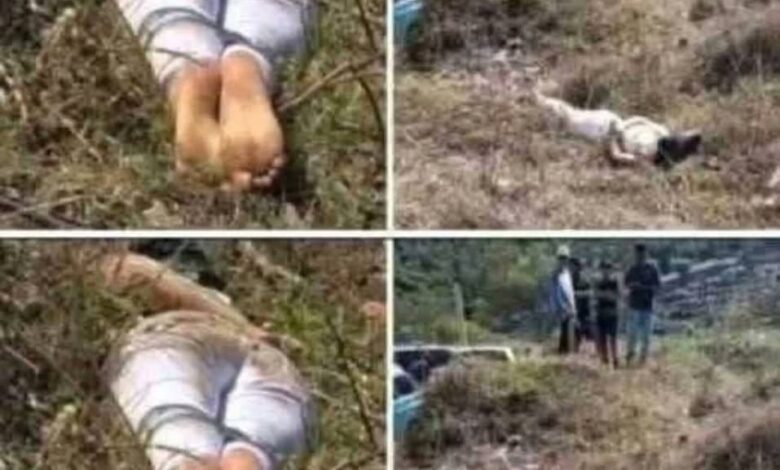
For hours, people walked past the woman lying motionless beside the road.
Some glanced at her.
Others crossed the street.
Cars slowed, then continued on.
Nobody stopped.
From a distance, there seemed to be an obvious explanation. Perhaps she was sleeping. Perhaps she was intoxicated. Perhaps someone had already called for help.
But every assumption was wrong.
She was alive.
And somewhere inside a body too weak to move, she was desperately waiting for one person to realize it.
The morning had begun like countless others. Traffic moved steadily through the neighborhood while pedestrians hurried toward work, stores, appointments, and buses.
Nobody expected an emergency.
That may have been part of the problem.
When people expect danger, they notice it.
When something frightening appears inside an otherwise ordinary scene, the mind often tries to make it ordinary too.
The woman lay near the sidewalk, barely moving.
The first person who noticed her hesitated.
He looked over his shoulder.
Then kept walking.
Another passerby slowed.
She stared for several seconds before continuing toward her destination.
Soon another person passed.
Then another.
With each one came another lost opportunity.
Nobody knew how long the woman had been there.
Nobody knew what had happened to her.
And because nobody stopped long enough to check, nobody realized that she was still breathing.
Inside, however, she remained conscious enough to understand fragments of what was happening around her.
Footsteps.
Engines.
Voices.
Doors opening and closing.
Life continuing only feet away.
She tried to move.
Her body wouldn’t cooperate.
She tried to call out.
Nothing meaningful came.
Imagine the terror of hearing people nearby while being unable to make them understand that you need them.
A pair of shoes enters your field of vision.
Hope rises.
Then the shoes disappear.
Another person approaches.
Another chance.
Another person walks away.
Minutes begin blending together.
You don’t know whether the next stranger will finally stop—or whether there will even be a next stranger.
As the day continued, the woman became part of the scenery.
That sounds cruel.
But it reveals something uncomfortable about human behavior.
When we encounter an ambiguous situation, we search for explanations that allow us to continue with our lives.
She’s probably sleeping.
Someone else must know about her.
Maybe an ambulance has already been called.
I don’t want to interfere.
What if she’s dangerous?
What if I’m misunderstanding the situation?
Each thought can sound reasonable.
Together, they can become deadly.
Then one person did something remarkably simple.
They stopped.
At first, there was nothing heroic about it.
No dramatic rescue.
No special training.
No extraordinary act of bravery.
Just attention.
The stranger looked at the woman more carefully.
Something didn’t feel right.
Instead of trusting the easiest explanation, they moved closer while keeping a safe distance.
“Ma’am?”
No response.
“Can you hear me?”
Still nothing.
But then came the detail everyone else had missed.
A movement.
Small enough to overlook.
A faint breath.
The stranger immediately realized what was happening.
This wasn’t someone peacefully sleeping.
This was a medical emergency.
Emergency services were called.
Suddenly, the same patch of pavement hundreds of people had treated as ordinary became the center of a race against time.
Paramedics arrived.
They checked her breathing and vital signs.
They worked to stabilize her before transporting her for medical care.
The woman who had appeared lifeless only minutes earlier was now surrounded by people fighting to keep her alive.
And the person who finally stopped stood nearby, shaken by one terrifying thought:
What if I had kept walking too?
The question spread through the community afterward.
People remembered seeing her.
One person recalled passing earlier that morning.
Another remembered noticing her from a car.
Someone else admitted assuming she was intoxicated.
Nobody had intended to hurt her.
That was what made the story so disturbing.
Cruelty wasn’t required.
Indifference wasn’t even necessarily required.
All it took was assumption.
People saw something unusual and created explanations without verifying them.
Then they trusted those explanations enough to walk away.
Psychologists have long described versions of the “bystander effect,” where people can become less likely to intervene when others are present.
Part of the reasoning can be deceptively simple:
If nobody else is reacting, perhaps there isn’t really an emergency.
But imagine everyone thinking the same thing.
One person looks around and sees nobody helping.
So they assume help isn’t necessary.
The next person sees the first walking away.
They make the same assumption.
Soon, collective inaction begins masquerading as evidence that everything is fine.
But sometimes everything is not fine.
Sometimes the person who looks drunk is experiencing dangerously low blood sugar.
Sometimes the person who appears asleep has suffered a stroke.
Sometimes confusion can signal a neurological emergency.
Sometimes someone who has collapsed simply cannot call for help.
And sometimes the person everyone assumes is dead is still alive.
That doesn’t mean people should recklessly place themselves in danger.
Personal safety matters.
You don’t have to physically approach an unknown person when doing so feels unsafe.
You don’t need medical training.
You don’t need to diagnose anything.
But you can pay attention.
You can call emergency services when someone appears unresponsive or seriously distressed.
You can describe what you’re seeing.
You can follow instructions from trained dispatchers.
Sometimes that is enough to start the chain of events that saves someone’s life.
For the woman beside the road, survival did not begin with complicated medical equipment.
It began when one stranger challenged an assumption.
They looked twice.
They asked a question.
They waited for an answer.
And when no answer came, they called for help.
Such a small decision.
Yet consider the alternative.
If that person had been rushing somewhere…
If they had been staring at their phone…
If they’d thought, “Someone else will handle it”…
The ending might have been very different.
That’s why the story stayed with the people who heard it.
It forced them to confront something most of us would rather not consider:
How many things do we stop seeing because everyone around us seems unconcerned?
Cities teach people to filter.
There are too many faces.
Too many noises.
Too many situations demanding attention.
We cannot investigate every unusual thing we encounter.
But there is a difference between respecting our limits and automatically deciding that a vulnerable person isn’t our concern.
Sometimes compassion requires only seconds.
“Are you okay?”
“Do you need help?”
“Can you hear me?”
And if someone appears unconscious, seriously injured, or unable to respond, getting professional help may matter far more than trying to determine the cause yourself.
The stranger who finally stopped didn’t know the woman’s story.
Didn’t know her name.
Didn’t know where she’d come from or why she was lying there.
None of that mattered.
For those few minutes, she wasn’t a stranger to categorize.
She was simply a human being who might need help.
That was enough.
Later, as the ambulance disappeared down the street, normal life gradually returned.
Traffic resumed.
People continued walking.
Businesses stayed open.
From the outside, the neighborhood looked exactly as it had before.
But for at least a few people, something had changed.
They had learned how frighteningly easy it is to look directly at someone without truly seeing them.
The woman had been visible all along.
What had been missing was attention.
Her survival became a reminder that emergencies don’t always announce themselves with screaming, blood, or dramatic cries for help.
Sometimes an emergency is silent.
Sometimes the person who needs you cannot wave.
Cannot shout.
Cannot explain.
They can only wait.
Wait for someone to notice the unusual stillness.
Wait for someone to question the convenient explanation.
Wait for someone to care enough to stop.
And that’s perhaps the most important part of what happened that day.
The person who made the difference wasn’t necessarily the strongest person who passed.
Or the smartest.
Or the most qualified.
They were simply the person who refused to assume.
Hundreds of footsteps may pass someone in need.
It only takes one pair to stop.
One person to look again.
One person to make the call.
One person to ask:
“Are you okay?”
Because sometimes silence doesn’t mean someone is beyond saving.
Sometimes it means they’re still there.
Still breathing.
Still fighting.
Still hoping that somewhere among all those passing faces, one person will finally see them.