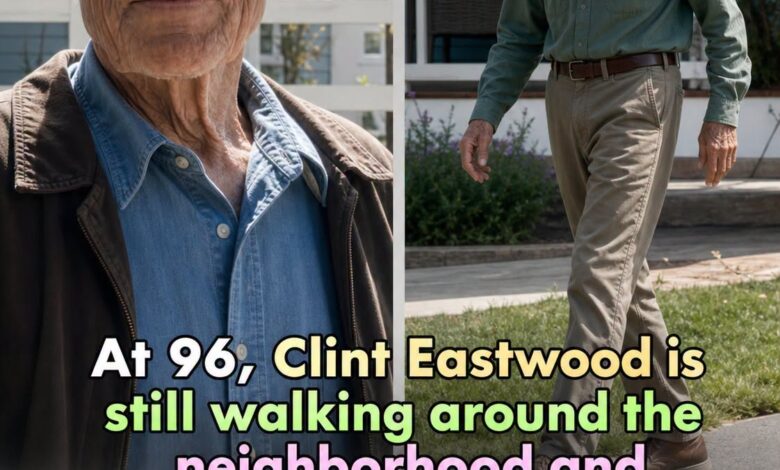
At 96, Clint Eastwood still walks around the neighborhood and shows no sign of giving up or intending to play the part of a retiree..

Clint Eastwood never seemed particularly interested in becoming a monument.
That may be one of the strangest things about his extraordinary longevity.
Hollywood loves monuments. It loves anniversaries, lifetime-achievement reels, career retrospectives, standing ovations, and carefully polished stories about legacy. After enough decades, a famous person is almost expected to stop creating and begin explaining what all the creating meant.
Eastwood largely chose something simpler.
He kept working.
Not frantically.
Not as though another movie could somehow prove what dozens of previous films had failed to establish.
He simply continued.
Actor.
Director.
Producer.
Composer.
Storyteller.
A man who spent much of his career appearing to conserve every unnecessary movement seemed to approach aging the same way: less announcement, more action.
That attitude makes sense when you consider how uncertain his beginning actually was.
Eastwood wasn’t born into Hollywood royalty. His rise wasn’t a clean progression from gifted newcomer to inevitable star. Before international fame, there were small parts, television work, rejection, and the long apprenticeship familiar to performers whose eventual success makes their early uncertainty easy to forget.
Then came Rawhide.
Then Sergio Leone.
The Westerns transformed Eastwood’s restraint into mythology.
The squint.
The silence.
The economical movement.
The sense that his characters were thinking more than they were saying.
Later came Dirty Harry Callahan, another role that permanently attached Eastwood to a particular kind of American masculinity.
He could easily have spent the rest of his career repeating it.
Hollywood would have paid him to.
Instead, the actor increasingly moved behind the camera.
That may be the most revealing turn in his career.
Directing required a different kind of authority.
Less posing.
More observing.
Less concern with being the center of every frame.
More responsibility for everything surrounding it.
Across the decades, films such as Unforgiven, Mystic River, Million Dollar Baby, Letters from Iwo Jima, Gran Torino, and others complicated the image audiences thought they understood.
The invincible gunslinger aged.
Violence acquired consequences.
Certainty became less certain.
Heroes became damaged.
Sometimes the strongest character in an Eastwood film wasn’t the person who could dominate a room.
It was the person forced to live with what happened afterward.
Perhaps that’s why his later career has felt so unusual.
He didn’t simply grow older while continuing to make movies.
Age itself became part of the material.
Hollywood generally treats aging as something to conceal, correct, soften, or apologize for.
Eastwood often seemed willing to let it remain visible.
The slower walk could stay.
The weathered face could stay.
The vulnerability could stay.
Aging didn’t have to be edited into youthfulness to remain cinematic.
And he kept returning to work long after conventional career logic said he had nothing left to prove.
That phrase—nothing left to prove—sounds flattering.
But it can also become a comfortable prison.
It suggests that once you’ve accumulated enough success, curiosity should retire.
Eastwood seemed uninterested in that bargain.
His working habits became part of his legend: preparation, efficiency, relatively few takes when he believed he had what he needed, and a preference for avoiding unnecessary fuss.
There is something almost anti-Hollywood about the image.
Arrive.
Know what you’re doing.
Do the work.
Move on.
That doesn’t mean his life or career has been simple.
It hasn’t.
Eastwood’s personal history is complicated, including multiple relationships and a large family. His films and public positions have inspired admiration, criticism, argument, and reevaluation across generations.
Longevity does not automatically equal sainthood.
Nor should it.
Turning an accomplished person into a flawless symbol usually makes the story less interesting, not more.
Eastwood’s appeal has often existed precisely in the contradictions.
Individualism paired with collaboration.
Minimalism inside an enormous industry.
A screen image built on toughness alongside films increasingly interested in regret, mortality, and consequence.
Even the mythology surrounding his wealth demonstrates how easily celebrity stories become detached from evidence.
Claims periodically circulate online suggesting that Eastwood plans to give away everything he owns or has already arranged some sweeping charitable disposal of his fortune.
Such stories should be treated cautiously unless supported by reliable reporting or documentation.
But perhaps the fascination with them reveals something.
People want the final chapter to contain a grand gesture.
A fortune surrendered.
A perfect quotation.
A dramatic announcement explaining what the entire life meant.
Eastwood’s career suggests that the answer may be less theatrical.
The work is the statement.
Film after film.
Year after year.
Decade after decade.
There is a particular dignity in continuing to learn after you’ve already become an expert in everyone else’s eyes.
That may be the wealth worth noticing.
Not the estimated value of houses, investments, residuals, or decades of filmmaking.
Not the number attached to an estate.
Those things are real, but they are poor measurements of a life.
A more interesting measure is whether success made someone static.
Eastwood could have become trapped inside his own mythology.
He could have spent decades recreating the Man with No Name.
Instead, he directed love stories, war films, crime dramas, biographies, tragedies, and meditations on aging.
Some succeeded magnificently.
Others divided critics or audiences.
That’s part of continuing.
If you’re still genuinely working, you’re still capable of making something imperfect.
A monument doesn’t risk failure.
A working artist does.
That distinction matters.
Our culture is obsessed with legacy because legacy gives us the comforting illusion that a life can eventually be summarized.
Best films.
Awards.
Net worth.
Children.
Famous quotations.
Final wishes.
Put everything into categories, total the numbers, and perhaps we can determine whether someone “won.”
But lives resist scoreboards.
Eastwood’s certainly does.
His most famous performances belong to different generations.
Someone remembers the Westerns.
Someone else remembers Dirty Harry.
Another generation discovered Unforgiven.
Another knows Million Dollar Baby or Gran Torino.
The remarkable thing isn’t simply that Eastwood remained famous.
It’s that he repeatedly refused to exist only as a memory of himself.
That may be the deeper meaning of aging “his way.”
Not defiance for its own sake.
Not pretending time doesn’t matter.
Quite the opposite.
Time matters enormously.
That’s why you use it.
You wake up.
You arrive.
You tell another story.
You remain curious enough to risk doing something that doesn’t merely repeat your greatest success.
Eventually, every career ends.
Every filmmaker reaches a final frame.
No amount of discipline negotiates an exemption from mortality.
But there is a difference between preparing to become a monument and continuing to participate in your own life.
Eastwood’s long career has repeatedly leaned toward participation.
Maybe that’s why the rumors about giving everything away feel almost beside the point.
Whatever eventually happens to the money cannot summarize the man.
The films will remain.
So will the arguments about them.
So will the contradictions.
So will images of that unmistakable face aging across more than half a century of cinema.
But perhaps his clearest statement was never delivered in dialogue.
It was made every time the world suggested he’d already done enough and he returned to work anyway.
No grand declaration.
No demand that everyone admire the legacy.
Just another morning, another set, another story still worth attempting.
Clint Eastwood spent decades playing men who seemed to need nobody’s permission.
In the end, he appears to have applied the same rule to growing old.
He didn’t ask how a legend was supposed to retire.
He simply kept moving.