The first sign of trouble was not what people saw.
It was what they heard.
A deep, unnatural groan rose from beneath the highway, vibrating through steering wheels, tires, and concrete. Drivers later described it as a sound that seemed to come from the earth itself—a heavy, straining noise that instantly triggered something primal inside them.
Before anyone could fully understand what was happening, the road began to move.
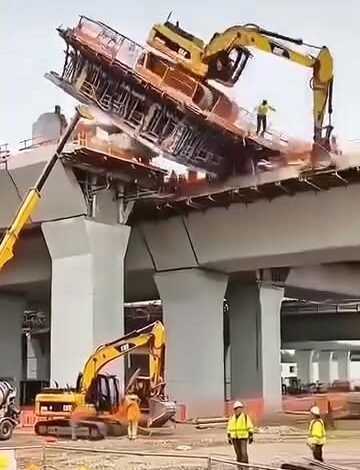
What had been an ordinary stretch of highway only moments earlier suddenly seemed alive beneath the wheels of hundreds of vehicles. The pavement buckled. Concrete cracked open. Guardrails twisted under impossible pressure.
Then the collapse began.
One moment people were thinking about work, errands, appointments, and the routine concerns of everyday life.
The next, they were fighting to survive.
Drivers slammed on their brakes as sections of roadway shifted beneath them. Tires screeched across the pavement. Vehicles swerved violently from lane to lane as people desperately searched for a path to safety.
Confusion spread almost instantly.
No one expects the road itself to disappear.
Mechanical failures happen.
Traffic accidents happen.
Bad weather happens.
But roads are supposed to be permanent.
Reliable.
Solid.
People trust them without thinking.
That trust shattered in seconds.
Witnesses later recalled watching cracks race across the surface like lightning. What began as thin fractures quickly widened into jagged breaks. Entire sections of asphalt started sinking and separating as the structure beneath them failed.
The scene unfolded so quickly that many drivers had little time to react.
Some accelerated, hoping to clear the danger before it reached them.
Others instinctively hit the brakes.
Several later admitted they were not even sure why they chose one action over the other.
Fear made the decision for them.
One survivor remembered glancing into the rearview mirror after crossing what would become the collapse zone.
The image never left them.
Behind their vehicle, the highway was gone.
Not damaged.
Not partially blocked.
Gone.
Concrete slabs plunged downward into a rising cloud of dust and debris. Metal supports twisted and snapped. Chunks of roadway that had carried thousands of vehicles suddenly vanished into destruction.
The driver had escaped by only seconds.
A few moments later, they would have been part of the collapse.
That realization would haunt them long after the dust settled.
Across the scene, panic erupted.
Car horns blared continuously.
Drivers abandoned vehicles.
Passengers climbed over barriers.
Some ran away from the danger as quickly as possible.
Others moved toward it.
Those who rushed forward were not thinking about heroism.
They were thinking about the people who might still be trapped.
The possibility that someone needed help.
The possibility that someone was injured.
The possibility that every second mattered.
In moments of disaster, ordinary people often reveal extraordinary courage.
Strangers called out to one another.
People checked vehicles.
Others searched for survivors.
Many had no idea whether additional sections of roadway might collapse beneath them.
They helped anyway.
Because sometimes instinct is stronger than fear.
For those who lived through the disaster, the experience created an immediate and unsettling connection to past tragedies.
Many survivors referenced the Interstate 35W bridge collapse, when a routine summer evening suddenly transformed into catastrophe.
That event had already become a symbol of infrastructure failure in America.
Now, standing beside another shattered roadway, many found themselves confronting the same uncomfortable question:
How could something so important fail so suddenly?
The question lingered long after emergency crews arrived.
Long after investigators secured the scene.
Long after headlines spread across television screens and social media feeds.
Because beneath the immediate shock was something deeper.
A sense of betrayal.
People place enormous trust in infrastructure.
Every day, millions drive across bridges, overpasses, tunnels, and highways without giving them a second thought.
Few people inspect the concrete beneath their tires.
Few examine support beams overhead.
Few question whether the road will still exist when they reach the other side.
They simply trust.
That trust is essential.
Modern life depends on it.
But when infrastructure fails, that confidence can disappear instantly.
For survivors, gratitude and anger often arrived together.
They were grateful to be alive.
Grateful their families would see them again.
Grateful they had escaped what could easily have become a mass casualty event.
At the same time, many struggled with frustration.
Questions emerged almost immediately.
Could the collapse have been prevented?
Were warning signs missed?
Had inspections identified problems?
Had repairs been delayed?
Was this simply an unavoidable failure—or the result of decisions made years earlier?
Investigators began searching for answers.
Engineers examined debris.
Officials reviewed maintenance records.
Experts analyzed structural conditions and timelines.
Every fractured beam and broken slab became part of a larger effort to understand what had happened.
But for many people, the technical explanations only told part of the story.
The emotional impact proved harder to measure.
Some survivors reported difficulty driving afterward.
Others became hyperaware of bridges and overpasses they had crossed countless times before.
Suddenly, familiar routes felt different.
Ordinary commutes carried new anxiety.
The confidence they once took for granted had been replaced by uncertainty.
A highway collapse does more than damage concrete.
It damages assumptions.
The assumption that routine means safe.
The assumption that what worked yesterday will work tomorrow.
The assumption that critical infrastructure will always hold.
Those assumptions are rarely questioned until something breaks.
Then everyone notices.
The disaster also reignited a broader national conversation about aging infrastructure.
Across the country, countless bridges, highways, tunnels, and transportation systems were built decades ago.
Many continue carrying traffic far beyond what their original designers anticipated.
Years of weather, heavy use, environmental stress, and gradual deterioration place enormous pressure on structures that often receive little public attention until something goes wrong.
Maintenance is rarely exciting.
Inspection reports rarely make headlines.
Preventative repairs rarely generate public celebration.
Yet these quiet, often invisible efforts are what keep roads standing and communities connected.
When they are delayed, ignored, or underfunded, risks can accumulate slowly over time.
Sometimes for years.
Sometimes for decades.
Then one day, without warning, the consequences become impossible to ignore.
For those who witnessed the collapse firsthand, the disaster became more than a news story.
It became a permanent memory.
A dividing line between before and after.
Before the road gave way.
Before the panic.
Before the dust cloud.
Before the realization that an ordinary drive could transform into a survival story within seconds.
Many survivors still remember small details.
The sound.
The vibration beneath the wheels.
The sudden silence after the collapse.
The faces of strangers helping one another.
The overwhelming relief of standing safely on solid ground.
And perhaps most vividly, the understanding of how quickly life can change.
Because the frightening truth is that no one began that day expecting disaster.
People were heading to work.
Going home.
Running errands.
Planning dinners.
Thinking about weekends.
Living ordinary lives.
Then the ground beneath them failed.
That reality is what makes infrastructure disasters so unsettling.
They strike at places people trust most.
Roads.
Bridges.
Highways.
The systems woven into daily life so completely that they become almost invisible.
Until they fail.
Then everyone sees them.
The collapse serves as a powerful reminder that infrastructure is not merely concrete, steel, and engineering.
It is safety.
It is trust.
It is the foundation beneath countless ordinary moments.
When that foundation weakens, the consequences extend far beyond transportation.
They reach into communities.
Families.
Memories.
Lives.
In the end, survivors carried away more than stories of fear.
They carried a renewed awareness of how fragile certainty can be.
How quickly normal can become extraordinary.
And how a routine drive on a familiar road can become a life-changing experience in the span of a few terrifying seconds.
Because sometimes the greatest danger is not what people expect.
It is what they never imagined could happen at all.