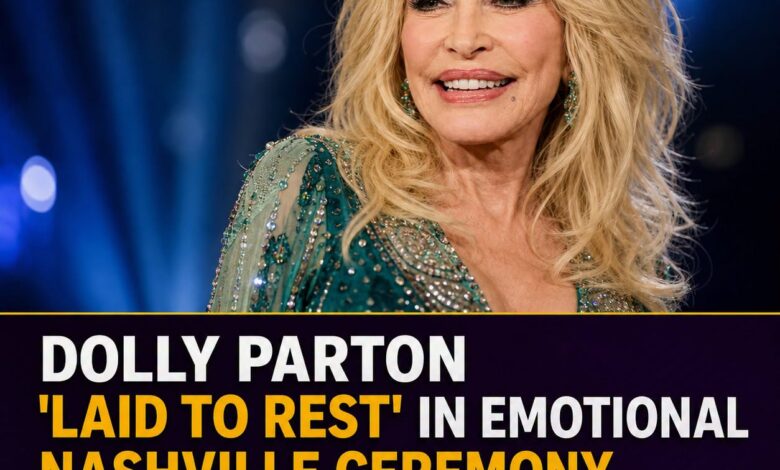
They gathered quietly in Nashville.
No red carpet.
No roaring crowd.
No wall of cameras waiting to capture one final image of the woman who had spent a lifetime knowing exactly how to face them.
This time, Dolly Parton belonged only to the people who had known her without the spotlight.
Family.
Old friends.
The small circle who understood that beneath the rhinestones, towering hair, famous laugh, and songs known around the world was a woman they had simply loved.
And when Dolly was laid to rest beside her beloved husband, Carl Dean, the symbolism was almost impossible to miss.
After everything—the records, the stages, Dollywood, Hollywood, awards, tours, businesses, books, and decades of international fame—her journey ended where so much of her identity had begun.
Tennessee soil.
Beside Carl.
The man who had spent most of their marriage deliberately outside the glare that followed his wife everywhere else.
Their love story had always seemed almost improbable.
Dolly belonged to millions of people in a public sense.
Carl wanted almost none of that world.
He rarely appeared beside her at celebrity events. He did not build an identity from being Mr. Dolly Parton. While she traveled, performed, recorded, and became one of the most recognizable women alive, he protected a quieter life.
And somehow, they made those two worlds fit.
Dolly could belong to the stage without surrendering the part of herself that belonged at home.
Now, in the final stillness, they were together again.
But inside the funeral, another love story was being remembered.
Not romantic love.
Family love.
The kind that rarely appears in biographies because it happens in kitchens, backstage hallways, telephone calls, family gatherings, and private conversations.
Dolly never had children of her own.
That fact inspired endless public curiosity over the years.
People asked whether she regretted it.
Whether fame had required too much.
Whether motherhood was the one role she had somehow missed.
But the people inside Dolly’s family knew the story was more complicated.
There had always been children around her.
Nieces.
Nephews.
Godchildren.
Young relatives who did not experience Dolly primarily as an international superstar.
To them, she could be something much simpler.
And much more intimate.
“Aunt Granny.”
That was the Dolly her niece Lainey Mae Parton remembered as she prepared to speak.
For days, words had apparently been difficult.
How do you summarize someone who occupied so much space in your life?
How do you explain the difference between the woman the world mourns and the woman whose phone calls you still expect?
Public grief has facts.
Private grief has habits.
A voice you expect to hear.
A chair you expect to see occupied.
A joke you instinctively want to tell someone before remembering they are no longer there.
Lainey did not need to explain Dolly Parton the icon.
Everyone already knew her.
Instead, she spoke about Aunt Granny.
The woman who treated the dreams of the children around her as though those dreams deserved serious consideration.
That was one of Dolly’s gifts.
She knew how enormous a dream could feel when you were young.
She had been that child once.
A little girl in the Tennessee mountains with almost nothing material surrounding her and an imagination too large for the circumstances she had been born into.
She had dreamed before there was evidence that the dream made sense.
Perhaps that was why she never laughed when younger relatives dreamed boldly.
She understood that the world would provide enough doubt on its own.
Family did not need to add more.
If someone wanted to sing, Dolly listened.
If someone wanted to create, she encouraged them.
If someone was frightened, she did not necessarily pretend the fear was foolish.
She simply made it feel temporary.
That distinction mattered.
Fear could be real without becoming permanent.
Failure could hurt without becoming identity.
A closed door could disappoint you without proving that every door would remain closed.
Dolly had lived those lessons herself.
Then she passed them down.
Not as lectures.
As encouragement.
Lainey’s memories were not built around trophies.
They were built around warmth.
Laughter.
Music shared from the side of a stage.
Those strange backstage moments where the public Dolly might be only feet away, dazzling thousands, while the private Dolly could return moments later.
Imagine growing up with that transformation.
Aunt Granny walks toward the stage.
The audience erupts.
For the next hour, she seems larger than life.
Then she steps back behind the curtain and becomes family again.
That may have taught the children around her something the public could easily forget.
Fame was something Dolly did.
Love was something Dolly gave.
The two could overlap, but they were not the same.
That became especially clear at her funeral.
Outside that room, people could measure Dolly’s life through achievements.
Songs written.
Albums sold.
Awards received.
Businesses created.
Books mailed to children.
Generations influenced.
Inside the room, nobody needed statistics.
They knew the sound of her laugh without a microphone.
They knew what it felt like when she remembered something important about them.
They knew the version of Dolly who did not need an introduction.
And perhaps that is why Lainey’s memories carried such weight.
She reportedly struggled to find bad ones.
Not because Dolly was perfect.
No human being is.
But because what remained strongest was how Dolly made people feel.
Safe enough to dream.
Important enough to be heard.
Loved without needing to accomplish anything first.
For someone who never became a mother in the traditional sense, Dolly seemed to have found countless places for maternal love to go.
That affection did not disappear simply because she had no sons or daughters of her own.
It expanded sideways.
Into nieces and nephews.
Into godchildren.
Into younger performers.
Into children receiving books through her literacy work.
Into generations of people she would never meet.
Perhaps “Aunt Granny” captured that better than any formal title could.
It was playful.
Affectionate.
Slightly ridiculous.
Very Dolly.
And completely removed from celebrity.
Nobody wins an award for being Aunt Granny.
There is no chart position for making a frightened child feel brave.
No trophy for remembering someone’s dream years after they first told you about it.
Those are quieter achievements.
They disappear unless the people who received them carry them forward.
At the funeral, they did.
As Lainey spoke, the distance between the public legend and private woman seemed to narrow.
The world had Dolly Parton.
The family had Aunt Granny.
Both were real.
One wore rhinestones beneath stage lights.
The other stood beside young relatives and convinced them that their futures were bigger than their fears.
And maybe those two women were not so different after all.
Dolly had spent her entire career doing something similar for strangers.
She made people believe.
Believe heartbreak could be survived.
Believe poverty did not have to determine destiny.
Believe humor could coexist with pain.
Believe you could be underestimated and still become impossible to ignore.
The encouragement she gave privately was simply the smallest, most intimate version of what she had been giving publicly for decades.
Then came the hymn.
There are moments at funerals when language finally becomes inadequate.
People have spoken.
Memories have been shared.
Every sentence that can be offered has already been offered.
And music takes over.
For Dolly, that felt especially appropriate.
Songs had always carried what ordinary speech could not.
Faith.
Longing.
Grief.
Home.
Love.
So as the final hymn filled that private space, the family did not need to explain what they were losing.
They could simply feel it.
The woman who had held so many pieces of the family together was gone.
The aunt.
The sister.
The wife.
The friend.
Aunt Granny.
Outside, the world would continue mourning a legend.
Radio stations would play her songs.
Fans would leave flowers.
Old interviews would circulate.
Photographs would appear everywhere.
People who had never met Dolly would cry because her voice had accompanied some important part of their lives.
That grief was real too.
But inside the family, something quieter was happening.
They were losing the person behind all of it.
And perhaps there was comfort in knowing where she would rest.
Beside Carl.
After years in which his absence had changed the shape of her private world, Dolly’s final resting place placed their names together again.
There would be no touring schedule separating them.
No stage waiting in another city.
No cameras.
No public obligations.
Just stillness.
Tennessee.
Home.
For a woman whose life had become global, there is something profoundly fitting about that return.
Dolly traveled almost everywhere fame could take a person.
But she never stopped carrying the mountains with her.
Her accent remained.
Her stories remained.
Her faith remained.
Her humor remained.
Home was not something she outgrew.
It was something she took with her.
And eventually, something she returned to.
Lainey’s tribute therefore became more than a niece remembering an aunt.
It restored proportion to an enormous life.
Dolly Parton had become so famous that it was easy to imagine her belonging to history.
But before history claimed her, she belonged to people.
People who loved her without buying a ticket.
People who knew her before or beyond the costume.
People who could remember her not because she changed country music, but because she changed the emotional weather in a room.
She made fear feel temporary.
She made dreams feel possible.
She made children believe they were worth listening to.
That is a different kind of legacy.
And unlike fame, it cannot be measured.
When the last hymn faded, there was no applause.
There didn’t need to be.
Dolly had received enough applause for several lifetimes.
This moment belonged to silence.
To family.
To goodbye.
The world could keep the recordings.
The photographs.
The rhinestones.
The songs.
The stories.
The endlessly recognizable image of Dolly Parton standing beneath stage lights and smiling as though she had personally invited everyone in the audience.
But the people gathered there carried something the world could never fully possess.
They carried Aunt Granny.
Her private jokes.
Her encouragement.
Her tenderness.
The sound of her voice when no microphone was nearby.
The memories that would never appear in documentaries because they belonged only to them.
And maybe that was the gentlest ending possible.
Dolly had spent a lifetime giving pieces of herself away.
To music.
To audiences.
To children.
To family.
Yet the most important parts were never contained in the glitter.
They lived in people.
As the family finally walked away, they were not leaving Dolly behind in that Tennessee ground.
They were carrying forward everything she had placed inside them.
The courage to dream.
The instinct to laugh.
The belief that fear eventually passes.
The responsibility to make someone else feel seen.
The world had buried a legend.
But that small circle had said goodbye to something much more precious.
A wife reunited in rest with the man she loved.
An aunt whose affection had filled spaces no spotlight ever reached.
A woman who never had children of her own, yet somehow found countless places to pour a mother’s heart.
The rhinestones belonged to history now.
The songs belonged to everyone.
But Aunt Granny belonged to them.
And long after the final hymn disappeared into the Tennessee air, that was the Dolly they would carry home.