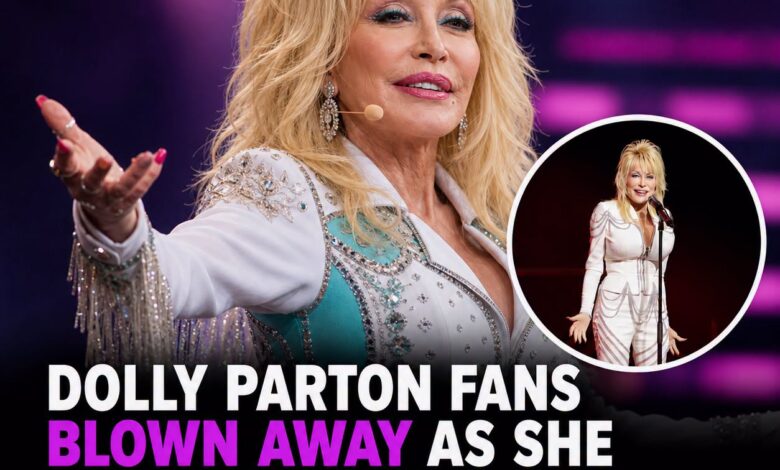
For decades, the world knew exactly what Dolly Parton was supposed to look like.
The towering blonde hair.
The dramatic makeup.
The glittering clothes.
The rhinestones catching every available beam of light.
Her appearance became so recognizable that even a silhouette could announce her before she sang a single note. Dolly didn’t merely have a style. She built a visual language, exaggerated it deliberately, laughed about it openly, and then wore it with such confidence that what might have looked ridiculous on someone else became unmistakably hers.
Then an old photograph resurfaced.
And suddenly, people were staring at a Dolly they barely recognized.
The image, taken in a recording studio in 1965, seemed almost startling in its simplicity. There was no enormous platinum bouffant framing her face. No elaborate stage costume. No explosion of sequins.
Instead, there was a young woman in a simple white sweater.
Her natural hair, considerably more restrained than the famous wigs that would later become part of her identity, was swept back from her face. She leaned toward the microphone with the concentration of someone who had not yet become a global institution.
She was simply Dolly.
Young.
Beautiful.
Ambitious.
And standing at the edge of a future she could not possibly have fully imagined.
The photograph had always been a piece of history.
In mourning, however, it became something more.
It became a doorway.
Fans who had spent their lives seeing the finished creation were suddenly confronted with the young artist underneath it—the woman before the visual mythology became inseparable from the music.
And the reaction was immediate.
People called her gorgeous.
Some said they had never seen her look so natural.
Others admitted they hadn’t realized how striking she was without the towering hair and theatrical styling.
A recurring question appeared beneath the photograph:
Why had Dolly ever thought she needed wigs?
It was meant as a compliment.
But it also misunderstood Dolly.
Because “need” was never really the point.
Dolly Parton’s famous appearance wasn’t created because the woman underneath wasn’t beautiful enough.
It was created because ordinary beauty wasn’t what interested her.
She wanted transformation.
The difference matters.
Dolly had spoken many times about where her exaggerated style came from. As a child growing up poor in East Tennessee, she was fascinated by glamorous women whose appearance other people might have dismissed as excessive.
The brighter the lipstick, the better.
The higher the hair, the more exciting.
The tighter and flashier the clothes, the more glamorous they seemed to her.
Where polite society might have seen “too much,” Dolly saw possibility.
Then, once she had enough control over her own life to decide exactly how she wanted to look, she became gloriously too much herself.
More blonde.
More makeup.
More curves.
More rhinestones.
More hair.
Dolly wasn’t accidentally artificial.
She was intentionally theatrical.
That’s why the 1965 photograph is so revealing.
It proves something fans already knew but rarely had such a clear opportunity to see.
The spectacle was constructed.
The woman wasn’t.
Long before the wigs reached their famous heights, the essential Dolly was already there.
Look at the photograph again.
Forget the hair.
Look at the posture.
The focus.
The microphone.
This was a young woman from Locust Ridge who had already made one of the defining decisions of her life.
After graduating from high school in 1964, Dolly headed for Nashville.
She didn’t wait several years to decide whether music might become a serious career.
The dream had been serious long before graduation.
As a child, she had performed on the porch of her family’s mountain home using a tin can and tobacco stick as a pretend microphone.
Now the microphone was real.
The studio was real.
The stakes were becoming real.
But success wasn’t guaranteed.
That’s easy to forget when looking at old photographs of people who later became legends.
History makes ambition look prophetic.
We know what happens next.
The person inside the photograph doesn’t.
The Dolly captured in 1965 didn’t know that “Jolene” would become one of the most recognizable songs in country music.
She didn’t know that “I Will Always Love You” would travel far beyond its original meaning and eventually become one of the most famous compositions of her career.
She didn’t know about 9 to 5.
She didn’t know about Dollywood.
She didn’t know millions of children would someday receive books because of a literacy program she created.
She didn’t know generations of singers would cite her as an influence.
She certainly didn’t know strangers would one day study a photograph of her standing at a microphone and feel emotional simply because she was young and alive inside it.
She was trying to make it.
That uncertainty gives the photograph its power.
This isn’t Dolly remembering the beginning.
This is Dolly still inside the beginning.
The woman who would eventually control every detail of her public image was still discovering what that image would become.
And hair would become an important part of it.
Dolly’s relationship with wigs was never simply about vanity.
They were practical, certainly. Elaborately styling natural hair every day could be time-consuming and damaging, particularly for a performer whose appearance needed to survive travel, television lights, stage performances, weather, and endless public commitments.
A wig could be prepared in advance.
It could maintain the silhouette audiences expected.
It offered consistency.
But Dolly turned practicality into identity.
The hair got bigger.
Then bigger again.
Eventually it became almost architectural.
People joked about it.
Dolly joked harder.
That was one of her great defensive talents.
She frequently reached the punchline about herself before anyone else could use it against her.
Call her artificial?
She’d tell you how much work went into it.
Make fun of her hair?
She’d make a better joke about it.
Criticize the makeup?
She’d apply more.
The exaggeration became a form of control.
You couldn’t embarrass Dolly Parton by pointing out that Dolly Parton looked like Dolly Parton.
She had already decided that was the point.
And there was something quietly rebellious about that.
Women in entertainment are constantly told how they should age, dress, behave, and present themselves.
Be glamorous, but don’t look like you’re trying.
Be sexy, but not too sexual.
Be youthful, but age gracefully.
Wear makeup, but make it look natural.
Stand out, but don’t become ridiculous.
Dolly rejected the entire negotiation.
She wasn’t interested in convincing anyone that her beauty required no effort.
The effort was part of the fun.
The wig was a wig.
The rhinestones were rhinestones.
The makeup was makeup.
There was no deception because she never pretended otherwise.
That honesty is what makes the newly cherished studio photograph so fascinating.
Seeing Dolly without the familiar armor doesn’t expose some secret truth that invalidates the public image.
It completes it.
Both women were Dolly.
The young singer in the white sweater was real.
So was the superstar beneath the enormous blonde wig.
One wasn’t authentic while the other was fake.
The transformation itself was authentic.
That distinction became especially poignant after her death.
Grief changes photographs.
An image that once inspired curiosity can suddenly become evidence of time passing.
People notice details differently.
The youth in someone’s face becomes almost painful.
A casual expression feels precious because you know how the story ends.
The photograph stops being merely “Dolly before the wigs.”
It becomes a frozen moment when almost everything was still ahead.
That may explain the tenderness in so many reactions.
People weren’t merely discovering that Dolly Parton had beautiful natural hair.
They were seeing vulnerability.
Not weakness.
Possibility.
Here was the woman before the world demanded that she keep being the woman it recognized.
Before every public appearance carried expectations.
Before “Dolly” became both a human being and an institution.
There is something intimate about seeing a famous person before their image hardened into mythology.
It reminds us that legends don’t begin as legends.
They begin uncertain.
Unknown.
Trying.
Dolly’s later appearance could sometimes make her seem almost indestructible.
The hair never fell.
The smile rarely disappeared.
The jokes kept coming.
The rhinestones remained bright.
Even conversations about hardship somehow became funny when she told the story.
But beneath all that theatrical confidence was the same young woman who once stood at a studio microphone hoping someone would listen.
The difference was that eventually almost everyone did.
Perhaps that’s why arguing over whether she looked “better” with natural hair misses the beauty of the photograph.
There is no competition.
The young Dolly didn’t need giant wigs to be beautiful.
The older Dolly didn’t need to abandon them to prove she was beautiful.
She wore them because she wanted to.
That choice became part of the larger lesson of her life.
Dolly Parton rarely allowed other people’s definitions of taste to dictate how much space she occupied.
She could come from poverty and become wealthy without apologizing for enjoying glamour.
She could wear exaggerated makeup while writing songs of extraordinary emotional delicacy.
She could look almost cartoonishly artificial while speaking with remarkable sincerity.
She could be underestimated because of her appearance and then reveal herself as the smartest businessperson in the room.
The contradiction was never a flaw.
It was the design.
The 1965 photograph simply shows us the foundation before the architecture rose around it.
White sweater.
Natural hair.
Microphone.
Dream.
Everything essential was already there.
Years later, Dolly would suggest that separating her famous appearance from herself was nearly impossible.
By then, the wigs weren’t merely accessories.
They carried memories.
They represented the girl who had once looked at glamour from a distance and promised herself that someday she would have as much of it as she wanted.
She kept that promise spectacularly.
And perhaps that’s what fans finally understood while looking at that quiet old photograph after she was gone.
The wigs never made Dolly Parton.
The rhinestones didn’t create her confidence.
The makeup didn’t manufacture the woman underneath.
Those things were expressions of something that had existed long before them.
The courage to imagine herself differently.
The courage to become that person publicly.
And the courage to keep doing it even when people laughed.
In 1965, the world hadn’t yet received the full Dolly Parton spectacle.
There was just a young woman leaning toward a microphone, her own hair swept back, her future still unwritten.
She didn’t need the wig to glow.
Later, she wouldn’t need anyone’s permission to wear one.
And somewhere between those two versions of Dolly lies the secret of why people loved her so deeply:
The hair could change.
The costumes could change.
The entire spectacle could be put on or taken off.
But the woman brave enough to create it had been there from the beginning.