My Daughter Handed Me the Twins in the Hospital Parking Lot and DROVE AWAY — 19 Years Later She Came Back in a White Mercedes, and What My Grandsons Did at the Dinner Table Made Her Drop Her Wine Glass.

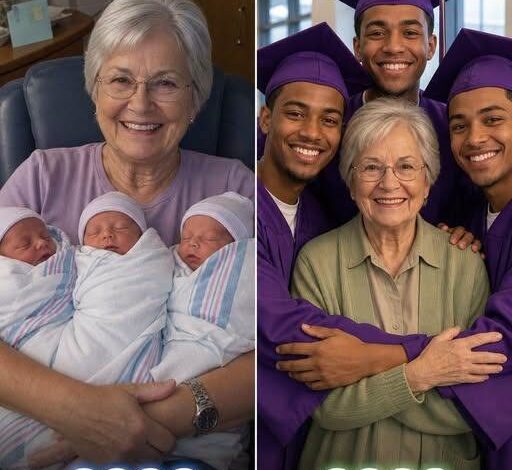
I was fifty-eight years old, nearly broke, and standing in a hospital parking lot when my daughter placed two newborn boys into my arms and drove away.
There was no dramatic goodbye.
No long explanation.
No promise that she would call tomorrow.
Kimberly handed me one baby.
Then the other.
Both wrapped in hospital blankets.
One of them began crying before she reached her car.
I remember looking down at the two tiny faces and then back at my daughter.
“Kimberly?”
She wouldn’t look at me.
“I can’t do this.”
“That isn’t an answer.”
“It’s the only one I have.”
Then she got into the car.
I thought she might change her mind.
I thought she might sit there for five minutes, cry, open the door, and come running back.
She didn’t.
The taillights disappeared at the edge of the lot.
And suddenly, there I was.
Fifty-eight.
Bad back.
No savings worth mentioning.
A station wagon with a heater that worked only when it felt charitable.
And two newborn boys who had no idea their entire world had just changed.
For several minutes, I stood there asking myself the most useless question imaginable.
What am I supposed to do now?
Then one of the boys cried harder.
So I did the first thing that needed doing.
I held him closer.
That became the pattern for the next nineteen years.
Not one grand decision.
Thousands of small ones.
Feed them.
Change them.
Get through the night.
Find formula.
Call the pediatrician.
Go to work.
Come home.
Do it again.
People like to tell stories about sacrifice as though sacrifice arrives with music playing in the background.
It doesn’t.
Most of the time, sacrifice looks like standing under fluorescent lights at a grocery store calculating whether you can afford diapers and milk in the same week.
The boys grew up in a single-wide with drafty windows and a roof that leaked whenever rain came sideways.
There were winters when I stuffed towels beneath the doors because the heating bill scared me more than the cold.
There were summers when the old air-conditioning unit quit and all three of us slept in the living room in front of two box fans.
Dinner was rarely impressive.
Macaroni.
Soup.
Eggs.
Peanut-butter sandwiches.
Whatever stretched.
Whatever filled two growing boys without emptying my wallet completely.
I took extra shifts.
Night work.
Weekend jobs.
Anything.
Some mornings, I would come home exhausted and find both boys already awake.
Caleb would ask:
“Did you bring donuts?”
Noah would immediately yell:
“He never brings donuts!”
Then I would stand there with my back aching and my eyes burning and realize I had forgotten how tired I was.
That was love.
Not some enormous feeling floating above ordinary life.
Work.
Repetition.
Being there.
I did not always do it gracefully.
There were nights when I snapped.
Days when I worried about money so much that I became quiet.
School forms I forgot.
Birthdays where the cake leaned sideways because I had baked it myself.
I missed one parent-teacher conference because my shift ran late.
I apologized for that for three years.
The boys eventually started making fun of me.
“Dad, it was fourth grade.”
“I know.”
“We survived.”
“Barely.”
That was when they would laugh.
Dad.
They began using the word so naturally that I eventually stopped noticing.
At first, they called me Grandpa.
Then sometimes Pop.
Then one day, Caleb shouted from the backyard:
“Dad! Noah broke the mower!”
Noah shouted back:
“I did not!”
I froze inside the kitchen.
Neither boy noticed.
The word had simply arrived.
No ceremony.
No permission.
No discussion.
I never corrected them.
Maybe I was afraid that if I touched the moment, it would disappear.
Years passed.
The boys became teenagers.
Then young men.
The single-wide still leaked occasionally.
My station wagon finally died beside a gas station and had to be towed away like a fallen soldier.
Caleb learned to drive in a used pickup.
Noah worked at a hardware store after school.
They earned scholarships.
They saved.
They argued over everything.
Music.
Shoes.
Who had eaten the last frozen pizza.
Normal things.
By the time they were eighteen, I honestly believed the hardest part was behind us.
Then the gifts began arriving.
The first package contained a gold watch.
Not flashy.
Expensive.
There was no return address.
Only Caleb’s name.
Two weeks later, Noah received a leather jacket.
Then came a cashier’s check for tuition.
That one frightened me.
I held the check at the kitchen table while both boys stared at it.
“Who sent this?”
Caleb shrugged.
“No idea.”
“You expect me to believe somebody anonymously sent you twenty thousand dollars?”
Noah looked uncomfortable.
That was when I knew.
“Who?”
Silence.
Then Caleb said the name.
“Mom.”
The room changed.
I hadn’t heard Kimberly’s name spoken inside that house in years.
Not because I had forbidden it.
Because eventually there was nothing left to say.
She had called twice during the boys’ first year.
Once when they were four.
Then nothing.
Birthdays passed.
Christmases.
School plays.
Fevers.
Broken bones.
First jobs.
Driving lessons.
All of it without her.
And now she had returned as a gold watch.
A jacket.
A tuition payment.
“When did she contact you?”
Noah answered.
“About six months ago.”
I stared at him.
“Six months?”
“We didn’t know what to do.”
“So you hid it?”
Caleb bristled.
“We’re adults.”
“I know.”
“Then we get to decide whether we talk to her.”
That stopped me.
Because he was right.
My job had never been to own them.
My job had been to get them far enough that their choices truly belonged to them.
I sat down.
“You do.”
Both boys watched me.
“And if you want a relationship with your mother, I will not stop you.”
Noah’s expression softened.
“But?”
“But money is not a relationship.”
That became the heart of the problem.
Kimberly had returned with explanations.
She said she had been overwhelmed.
Too young emotionally, despite her age.
She had been frightened by motherhood.
She had gotten involved with someone controlling.
Then moved.
Then struggled.
Then convinced herself the boys were better without her.
Some of it might even have been true.
I eventually learned that regret had followed her for years.
But regret does not raise children.
Regret does not sit beside a hospital bed.
It doesn’t sew a Halloween costume at midnight.
It doesn’t wait in the rain after soccer practice because the coach forgot to call.
Regret can be real.
So can absence.
Kimberly wanted to repair things quickly.
That was impossible.
She offered money.
College.
Cars.
A better apartment for each boy.
Then she offered something more complicated.
She wanted them to use her last name.
That was where everything exploded.
The boys were legally Hendersons.
My name.
Kimberly said she wanted to “restore what had been lost.”
I hated that phrase.
Nothing had been lost.
She had left.
Those were different things.
Still, I refused to tell Caleb and Noah what to do.
“If you want her name, take it.”
They both stared at me.
“You mean that?” Noah asked.
“Yes.”
Caleb narrowed his eyes.
“You’re not going to guilt us?”
“No.”
“Not even a little?”
“I’m old. I reserve the right to sigh dramatically.”
That made them laugh.
But the issue didn’t disappear.
Kimberly eventually petitioned the court over portions of old guardianship and inheritance paperwork connected to the boys.
By then they were nineteen.
Legally adults.
The hearing in Raleigh was less dramatic than people later made it sound.
No packed television gallery.
No screaming lawyers.
Just paperwork, witnesses, history, and three adults trying to explain nineteen years in legal language.
Kimberly testified first.
She cried.
I believed the tears.
She said she loved them.
I believed that too.
People sometimes think believing someone’s love means excusing what they did.
It doesn’t.
Love can be real and still fail people.
When it was my turn, I did not attack her.
I simply answered.
Who attended their medical appointments?
I did.
Who enrolled them in school?
I did.
Who claimed them as dependents?
I did.
Who signed permission slips?
Me.
Who stayed during hospitalizations?
Me.
Who provided housing?
Food?
Transportation?
Supervision?
Me.
Not because I was extraordinary.
Because somebody had to.
Then the judge asked Caleb and Noah whether they wanted to speak.
They did.
Caleb went first.
He looked toward Kimberly.
Then at me.
“My mother gave birth to me.”
He paused.
“I’m grateful for that.”
Kimberly covered her mouth.
“But the person I call Dad is him.”
He pointed toward me.
My vision blurred immediately.
Then Noah spoke.
“Same.”
The judge smiled slightly.
Noah continued.
“We’re not saying she isn’t our mother. We’re saying he is our father.”
That word did something nineteen years of exhaustion had never managed to do.
It made me feel suddenly weak.
Dad.
I had heard them say it thousands of times.
In the kitchen.
Across the yard.
On the phone.
But hearing it there, when they had been given every opportunity to choose differently, changed the word.
It became deliberate.
Then came the part nobody had told me about.
The boys had filed paperwork of their own.
They wanted to preserve my surname legally and make certain I remained their designated next of kin and beneficiary under documents they were now old enough to control.
Caleb looked at me.
“We’re signing you into the future.”
I lost it.
Completely.
There are dignified ways to cry in court.
I discovered none of them.
Kimberly cried too.
Not angrily.
That somehow made it harder.
The judge gave us time.
Outside afterward, Kimberly approached me.
For a moment, I felt fifty-eight again.
Hospital parking lot.
Two newborns.
Her car disappearing.
“I thought money could help,” she said.
“It can.”
She looked surprised.
“It can pay tuition. Buy a car. Fix things.”
I swallowed.
“But it cannot purchase the years after they already happened.”
She nodded.
“I know that now.”
I believed her.
That did not mean everything was fixed.
The boys eventually built separate relationships with Kimberly.
Different ones.
Caleb was more cautious.
Noah asked more questions.
Sometimes one visited her while the other stayed home.
I stayed out of it as much as I could.
They were allowed to love her without betraying me.
That mattered.
Family is not a competition where affection for one person automatically subtracts from another.
Kimberly had given them their beginning.
I had given them continuity.
Both facts could exist.
The expensive gifts became less important over time.
The watch was eventually scratched.
The leather jacket got caught on a fence.
The tuition money helped.
I was grateful for that.
But none of those things became the memories the boys talked about most.
They remembered the station wagon.
They remembered the kitchen table.
They remembered how I burned pancakes on Saturdays.
They remembered the winter the pipes froze and all three of us showered at the truck stop for two days.
They remembered me falling asleep during one of Caleb’s terrible action movies and denying it afterward.
They remembered belonging.
That was the thing I had given them without realizing its value.
Not money.
Security.
The knowledge that someone would still be there tomorrow.
Looking back, I understand something else.
I thought I was raising those boys.
They were raising me too.
They taught me patience.
Humility.
How to apologize.
How to keep going when exhaustion no longer felt noble.
How to love someone without demanding that they repay you for being loved.
And eventually, they taught me that fatherhood was not something Kimberly could take back simply because biology came first.
Fatherhood had been built.
Breakfast by breakfast.
Ride by ride.
Night by night.
Year after year.
For a long time, I believed the hospital parking lot was the day my life fell apart.
Now I think it was the day my real life began.
I didn’t choose those boys in that first moment.
Not consciously.
I was terrified.
I wanted someone else to tell me what to do.
But I chose them the next morning.
And the morning after that.
And every day afterward.
That was the part that mattered.
Nineteen years later, when they stood beside me in that Raleigh courtroom and called me Dad, they were making the same kind of choice.
Not one based on biology.
One based on history.
Presence.
Trust.
They were not erasing Kimberly.
They were not pretending the hospital parking lot never happened.
They were acknowledging the life that came after it.
That is what family became for us.
Not a perfect beginning.
Not a clean story.
A thousand ordinary choices strong enough to survive an ugly first chapter.
I started with almost nothing.
Two newborn boys.
A failing station wagon.
A leaky trailer.
A paycheck already stretched too thin.
Nineteen years later, I sat at my kitchen table while two grown men argued over who had eaten the leftover pizza.
Caleb looked at me.
“Dad, tell him.”
Noah groaned.
“Don’t bring Dad into this.”
And suddenly I started laughing.
“What?”
They stared at me.
“Nothing.”
Because there it was again.
Dad.
Not dramatic anymore.
Not something that needed a courtroom.
Just part of the house.
Part of us.
And that may be the truest thing I learned from all of it.
Blood can explain where a story begins.
It can give you a name.
A face.
A history.
But blood alone cannot guarantee who stays.
That part is built differently.
Through meals.
Mistakes.
Forgiveness.
Exhaustion.
Showing up.
Showing up again.
And again.
Until one day, nobody remembers exactly when responsibility became love or when love became family.
They only know who was there.
Kimberly gave those boys life.
I will always respect that truth.
But the nineteen years afterward taught me another truth just as powerful.
Family is not simply the person who gives you a beginning.
Sometimes family is the person who keeps choosing you after the beginning becomes difficult.
The person who stays.
And when those two boys eventually chose my name, my home, and that one simple word—Dad—I finally understood what we had been building all along.
Not repayment.
Not recognition.
Not some reward for sacrifice.
A family.
Imperfect.
Complicated.
Real.
Blood started our story.
But love decided who stayed long enough to help write the rest.