For millions of people mourning Dolly Parton, the tributes offered a kind of shelter.
Friends remembered her laughter.
Musicians remembered her generosity.
Fans returned to songs that had followed them through marriages, heartbreaks, childhoods, and losses of their own.
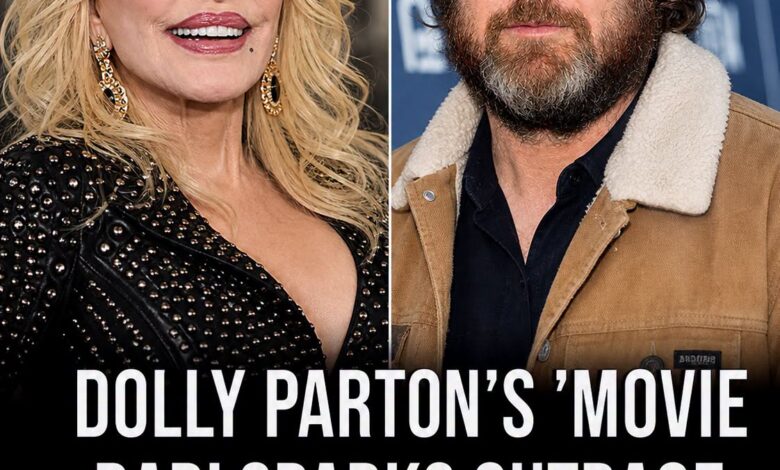
Then Ricky Schroder posted his message.
And instead of comforting people, it made many of them furious.
Schroder had a personal connection to Dolly that most fans could only dream of having. The two had worked together on the 1991 television movie Wild Texas Wind, and he affectionately remembered her as his “Movie Mama.”
That history gave him something valuable to contribute.
He had known Dolly.
He had shared a set with her.
He had memories of the person behind the rhinestones and carefully constructed public image.
So when he spoke after her death, people expected a story about that woman.
Instead, Schroder used part of his tribute to emphasize where he believed Dolly had been wrong.
He objected to her support for transgender people.
He criticized her connection to COVID-19 vaccination efforts.
And after outlining those disagreements, he said he loved her anyway.
Perhaps Schroder intended that sentence as an expression of unconditional affection.
To many readers, it landed exactly the opposite way.
It sounded conditional.
As though Dolly’s compassion required forgiveness.
As though her support for people Schroder disagreed with constituted a flaw that had to be acknowledged before he could properly say goodbye.
And because she was no longer alive to answer him, the timing made the words sting even more.
The reaction was immediate.
Fans flooded social media with criticism, arguing that a memorial wasn’t the place to settle ideological disagreements with the dead.
Others questioned why someone with genuine memories of Dolly would choose those particular details when given an opportunity to honor her life.
Public figures joined the condemnation.
Katie Couric reacted critically.
Boy George was similarly unimpressed.
For many people, the problem wasn’t that Schroder had political or cultural disagreements with Dolly.
People who care about each other disagree all the time.
The problem was the decision to make those disagreements part of the farewell.
A eulogy reveals something about the person being remembered.
But sometimes it reveals even more about the person delivering it.
Dolly Parton’s public life had been defined by an unusual ability to make people with radically different beliefs feel welcome.
She grew up surrounded by deep Christian faith.
She spoke openly about God throughout her career.
She also repeatedly expressed affection for LGBTQ+ fans who had embraced her.
Those things were not contradictions in Dolly’s worldview.
Love was the bridge.
She didn’t appear interested in checking someone’s political affiliation, sexuality, background, income, or identity before deciding whether they deserved kindness.
That instinct made her increasingly unusual in a culture where almost everything eventually becomes a loyalty test.
Dolly resisted those tests.
Her response was generally simple.
Love people.
Let God handle the rest.
That philosophy didn’t require everyone to agree with her.
It certainly didn’t require Dolly to agree with everyone who loved her.
It simply left room for human beings to exist beside one another without turning every difference into a declaration of war.
That is why Schroder’s tribute felt so jarring to some fans.
He appeared to be applying exactly the kind of test Dolly had spent much of her public life refusing to impose.
Then there was the vaccine issue.
During the COVID-19 pandemic, Dolly donated $1 million to Vanderbilt University Medical Center, helping support coronavirus research that included work connected to the Moderna vaccine.
When she later received her own vaccination, she approached the moment in characteristic Dolly fashion.
She used humor.
She modified one of her most famous songs.
And she encouraged others to protect themselves.
To supporters, it was another example of something Dolly had done throughout her life: use her money and celebrity to help when she believed she could make a difference.
She didn’t merely tweet sympathy.
She wrote a check.
That same impulse had already produced one of her greatest legacies.
The Imagination Library.
What began as a literacy program in her home region grew into an enormous book-gifting effort, placing books into the hands of children regardless of their family’s income or circumstances.
The philosophy behind it was uncomplicated.
Children deserved books.
That was enough.
Again and again, Dolly’s generosity operated that way.
She remembered being poor.
She remembered what it felt like to come from somewhere people underestimated.
And after becoming extraordinarily successful, she kept reaching backward to pull other people forward.
That is why so many fans reacted defensively after her death.
They weren’t simply protecting a favorite singer.
They were protecting what Dolly represented to them.
Generosity without interrogation.
Faith without constant condemnation.
Success without forgetting poverty.
Glamour without shame.
Kindness without requiring sameness.
Schroder’s defenders could reasonably point out that grief is personal.
Nobody writes the perfect tribute.
People are entitled to remember complicated relationships honestly, and loving somebody doesn’t require agreeing with everything they believed.
That much is true.
In fact, disagreement can coexist with genuine affection.
But timing and emphasis matter.
When someone dies, there is a difference between saying, “We didn’t always agree, but I loved her,” and cataloguing precisely which parts of the deceased person’s compassion or advocacy you found objectionable.
One keeps the focus on the relationship.
The other risks making the deceased a supporting character in somebody else’s argument.
That distinction seemed to drive much of the backlash.
Fans wanted Dolly’s death to remain about Dolly.
They wanted the songs.
The stories.
The ridiculous jokes.
The enormous hair.
The mountain childhood.
The marriage to Carl Dean.
The songwriting.
The books mailed to children.
The countless people who described being treated warmly by her when nobody important was watching.
They didn’t want another political fight.
Dolly herself had spent decades trying to avoid becoming ammunition in exactly those fights.
She could speak about issues, but she was famously reluctant to become a partisan mascot.
She understood the cost.
Once a beloved public figure becomes a symbol belonging exclusively to one political tribe, everyone on the other side is encouraged to reject them.
Dolly wanted a larger room.
Her audience contained conservative Christians and drag queens.
Country traditionalists and pop stars.
Grandparents and teenagers.
People from tiny Appalachian towns and people who had never seen the Smoky Mountains.
They didn’t have to agree with one another to sing “Jolene.”
That may sound trivial.
It isn’t.
Shared cultural spaces have become increasingly rare.
Dolly Parton was one.
And her relationship with LGBTQ+ fans was especially revealing.
Queer audiences had embraced Dolly for decades, drawn partly to the theatricality of her appearance but also to her insistence on being exactly who she wanted to be.
Dolly understood what it meant to have people judge the packaging before discovering the person underneath.
She had been mocked for looking cheap.
Dismissed for being too feminine.
Underestimated because of her accent.
Treated as though enormous wigs and tight dresses somehow canceled intelligence.
Her response wasn’t to become more respectable.
She became more Dolly.
More hair.
More rhinestones.
More confidence.
There was something liberating about that example.
You didn’t have to make yourself smaller so other people would become comfortable.
You could walk into the room looking exactly as outrageous as you pleased and still be the smartest businessperson sitting at the table.
That message traveled far beyond country music.
Perhaps this is why the controversy surrounding Schroder’s words became larger than one celebrity tribute.
It raised a basic question about what we owe someone when they’re gone.
Must we pretend we agreed with everything?
No.
Must grief erase every complicated feeling?
Of course not.
But there is generosity in knowing when an argument no longer needs to be won.
Dolly understood generosity.
She practiced it with money, certainly, but also with attention.
With humor.
With acceptance.
With the unusual willingness to leave people their dignity.
That doesn’t mean she was perfect.
Turning her into a flawless saint would flatten her into something less interesting than the complicated human being she actually was.
But perfection wasn’t what people were mourning.
They were mourning the way she made them feel.
Seen.
Welcome.
Encouraged.
Entertained.
Less alone.
And that explains why the phrase “loved her anyway” bothered so many people.
They heard the “anyway” louder than the love.
They wondered why acceptance of transgender people or support for vaccination needed to appear as strikes against Dolly’s character in a message supposedly honoring her.
Most of all, they wondered why those disagreements mattered at that particular moment.
Because death changes the purpose of the conversation.
There will always be time to debate politics.
There will always be another argument online.
Another outrage.
Another ideological battle demanding everyone choose a side.
A farewell is different.
A farewell asks something quieter from us.
Remember.
Be grateful.
Tell the story worth preserving.
Schroder had every right to remember Dolly in his own way.
And everyone reading his words had the right to decide what those words revealed.
The backlash ultimately produced an unintended contrast.
On one side was a debate about where Dolly had supposedly gone wrong.
On the other were reminders of what she had actually done.
A million dollars toward medical research.
Millions upon millions of books placed into children’s hands.
Jobs created in the Tennessee mountains.
Songs written for people nursing wounds nobody else could see.
Support offered to communities that knew what rejection felt like.
Decades of giving without demanding that recipients become more like her first.
Perhaps that is the better place to leave the argument.
Dolly Parton didn’t require ideological perfection before extending affection.
She understood that human beings are bigger than their disagreements.
That doesn’t mean convictions don’t matter.
It means love doesn’t always have to become another battlefield.
In the end, the strongest tributes to Dolly may not be the ones written by celebrities at all.
They’re the children opening books because she believed literacy could change a life.
They’re the musicians singing songs she wrote before they were born.
They’re the LGBTQ+ fans who remember being welcomed by a country icon when acceptance wasn’t guaranteed.
They’re the families in East Tennessee whose livelihoods were strengthened by investments she deliberately kept close to home.
They’re the people who never met her but somehow felt encouraged by her refusal to apologize for being exactly who she was.
Those things don’t need an “anyway.”
They don’t require political agreement.
They simply require gratitude.
And perhaps that’s the lesson hidden inside the controversy.
A real tribute doesn’t have to pretend someone agreed with us about everything.
It doesn’t even have to pretend they were perfect.
It only has to resist making their final moment about ourselves.
Dolly spent a lifetime giving people that kind of room.
Room to disagree.
Room to be strange.
Room to believe.
Room to become themselves.
After a life that generous, perhaps the simplest farewell is also the one most faithful to her example.
Thank you, Dolly.
No conditions attached.