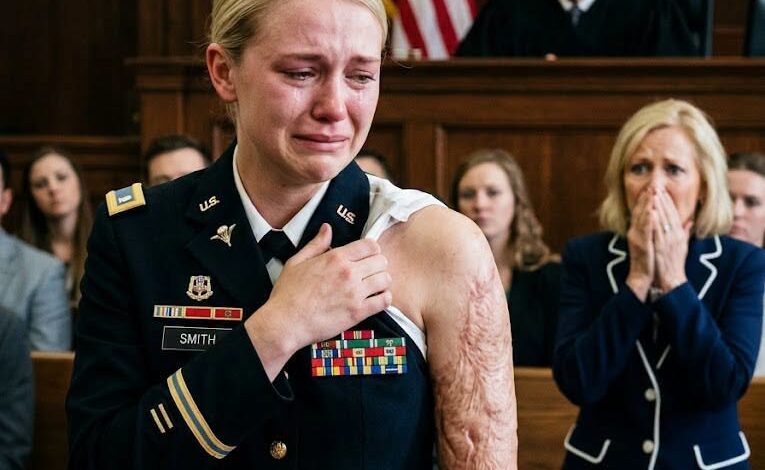
The courtroom had been filled with whispers from the moment I walked through the doors.
To the people sitting in the gallery, I wasn’t a decorated veteran or a respected executive. I was the man accused of lying about his past, hiding behind vague answers, and refusing to explain the inconsistencies that had become the centerpiece of the case against me.
Every unanswered question seemed to reinforce the prosecution’s argument.
Every time I declined to elaborate, jurors exchanged skeptical glances.
The silence that had protected my military oath was being mistaken for proof of deception.
I couldn’t defend myself the way everyone expected.
Not because I lacked an explanation.
Because I wasn’t legally permitted to give one.
For years, I’d carried responsibilities that remained classified under orders I had sworn to honor. Breaking that oath—even to save my own reputation—was never an option.
So I endured the accusations.
The headlines.
The disbelief.
I trusted that eventually the truth would arrive.
I just didn’t know when.
That moment came when the courtroom doors opened and Lieutenant General Duane Carney entered.
The room fell silent.
There was no dramatic announcement, no theatrical entrance.
His presence alone commanded attention.
As he took the witness stand, every eye followed him.
After taking the oath, he looked directly at the judge.
“I am here,” he began, “because this court has received authorization allowing me to verify information previously protected under national security restrictions.”
The atmosphere changed instantly.
One by one, he confirmed the assignments I had never been able to discuss.
The deployments.
The operations.
The commendations.
The injuries.
The classified missions that had seemed unbelievable when mentioned without supporting details.
Everything the prosecution had portrayed as fabricated was verified under oath.
My military record wasn’t exaggerated.
If anything, it had been incomplete because so much of it had remained protected.
The silence that jurors had interpreted as guilt suddenly became something entirely different.
Discipline.
Duty.
Obedience.
The prosecutor’s carefully constructed argument unraveled almost immediately.
Without the assumption that I had invented my past, the foundation of the entire case began to crumble.
But the most devastating evidence had yet to appear.
My attorney called Delwyn, a longtime investigator who had quietly spent months uncovering evidence far beyond what anyone expected.
He carried a small digital recorder to the witness stand.
What played next stunned the courtroom.
The voices belonged to my own mother and my brother, Curtis.
There was no anger.
No hesitation.
No remorse.
Instead, the recordings captured calm conversations about removing me from the company permanently.
They discussed discrediting my military service.
Destroying my reputation.
Manipulating legal documents.
Positioning themselves to seize control of Titan Tactical Systems before quickly selling the business for an enormous profit.
To them, I wasn’t family.
I was an obstacle.
Every recording painted the same picture.
Their actions hadn’t been driven by misunderstanding.
They had been planned.
Calculated.
Intentional.
The courtroom remained silent long after the final recording ended.
Judge Halpern removed his glasses and looked toward the defense table where my mother and brother sat.
The expression on his face had completely changed.
He no longer saw a complicated family dispute.
He saw evidence of an organized effort involving fraud, conspiracy, and deliberate deception.
Before anyone else spoke, he issued his order.
“Based on the evidence presented before this court today, I am directing that the appropriate authorities take the defendants into custody pending further proceedings.”
Chaos erupted.
Curtis shot to his feet and made a desperate attempt to flee toward the courtroom exit.
He barely reached the aisle before a U.S. Marshal intercepted him, bringing him to the floor within seconds.
My mother remained frozen in her chair, staring ahead as officers approached.
Only hours earlier, they believed they were moments away from destroying my future.
Instead, they left the courtroom in handcuffs.
The legal process continued for months.
Financial records were examined.
Corporate transactions were reviewed.
Witnesses testified.
The recordings proved authentic.
By the time everything concluded, convictions followed.
Both my mother and Curtis received prison sentences for their roles in the scheme, while additional participants faced their own legal consequences.
Eight months later, I walked back into Titan Tactical Systems as its undisputed owner.
The company I inherited looked very different from the one I wanted to build.
So I started over.
Not from scratch.
From principle.
We strengthened corporate oversight.
Created transparent financial safeguards.
Invested in employees instead of shortcuts.
Most importantly, we established a new nonprofit division dedicated to supporting military veterans facing challenges similar to the ones I had endured.
Some carried invisible wounds.
Others struggled because classified service prevented them from fully explaining parts of their careers.
Many had watched their reputations questioned simply because they could not disclose the complete truth.
I understood that burden better than most.
Our organization offered legal assistance, career support, counseling, and advocacy for veterans navigating circumstances few civilians could fully appreciate.
Helping them became the most meaningful achievement of my professional life.
Today, the medals once questioned by strangers hang in simple frames behind my office desk.
Visitors often notice them.
Some ask about their stories.
Others simply admire them.
To me, they represent something far more important than military recognition.
They remind me that honor isn’t measured by applause or public opinion.
Sometimes it means remaining faithful to your principles when doing so costs you everything.
There were days I wondered whether the truth would ever surface.
Whether keeping my oath had been worth losing my reputation.
Whether justice would ever arrive.
Eventually, it did.
Not through anger.
Not through revenge.
But through patience, integrity, and evidence that could no longer be ignored.
The people who tried hardest to erase my name ultimately exposed their own.
And the company they hoped to exploit became a place dedicated to restoring the dignity of others who had been unfairly judged.
Justice rarely follows our preferred timeline.
Sometimes it arrives long after the damage has been done.
But when truth is supported by integrity instead of convenience, it has a remarkable way of enduring.
Mine simply took a little longer to be heard.