Two months after my divorce, I found my ex-wife sitting alone in a hospital corridor.
And the moment I recognized her, something inside me broke so completely that I knew the man who walked into that building would never walk out the same again.
The hallway smelled like disinfectant, burnt coffee, recycled air, and the thin plastic scent of hospital blankets that had been washed too many times.
Cold air pushed steadily from the ceiling vents even though half the people waiting nearby were hugging themselves for warmth.
Somewhere behind the nurses’ station, a heart monitor beeped in slow, calm intervals that felt almost cruel against the exhaustion hanging in the building.
Hospitals have a strange relationship with suffering.
Everything inside them keeps moving normally while entire lives collapse quietly in plastic chairs.
I wasn’t there for her.
I was there for David.
My best friend had undergone surgery that morning, and at exactly 1:17 p.m. he texted me:
Still alive. Bring coffee if you’re coming.
That was David’s personality perfectly summarized.
Humor first.
Pain second.
So I stopped at the lobby café, bought the worst coffee ever poured into a paper cup, signed my visitor badge at the front desk, and followed blue hallway signs toward internal medicine recovery.
I remember noticing a tiny American flag sitting beside the visitor printer.
Not because it mattered.
Because I was trying very hard not to look at the families around me.
Hospitals make loneliness visible in ways ordinary life hides.
You notice who sits alone.
Who keeps checking the entrance doors.
Who carries flowers because they don’t know what else to carry.
The elevator doors opened onto the third floor with a soft mechanical ding.
I stepped out.
Walked halfway down the corridor.
Then stopped completely.
At first, my brain refused to understand what I was seeing.
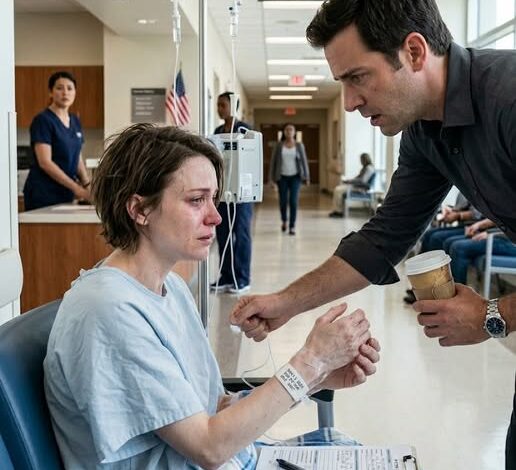
A woman sat alone near the far corner beneath fluorescent lighting with a folded blanket across her lap and an IV stand beside her chair.
A clipboard rested half-hidden beneath the blanket like she’d tried covering it before anyone noticed.
Her hospital gown was pale blue.
Her shoulders looked painfully narrow inside it.
Her hair—
Her hair was gone.
Not completely bald.
But cut very short.
Too short.
Then she turned slightly, and the overhead light touched the side of her face.
Emily.
My ex-wife.
The woman I divorced eight weeks earlier.
The woman whose suitcase wheels scraped across our apartment floor at midnight while I stood frozen in the kitchen pretending silence hurt less than honesty.
My name is Michael Harris.
Thirty-four years old.
Office employee.
Former husband.
And at the time, I still believed exhaustion justified emotional cowardice.
Emily and I had been married for five years.
People always described us the same way:
“Steady.”
Not passionate.
Not dramatic.
Not explosive.
Steady sounded mature.
Respectable.
Like two adults who understood mortgages, grocery lists, and utility bills instead of romance.
For a while, maybe we really were steady.
Emily loved quietly.
That was the tragedy.
You don’t fully understand quiet love until the house loses it.
She made coffee before I woke up.
Folded my shirts warm from the dryer.
Asked if I’d eaten every single evening like nourishment could somehow repair whatever damage the world caused that day.
When we first got married, we talked endlessly about children.
Not fantasy versions.
Real ones.
Sticky fingers.
Soccer practice.
Plastic toys scattered through grass behind a little house with a porch swing.
We wanted ordinary happiness badly enough to believe wanting guaranteed arrival.
Then came the miscarriages.
The first one happened after weeks of cautious hope.
Emily bought tiny yellow baby socks and hid them inside her dresser drawer because she thought buying them openly might “jinx things.”
After the hospital confirmed the loss, she sat on the bathroom floor holding those socks against her chest for nearly an hour.
She didn’t cry loudly.
Emily never broke loudly.
That was part of the problem.
The second miscarriage arrived a year later.
By then everyone around us had learned polite sympathy phrases.
You’re still young.
These things happen.
Try again later.
Nobody understood that later wasn’t the issue.
Something inside our marriage had gone silent, and neither of us knew how to restore the sound.
Emily withdrew first.
I called it grief.
Then I withdrew too.
I called it work.
That sounded more responsible.
I stayed late at the office unnecessarily.
Volunteered for projects nobody wanted.
Answered emails at midnight because spreadsheets never looked at me with wounded eyes across dinner tables.
Grief rarely kicks doors open dramatically.
Sometimes it just moves into the kitchen and quietly rearranges everything until home stops feeling familiar.
By spring, Emily and I barely fought anymore.
We simply exhausted each other slowly.
Laundry.
Insurance forms.
Missed dinners.
Unspoken disappointment.
Everything became heavy.
On Tuesday, April 9th, at exactly 10:42 p.m., we stood in our kitchen beneath weak yellow stove lighting.
A cold pot sat untouched on the burner.
The sink overflowed with dishes.
Emily rested one hand against the counter, and I remember noticing how thin her wrist looked.
Then I said the sentence that destroyed us.
“Maybe we should get divorced.”
It didn’t sound angry.
That was what made it devastating.
It sounded tired.
Emily looked at me for a very long time before asking quietly:
“You decided that before tonight, didn’t you?”
I nodded.
No speech.
No explanation.
No bravery.
Just cowardice dressed as honesty.
She blinked once.
Then walked silently into the bedroom.
I heard closet doors slide open.
Hangers scrape metal.
The old gray suitcase fall onto the bed.
People underestimate sounds during endings.
Later those sounds become the entire memory.
The divorce moved quickly afterward.
Court forms.
Digital signatures.
County paperwork reducing five years into file numbers and stamped envelopes.
The final hearing lasted less than twenty minutes.
Emily wore a gray sweater.
I wore the blue shirt she ironed months earlier.
When everything ended officially, she looked at me and said softly:
“Take care of yourself, Michael.”
I answered:
“You too.”
Then we walked away from each other down opposite courthouse hallways like strangers carrying identical damage.
Afterward, I rented a tiny apartment across town.
One plate.
One fork.
One folding chair.
The refrigerator hummed louder than any human voice inside that place.
At first I told myself loneliness felt peaceful.
No difficult conversations.
No grief hanging over dinner.
But loneliness and peace are not remotely the same thing.
By the second month, I finally understood the shape of my mistake.
I missed Emily constantly.
The way she tucked her feet beneath herself on couches.
Her grocery lists in slanted handwriting.
The sound of mugs rinsing before work.
Most of all…
I missed being cared for by someone gentle.
Still, I did nothing.
Regret becomes incredibly lazy once pride moves in beside it.
Then David texted me.
Then I went to the hospital.
Then I saw Emily sitting alone beneath fluorescent lights trying to disappear.
For several seconds, I just stared.
The paper coffee cup bent slightly in my hand.
Emily looked thinner than I remembered.
Exhaustion darkened the skin beneath her eyes.
And somehow her shorter hair made her look both younger and older simultaneously.
There was a hospital bracelet around her wrist.
Clear IV tubing disappeared beneath the blanket over her lap.
She looked fragile.
Embarrassed.
Like someone apologizing silently for existing in public while unwell.
I walked toward her slowly.
My shoes squeaked once against polished hospital flooring.
She looked up immediately.
Shock crossed her face.
Not joy.
Not anger.
Shock.
“Michael?”
My chest tightened painfully.
I sat beside her before my brain could interrupt.
“What happened?” I asked quietly. “Why are you here?”
She looked away instantly.
“It’s nothing.”
Lie.
Weak.
Transparent.
Exhausted.
“Just tests.”
I reached for her hand automatically.
Ice cold.
“Emily,” I whispered, “don’t lie to me.”
Her fingers trembled once inside mine.
The blanket shifted slightly.
The clipboard slipped farther outward.
That’s when I saw it.
Hospital intake paperwork.
Name:
Emily Harris.
Emergency Contact:
Michael Harris.
My number.
My old address partially crossed out in blue ink.
I stared at the form so long the words blurred.
“You listed me?”
Emily closed her eyes briefly.
“I never changed it.”
That sentence shattered something inside me completely.
Even after divorce papers.
After silence.
After abandonment.
She still wrote my name where people called during emergencies.
Before I could answer, a nurse approached holding a sealed envelope and a plastic bag containing Emily’s belongings.
“Emily?” the nurse asked gently. “The doctor wants to review discharge instructions, but we need someone present for the conversation.”
Emily’s face collapsed slightly.
“Michael,” she whispered desperately, “please don’t make this harder.”
I looked at her.
Really looked.
At the woman I once promised to love in sickness and health.
And suddenly I understood something horrifying:
Legal paperwork had ended our marriage.
But my body still recognized her suffering like responsibility.
The nurse looked toward me carefully.
“Are you the emergency contact, sir?”
I thought about:
The courthouse.
The gray suitcase.
Emily saying take care of yourself.
Then I stood slowly.
“Yes,” I answered.
Emily turned her face away immediately, but not before I saw tears gather.
The nurse visibly relaxed.
“Then come with us.”
The consultation room was tiny.
Two chairs.
A tissue box.
A framed map on the wall.
Too bright.
Too clean.
Emily sat slowly like every movement required negotiation with pain.
I sat beside her.
Not across from her.
Beside.
She noticed.
The doctor arrived carrying a thick folder and the calm expression medical professionals wear when panic would only worsen things.
Emily had ignored symptoms too long.
Minimized them.
Handled everything alone because she didn’t want to burden anyone.
Especially not me.
There would be medications.
Appointments.
More tests.
Insurance paperwork.
I don’t remember most medical terminology from that conversation.
I remember Emily twisting the edge of the blanket nervously.
I remember discharge papers sliding across the table.
I remember how small she looked reading them alone.
After the doctor left, silence filled the room.
Finally I asked quietly:
“Why didn’t you call me?”
Emily laughed once.
Exhausted.
Humorless.
“We’re divorced.”
“I know.”
“You made sure of that.”
No anger.
Just fact.
And somehow facts hurt worse.
“I thought leaving would stop hurting us,” I admitted quietly.
Emily looked directly at me.
“Did it?”
No.
Not remotely.
“No,” I answered.
She nodded slightly.
Like she already knew.
“I didn’t want to become someone you felt obligated to save,” she whispered.
“That’s never what you were.”
Her mouth trembled.
“You stopped coming home, Michael.”
There it was.
Not screaming.
Not dramatic accusations.
Simple truth entered calmly into evidence.
“I know.”
“You stopped asking how I was.”
“I know.”
“And eventually I got tired of being the saddest thing in every room.”
I looked directly at her because she deserved at least that much courage now.
“I was a coward.”
Emily nodded once.
“Yes.”
One word.
Completely accurate.
The nurse returned with medication schedules and follow-up paperwork.
Emily reached for the forms, but her hand shook visibly.
So I took them gently instead.
Not because she was incapable.
Because I finally understood what showing up looked like.
I reviewed appointment dates.
Emergency numbers.
Medication instructions.
Emily watched quietly while I organized papers into folders automatically.
For the first time in months, I was doing something useful instead of emotionally convenient.
When discharge finally came, Emily insisted she could walk independently.
She managed five steps before swaying dangerously.
I moved beside her silently and offered my arm.
She stared at it briefly.
Then accepted.
We moved slowly through the corridor together.
Past vending machines.
Past the reception desk with the little flag.
Past families carrying balloons and flowers toward different forms of hope.
Outside, sunlight forced us both to squint.
I opened the passenger door of my old sedan.
Emily hesitated.
“I can call a rideshare.”
“You don’t have to.”
“This doesn’t fix anything.”
“I know.”
“I’m not pretending April didn’t happen.”
“I’m not asking you to.”
She looked toward the hospital entrance.
People entered carrying coffee and fear.
“I don’t know what this is anymore,” she whispered.
“Neither do I.”
That was the first completely honest thing I’d said to her in months.
She got into the car.
I drove her home.
Her apartment was painfully tidy.
The kind of cleanliness lonely people maintain because disorder feels overwhelming when nobody else lives there.
I made tea because I didn’t know how else to help.
Emily sat quietly at the kitchen table watching steam rise from the mug.
Finally she whispered:
“You don’t have to stay.”
“I know.”
“You can leave after tea.”
“I know.”
She looked at me carefully.
“Then why are you still here?”
Because I loved you badly instead of well.
Because I abandoned grief instead of sharing it.
Because I confused escape with peace.
But I couldn’t hand all those truths to a sick exhausted woman at once.
So instead I answered honestly enough.
“Because someone needs to drive you to Monday’s appointment.”
Emily covered her face with one trembling hand.
Her shoulders shook once.
I stayed where I was.
Not rushing toward forgiveness.
Not demanding absolution through guilt.
Eventually she lowered her hand.
“Don’t do this because you feel guilty.”
“I’m not.”
“Don’t do it because you want to feel like a good man.”
“I definitely don’t.”
That almost made her smile.
Almost.
Over the following weeks, I drove her to appointments.
Learned hospital parking structures.
Memorized medication schedules.
Carried paperwork folders.
Not heroically.
Consistently.
That was the difference.
Love isn’t always dramatic declarations when everyone watches.
Sometimes it’s simply reliability finally arriving late.
One evening after an exhausting appointment, Emily fell asleep on the couch while an old cooking show played quietly.
I noticed the gray suitcase still standing in the corner of her bedroom.
Unpacked.
Still there from April.
A monument to the night I let silence win.
When she woke later, she found me washing mugs in the kitchen.
“You still rinse them twice,” she murmured sleepily.
“So did you.”
She stared at me quietly.
“I hated that you remembered things like that.”
“I know.”
“And then I hated myself for being glad you remembered.”
I said nothing.
Some moments break if touched too aggressively.
The months afterward weren’t magically beautiful.
There were difficult mornings.
Scary test results.
Conversations about grief we should have had years earlier.
But this time, I stayed.
And eventually, sitting together after another appointment while rain dotted the windshield softly, Emily looked at me and said:
“I don’t want our old marriage back.”
“Neither do I.”
“The old one was lonely.”
“I know.”
“If there’s ever anything again between us, it can’t survive on silence.”
I nodded slowly.
“It won’t.”
She adjusted the air vent away from my shoulder automatically because she remembered cold air bothered me.
Such a tiny gesture.
But Emily always hid love inside tiny gestures.
And suddenly I understood something devastating.
Finding my ex-wife sick and alone in that hospital corridor didn’t break me because of illness.
It broke me because for the very first time, I saw clearly what my absence had done to her long before the divorce papers arrived.
I couldn’t undo years of emotional abandonment in one afternoon.
But I could stop leaving.
That became the real beginning of everything afterward.
Not dramatic speeches.
Not instant forgiveness.
Just tea cooling quietly on a kitchen table while two exhausted people finally learned that love is not proven by how much regret you carry after walking away.
It’s proven by whether you stay once you finally understand the damage your absence created.