She Was Given Only Bread and Water While Her Stepsister Ate Steak—But What One Guest Noticed Changed Everything

“No,” she said. “Lily eats different food.”
The room went quiet.
Sofia kept her expression neutral.
“What do you mean by different food?”
Chloe shrugged.
“Just different.”
She seemed genuinely confused by the question.
“As in different meals?”
“Yeah.”
“Can you give me an example?”
Chloe thought for a moment.
“I usually have waffles or eggs before school.”
“And Lily?”
“Oatmeal sometimes.”
“Sometimes?”
“Or toast.”
Sofia nodded.
“What about dinner?”
Another shrug.
“Mom says Lily has a special diet.”
The answer sounded rehearsed.
Not because Chloe was lying.
Because she had heard it so many times she accepted it as fact.
Sofia thanked her and moved on.
Later that afternoon, she sat alone with Lily.
The little girl perched nervously on the edge of a chair, hands folded tightly in her lap.
Sofia smiled gently.
“You have a beautiful room.”
“Thank you.”
“Do you like living here?”
Lily hesitated.
Then nodded.
“Mostly.”
Mostly.
Not yes.
Mostly.
Sofia leaned forward.
“Can you tell me about your meals?”
Lily immediately looked toward the door.
As if checking whether someone might hear.
The gesture alone made Sofia’s heart ache.
“Nobody’s in trouble,” she said softly.
Lily lowered her voice.
“Am I allowed to answer?”
The question hit like a punch.
“You don’t need permission to tell the truth.”
Lily stared at the floor.
Then she whispered:
“Sometimes I’m really hungry.”
Sofia waited.
“When Chloe gets snacks, I usually stay in my room.”
“Why?”
“Because it’s easier.”
“Easier than what?”
Lily swallowed.
“Smelling them.”
The investigator wrote nothing for several seconds.
She simply sat there.
Listening.
Lily continued quietly.
“I try not to ask anymore.”
“Ask for what?”
“Food.”
The word barely escaped her lips.
“Why not?”
The child twisted her fingers together.
“Because Mom Victoria gets upset.”
A long silence followed.
Then came the question Sofia would remember for years.
“Is it bad to be hungry all the time?”
The investigator had spent twelve years working child welfare cases.
She had seen bruises.
Neglect.
Abandonment.
Violence.
But there was something uniquely heartbreaking about a child who no longer viewed hunger as unusual.
That evening, Sofia met with the pediatric specialist Daniel had contacted.
The medical records told their own story.
Lily weighed significantly less than expected for her age.
Her growth curve had flattened.
Several previous medical appointments documented fatigue and nutritional concerns.
Each time, Victoria had attributed the symptoms to sensitivity, picky eating, or digestive issues.
Yet testing showed no condition requiring dietary restrictions.
No allergies.
No metabolic disorders.
Nothing.
By the end of the week, investigators had enough evidence to obtain court authorization for a deeper review.
Victoria remained calm.
Almost too calm.
“This is ridiculous,” she said as officials arrived.
“You’re acting like I starve her.”
Nobody answered.
Because nobody had used that word.
Victoria had.
The investigators simply continued their work.
Then they opened the kitchen records.
Receipts.
Meal plans.
Household expenses.
Food purchases.
Patterns emerged quickly.
Chloe’s lunches included fresh fruit, protein snacks, yogurt, cheese, and prepared meals.
Lily’s lunches were dramatically smaller.
Repeatedly.
Consistently.
Over years.
The differences weren’t accidental.
They were documented.
Intentional.
Systematic.
When confronted with the evidence, Victoria’s explanation shifted.
“She needs discipline.”
No response.
“She overeats.”
No response.
“Someone has to teach self-control.”
Still no response.
Because the facts were speaking louder than she could.
Daniel sat quietly in the back during one meeting.
He watched Lily drawing with crayons while adults discussed legal matters around her.
At one point she looked up.
“Am I in trouble?”
Every adult in the room froze.
“No, sweetheart,” Daniel said gently.
“You’ve never been in trouble.”
She considered that.
Then returned to her drawing.
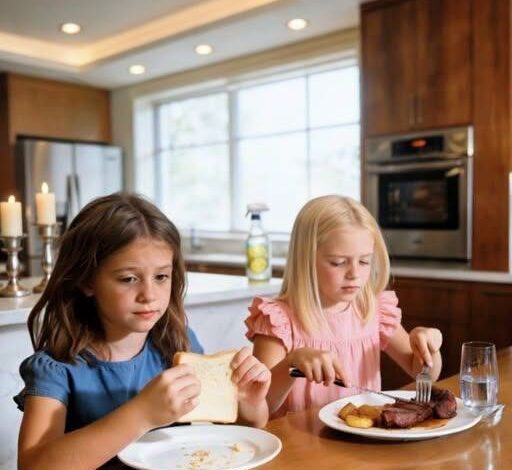
The picture showed two girls sitting at a table.
One had a large plate.
The other had a small one.
Neither figure was smiling.
A month later, temporary custody arrangements changed.
Lily moved into the home of her maternal aunt, Rebecca.
The first dinner there was nothing special.
No expensive ingredients.
No candlelight.
No polished dining room.
Just spaghetti.
Garlic bread.
Salad.
And a crowded kitchen table.
Rebecca placed a serving bowl in front of Lily.
“Would you like more?”
Lily froze.
The room grew quiet.
Rebecca smiled.
“You don’t have to finish what’s on your plate first.”
Lily stared at her.
“Really?”
“Really.”
The little girl looked around as though waiting for someone to object.
Nobody did.
Slowly, she reached for another spoonful.
Then another.
Tears filled Rebecca’s eyes.
Because no child should look surprised by abundance.
Or safety.
Or kindness.
Across town, legal proceedings continued.
The evidence eventually painted a clear picture.
Victoria had never deprived Chloe.
She had deprived Lily.
Not because of finances.
Not because of health concerns.
But because Lily represented a life that existed before Victoria entered the family.
A reminder she never fully accepted.
The court’s conclusions were harsh.
The consequences followed.
But for Lily, the most important moment wasn’t found in a courtroom.
It happened six months later.
At a school health screening.
The nurse smiled while reviewing her chart.
“You’ve grown three inches.”
Lily grinned.
“Really?”
“And you’ve gained healthy weight too.”
The little girl smiled even wider.
That afternoon she raced home carrying the report.
Rebecca hung it on the refrigerator.
Right beside one of Lily’s drawings.
A new drawing.
This one showed a dinner table too.
But everything was different.
Everyone had food.
Everyone was smiling.
And above the picture, written in careful second-grade handwriting, were six simple words:
Nobody has to ask anymore.
When Rebecca saw that sentence, she quietly stepped into the hallway and cried.
Because healing doesn’t always arrive dramatically.
Sometimes it arrives one meal at a time.
One safe evening.
One full plate.
One child finally learning that hunger is not something she deserves.
And that love should never have conditions attached to dinner.