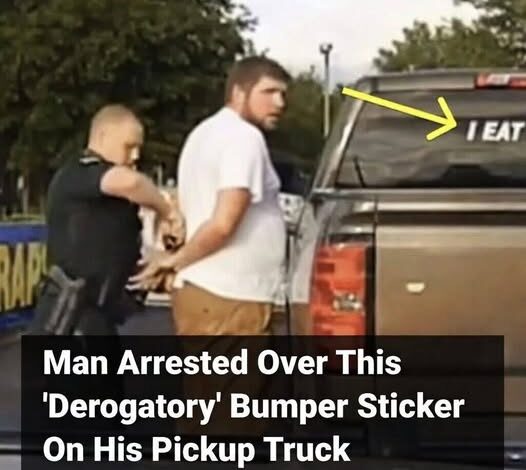
On that Lake City roadside, the law didn’t fail in theory; it failed in practice. Dillon Shane Webb’s case exposed how quickly “offensive” can be weaponized into “criminal” when unchecked authority meets fragile rights. He walked away with dropped charges, but not before the state rummaged through his car, cuffed his wrists, and entered his name into databases built for real danger, not wounded feelings.
His lawsuit did more than seek damages; it forced a reckoning. It reminded courts, deputies, and ordinary drivers that the First Amendment does not come with a politeness clause. The power of the state is most terrifying not when it crushes a movement, but when it quietly punishes one person for daring to stand on principle. Webb’s story lingers as a warning: freedoms are not lost in theory, but in moments when no one expects to need them.
It began with a sticker.
Not a weapon.
Not a threat.
Not violence.
A sticker.
That alone is what unsettled so many people afterward. Americans often imagine constitutional crises arriving dramatically:
mass censorship,
military force,
historic speeches,
streets filled with protest.
But rights rarely erode that cleanly.
More often, the danger appears smaller, almost forgettable at first:
a traffic stop,
an irritated official,
a decision made casually by someone wearing authority.
And suddenly, a principle people assumed was permanent becomes frighteningly fragile in real time.
Dillon Shane Webb was driving through Lake City, Florida, in 2019 when deputies noticed the decal on the back window of his truck. The sticker featured profanity directed toward law enforcement — crude, confrontational, undeniably offensive to many people.
But offensiveness is not automatically illegal.
That distinction sits at the center of the First Amendment itself.
American free speech protections were never designed solely to protect agreeable language. Popular opinions rarely require constitutional defense because majorities already tolerate them comfortably. The true test of free expression emerges around speech people dislike:
angry speech,
vulgar speech,
political speech,
speech perceived as disrespectful,
speech provoking discomfort rather than applause.
Webb’s sticker existed precisely inside that uncomfortable territory.
The deputy initiated the traffic stop anyway.
What followed transformed a rude decal into a national conversation about constitutional boundaries and the psychology of power. According to court records and later reporting, deputies cited concerns about the sticker violating laws regarding obscene or offensive displays visible to the public.
But the stop did not end there.
Webb was questioned.
Ordered out of the vehicle.
Eventually arrested.
His truck was searched.
His hands cuffed.
His identity entered into criminal justice systems designed for people suspected of genuine threats or crimes.
All because government authority encountered expression it found insulting.
That is the part civil liberties advocates found so alarming afterward.
Not merely that an arrest occurred.
But how ordinary it looked while happening.
No dictator delivered a speech.
No constitutional amendment vanished overnight.
Just officers on a roadside making decisions in the moment, supported initially by systems accustomed to granting broad deference to authority figures acting under claims of public order.
That is how rights often become vulnerable:
incrementally,
informally,
through ordinary enforcement choices rather than dramatic legal revolutions.
Supporters of the deputies argued the issue involved more than hurt feelings. Some claimed the language could provoke disturbances or violate decency laws protecting public spaces. Others framed the stop as routine discretion under existing statutes.
But constitutional scholars and civil rights attorneys quickly pointed toward a deeper problem.
The Supreme Court has repeatedly upheld broad protections for offensive speech specifically because governments cannot be trusted to define offensiveness neutrally. Once officials gain power to criminalize expression merely because it insults or disturbs, enforcement inevitably becomes subjective.
And subjective enforcement becomes dangerous quickly.
One officer’s “offensive” becomes another officer’s “criminal.”
One official’s discomfort becomes another citizen’s arrest record.
That instability threatens everyone eventually, regardless of political ideology.
Because constitutional rights lose meaning if they only protect agreeable people saying agreeable things.
Webb’s charges were eventually dropped.
Legally, that outcome mattered enormously.
Emotionally, it raised harder questions.
Dropped charges do not erase what already happened.
The stop still occurred.
The arrest still occurred.
The search still occurred.
For hours, Webb experienced the full force of state power over expression protected constitutionally. The handcuffs were real. The humiliation was real. The fear was real. The legal process itself became punishment long before courts clarified the constitutional problem.
That dynamic reveals something unsettling about civil liberties in practice.
Many rights become expensive to exercise once authorities decide to challenge them. Even innocent individuals can lose time, money, employment opportunities, emotional stability, and public reputation while navigating legal systems supposedly designed to protect them.
The process itself can intimidate people away from exercising rights fully in the future.
And perhaps that is what disturbed observers most:
the chilling effect.
If someone can be arrested over a vulgar political sticker, how many others silently censor themselves afterward simply to avoid risk? How many people decide controversy is not worth potential police attention even when the law technically protects them?
Freedom shrinks quietly that way.
Not always through official bans.
Through fear,
uncertainty,
and selective enforcement.
Webb responded by filing a federal lawsuit against the deputies and the sheriff’s office, arguing his constitutional rights had been violated. The lawsuit transformed a local roadside encounter into a broader legal and cultural debate about free speech, police discretion, and accountability.
Importantly, the case forced courts to confront not abstract theory, but practical reality.
Americans often speak about constitutional rights romantically, as though their existence alone guarantees protection automatically. But rights ultimately depend on human beings:
officers respecting boundaries,
judges enforcing standards,
citizens challenging abuses,
institutions correcting overreach.
Without those mechanisms functioning consistently, constitutional language risks becoming symbolic rather than protective.
Webb’s lawsuit therefore carried significance beyond personal compensation.
It became a reminder.
A reminder that constitutional protections require active defense precisely during small moments people are tempted to dismiss casually. Because governments rarely announce when they are crossing lines. Citizens usually recognize the danger only after someone has already been punished for testing limits authority hoped nobody would question.
The First Amendment especially survives through uncomfortable tolerance.
Americans celebrate free speech abstractly until confronted with speech they personally dislike. Then the temptation emerges to carve exceptions:
this expression is too rude,
too disrespectful,
too offensive,
too inflammatory.
But constitutional rights weaken every time emotional discomfort becomes justification for state punishment.
The irony inside Webb’s case was impossible to ignore too.
The sticker criticized police power.
Police power responded by validating the criticism publicly.
That irony transformed the story into national news because it illustrated concerns civil libertarians have warned about for decades:
unchecked authority often reacts defensively toward criticism itself.
And when authority cannot tolerate insult, freedom becomes conditional rather than guaranteed.
None of this means all speech lacks consequences socially.
People remain free to criticize vulgarity.
Businesses may reject offensive messaging.
Communities may express disapproval.
That is social consequence.
State punishment is different.
The distinction matters enormously because government possesses coercive force ordinary citizens do not:
arrest powers,
weapons,
detention,
criminal databases,
court systems.
Once those powers target protected expression improperly, the imbalance between citizen and state becomes deeply dangerous.
Webb’s case also exposed how emotionally reactive modern public discourse has become. Increasingly, many people across ideological lines confuse emotional offense with actual harm demanding legal intervention. The language of safety expands until discomfort itself starts sounding criminalized.
But democratic societies depend partly on tolerating expression people strongly dislike.
Otherwise whoever controls institutions eventually controls acceptable speech too.
That principle protects everyone eventually:
activists,
journalists,
protesters,
religious minorities,
political dissenters,
ordinary citizens angry enough to say something impolite.
The First Amendment was built precisely because governments historically abuse power most aggressively during moments of emotional certainty. Officials always believe restrictions are justified at the time.
History usually judges differently later.
In Webb’s case, courts ultimately sided with constitutional protections. Legal scrutiny forced recognition that profanity directed toward police, while offensive to many, remained protected speech under longstanding First Amendment precedent.
That legal reaffirmation mattered.
But the emotional residue remained too.
Because Webb’s story demonstrated how vulnerable rights become when exercised alone on ordinary days far away from national headlines. No massive protest surrounded him initially. No movement protected him in the moment. Just one individual facing the machinery of the state over expression many people found distasteful.
That vulnerability is exactly why constitutional protections exist.
Not for safe speech.
For risky speech.
And perhaps that is the deepest warning lingering beneath the case years later.
Freedoms rarely disappear all at once.
They erode through moments small enough people rationalize easily:
one arrest,
one search,
one overreach,
one citizen punished because authority confused criticism with threat.
Most Americans imagine they will recognize danger immediately if liberty ever comes under attack.
History suggests otherwise.
Usually it arrives disguised as procedure.
Routine.
Discretion.
Public order.
And only afterward do people realize how much depended on someone refusing quietly to surrender rights everyone assumed would always protect themselves automatically.
Dillon Shane Webb’s case mattered because he challenged that surrender.
Not perfectly.
Not politely.
But constitutional rights were never reserved only for polite people.
They were written precisely for moments when power becomes irritated enough to forget that freedom includes the right to offend the powerful too.