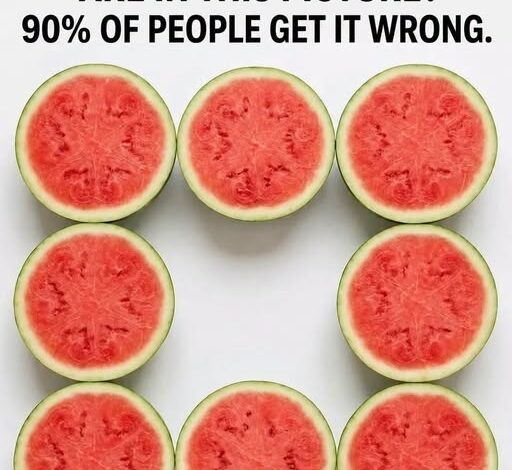
At first glance, the answer seems ridiculously easy.
There are watermelon slices arranged neatly in front of you. They’re round, nearly identical, and simple enough that your eyes immediately begin counting.
One.
Two.
Three.
And before you’ve even stopped to think about what you’re looking at, your brain confidently announces an answer.
That’s exactly how the puzzle catches you.
The real challenge isn’t mathematics.
It’s perception.
Our brains are remarkably good at recognizing familiar objects quickly. Most of the time, that’s useful. We don’t carefully analyze every chair before deciding it’s something we can sit on. We don’t inspect every cup from every angle before realizing it holds a drink.
We recognize patterns and move on.
But puzzles like this exploit that efficiency.
You see a circular piece of watermelon, so your brain quietly labels it:
One watermelon.
Then it sees another.
And another.
Soon you’re counting visible shapes rather than thinking about what those shapes actually represent.
That’s where the mistake begins.
Because those circles aren’t whole watermelons.
Each one represents only half of a watermelon.
Suddenly, the problem changes completely.
Instead of asking, “How many circles can I see?” you have to ask a much better question:
“How many complete watermelons can these pieces make?”
Now the solution becomes straightforward.
Take two halves.
Put them together.
They make one whole watermelon.
Take the next two halves.
They make another.
Continue pairing them, and the apparent complexity disappears.
Nothing in the picture changed.
The watermelon pieces stayed exactly where they were.
The only thing that changed was how you interpreted them.
And that’s what makes such a simple puzzle surprisingly interesting.
It reveals how quickly confidence can arrive before understanding.
When something looks familiar, we often stop investigating.
Our eyes recognize a pattern.
Our brain fills in the missing information.
Then we become attached to the answer we reached in the first few seconds.
That’s why two people can look at the same puzzle and argue passionately about different answers.
One person is counting shapes.
Another is counting halves.
Someone else might be thinking about how the watermelon was cut.
They’re looking at the same image but solving slightly different problems.
The disagreement isn’t necessarily about arithmetic.
It’s about assumptions.
And assumptions are powerful precisely because we rarely notice ourselves making them.
Imagine someone places two half-dollar coins on a table.
You wouldn’t say there are two dollars simply because there are two objects.
You understand that each object represents only part of the total value.
The watermelon puzzle asks you to apply that same reasoning visually.
A visible object isn’t automatically a complete unit.
That sounds obvious once it’s explained.
But that’s the brilliance of the trick.
The best puzzles hide their difficulty inside something that seems obvious.
They encourage speed.
They reward confidence.
Then they reveal that confidence wasn’t the same thing as accuracy.
There’s a useful lesson hiding underneath the fruit.
We do versions of this constantly in everyday life.
We read half a headline and assume we understand the story.
We hear one side of an argument and decide who is right.
We see someone’s reaction without knowing what happened beforehand and judge their character.
We notice one mistake and assume we understand someone’s intentions.
In each case, we’re doing something remarkably similar to counting watermelon halves as wholes.
We’re treating incomplete information as complete information.
Sometimes the difference between being wrong and being right isn’t intelligence.
It’s simply taking another look.
That’s why the most important moment in this puzzle happens before you calculate anything.
It’s the moment you stop and ask:
“What exactly am I counting?”
That question changes everything.
Once you recognize that every visible circle represents half a watermelon, the trick loses its power. You pair the halves, convert them into wholes, and arrive at the correct total.
The puzzle becomes easy again.
But now you’ve earned the answer instead of guessing it.
And perhaps that’s why these seemingly childish visual challenges spread so quickly online.
They’re not really testing whether adults can count.
They’re testing whether adults can slow down.
That’s much harder.
We’re surrounded by information demanding instant reactions. Headlines want immediate outrage. Social media rewards fast opinions. Arguments encourage us to choose sides before we’ve examined the evidence.
Speed feels like certainty.
But this little watermelon puzzle offers the opposite lesson.
Look twice.
Define what you’re counting.
Question the obvious assumption.
Then calculate.
Because sometimes the problem isn’t that the answer is hidden.
Sometimes it’s sitting directly in front of you, waiting for you to stop seeing what you expected to see.
Two halves make one whole.
Simple.
Obvious.
And surprisingly easy to miss.
So if this puzzle fooled you the first time, don’t worry about how quickly someone else solved it.
The interesting part isn’t whether you counted correctly in five seconds.
It’s whether you were willing to reconsider your first answer.
Because puzzles end when you discover the trick.
In real life, that second look can matter far more.