At first, all I felt was panic.
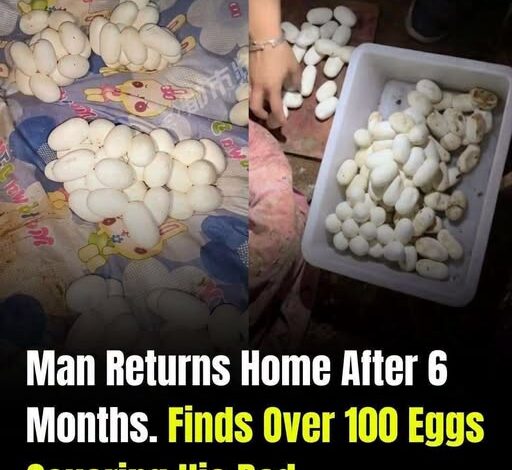
Finding a cluster of tiny white eggs tucked into the corner beside my bed was enough to send my imagination racing. Every possibility seemed worse than the last. Were they insect eggs? Something dangerous? Had my home somehow become infested without me noticing?
The more I looked at them, the more uneasy I became.
They were small, smooth, and surprisingly delicate, hidden in a place I rarely thought to check. Their presence transformed an ordinary bedroom into something unfamiliar, and suddenly every shadow and every faint rustle in the room seemed loaded with mystery.
I needed answers.
After comparing photos and seeking expert advice, I finally discovered what they were.
They weren’t insect eggs at all.
They were lizard eggs.
The relief was immediate.
The fear that had consumed me dissolved almost as quickly as it had appeared, replaced by curiosity and an unexpected sense of wonder. Instead of imagining a hidden threat, I began imagining the tiny reptile that had quietly found its way into my home, searched for a safe place, and instinctively chosen that sheltered corner to lay its eggs.
The discovery changed the entire story.
What I had interpreted as an invasion was actually a natural behavior carried out by a harmless animal simply trying to protect its future offspring.
Many small lizards seek out warm, quiet, protected locations to lay their eggs. Hidden spaces beneath furniture, inside garages, behind storage boxes, or in sheltered corners of homes can sometimes provide the stable conditions they need.
The mother doesn’t stay to guard the eggs.
After laying them, she leaves them to develop on their own, relying on the environment to provide the warmth necessary for incubation.
Once I understood that, the eggs looked different.
They no longer seemed frightening.
Instead, they appeared remarkably fragile.
Each one represented a tiny life that had not yet begun, carefully placed where instinct suggested it might have the best chance to survive.
Rather than feeling disturbed by their presence, I found myself feeling oddly honored.
Without realizing it, my home had briefly become part of a much larger natural story.
It reminded me that wildlife exists all around us, often unnoticed.
Even in neighborhoods filled with houses and streets, countless small animals continue following ancient instincts that long predate our buildings.
Sometimes those worlds overlap for a brief moment.
When they do, the experience can feel surprising, even unsettling, simply because it catches us off guard.
Wanting to protect both the eggs and my living space, I carefully moved them to a sheltered outdoor location nearby where they could continue developing in conditions more appropriate for wild reptiles.
The process required gentle handling and minimal disturbance.
Once they were safely relocated beneath natural cover, I stepped back with a sense of quiet satisfaction.
It felt less like removing something unwanted and more like returning something to where it truly belonged.
Back inside, my bedroom seemed different.
Not because anything about the room had changed physically.
Because my perspective had changed.
The place where I had first felt fear now reminded me of how easily unfamiliar things can be misunderstood.
So often, what frightens us initially is simply something we haven’t yet identified.
Without information, uncertainty fills the gaps.
Our imagination often paints pictures far scarier than reality itself.
Learning what those tiny eggs actually were transformed anxiety into appreciation.
It was a simple reminder that understanding has an extraordinary ability to dissolve fear.
The natural world is filled with creatures carrying out ordinary lives beyond our notice.
Most pose no threat at all.
They’re simply searching for food, shelter, or a safe place to raise their young, following instincts refined over countless generations.
By taking a moment to identify, understand, and respond thoughtfully instead of reacting out of panic, we often discover that what seemed alarming is simply another small part of nature quietly unfolding beside us.
That unexpected encounter left me with more than an interesting story.
It left me with a different way of looking at the world.
Not every mystery hiding in a forgotten corner deserves fear.
Sometimes it deserves curiosity.
Sometimes it deserves compassion.
And sometimes, all it takes is learning the name of what frightened us to realize it was never something to fear in the first place.
The tiny eggs are gone now, but the lesson remains.
The world is full of unfamiliar forms of life sharing the spaces around us every day.
When we approach them with patience instead of panic, knowledge instead of assumptions, we often discover that nature isn’t invading our lives at all.
It’s simply reminding us that we’re already part of it.