I Helped an Elderly Couple on the Highway — A Week Later, My Mom Yelled for Me to Turn on the TV

The first snow of the season drifted across the highway like torn pieces of lace, soft enough to look harmless but heavy enough to make the road shine beneath my headlights. I kept both hands on the wheel and glanced in the rearview mirror at my seven-year-old daughter, Emma, whose boots tapped happily against her booster seat.
“Daddy,” she asked, fogging the window with her breath, “do you think Grandma made apple pie?”
“I’d bet my last dollar on it,” I said. “And probably cinnamon rolls too.”
Emma squealed, and the sound warmed something in me the weather couldn’t touch.
It had been just the two of us for four years, ever since her mother decided marriage and motherhood were things she could leave behind. Emma had cried for her at first. Then slowly, painfully, we built a life around the empty space. My parents helped fill the holidays with noise, food, and the kind of love that made Emma forget, at least for a little while, that our family looked different.
We were forty minutes from their house when I saw the car on the shoulder.
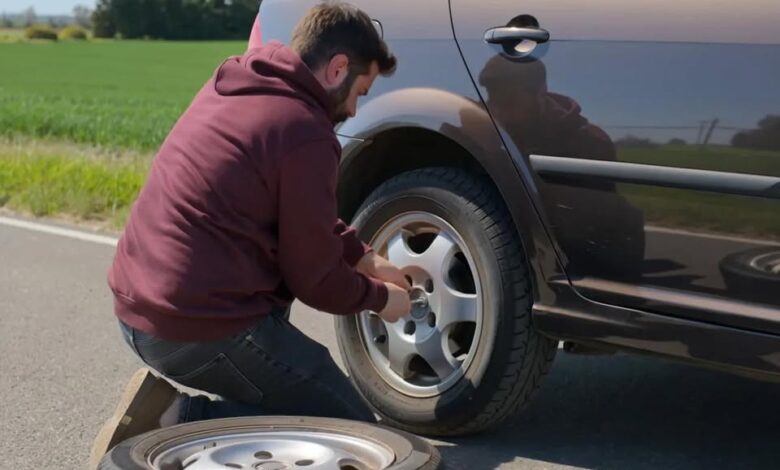
It was an old sedan with rust around the wheels and a shredded front tire hanging from the rim. Beside it stood an elderly couple. The man was bent over a jack, his thin gloves shaking as he fought with the lug nuts. The woman stood nearby, arms wrapped around herself, her gray hair whipped by the wind.
Cars kept passing.
I didn’t think. I signaled and pulled over.
“Stay in the car, sweetheart,” I told Emma, locking the doors. “I’m going to help them.”
“Are they okay?”
“They will be.”
The cold hit me hard when I stepped out. The woman turned as I approached, relief flashing across her face before embarrassment replaced it.
“Oh, please don’t trouble yourself,” she said. “We don’t want to ruin anyone’s holiday.”
“You’re not ruining anything,” I replied. “I’ve got tools.”
The man straightened slowly. “William,” he said, offering his hand. “This is my wife, Margaret.”
“Stuart.”
The tire was worse than I expected, but they had a spare. Their jack looked ancient, so I grabbed mine from the trunk and got to work. Margaret explained that roadside assistance was backed up for hours because of Thanksgiving traffic.
“We’re trying to get to our grandchildren,” she said. “The youngest has been practicing a song for us all week.”
I smiled despite the cold. “My daughter is in a Christmas carol phase. It’s not even December, but she’s committed.”
Margaret looked toward my car just as Emma waved from the back seat with her whole arm. The older woman’s face softened.
“She’s darling.”
The work was slow. My fingers went numb, my jeans soaked through at the knees, and William kept trying to help until I gently waved him off. Finally, the spare was secure.
“That’ll get you there,” I said, wiping grease on my jeans. “But replace it soon.”
William reached for his wallet.
“No,” I said immediately. “It’s Thanksgiving. Just get to your family.”
“At least let us thank you properly,” Margaret pleaded.
“You just did.”
William took my hand in both of his. His eyes were sharp and strangely emotional.
“Young man,” he said, “you reminded us today that kindness still exists.”
I didn’t know what to say, so I nodded and walked back to the car.
Emma was waiting with a drawing in her lap.
“Daddy, wait! I made them something.”
Before I could stop her, she rolled down her window and called, “Excuse me!”
Margaret lowered hers. Emma handed over the paper: two old people, a broken car, a dead tire with X’s for eyes, and two figures labeled carefully at the bottom:
EMMA & DADDY
“This is for you,” Emma said. “Because you were sad and now you’re not.”
Margaret pressed the drawing to her chest like it was made of gold.
We drove away, and by the time we reached my parents’ house, the whole thing had already begun fading into the background of turkey, pie, and family noise.
Then, nine days later, my phone rang while I was packing Emma’s lunch.
It was my mother.
“Stuart!” she shouted. “Turn on Channel Seven!”
“Mom, what’s wrong?”
“Just do it!”
I turned on the kitchen television and nearly dropped the sandwich.
There were William and Margaret, sitting in a news studio. But not as I remembered them. Margaret’s hair was perfectly styled. William wore an expensive suit. A headline ran across the screen:
LOCAL GOOD SAMARITAN SAVES FORMER SENATOR AND WIFE
The reporter smiled. “Senator Williams, what brings you here today?”
Senator.
I sank into a chair.
William told the story exactly as it happened—the snow, the flat tire, the cars that passed, and the stranger who stopped with his little girl in the back seat.
“He refused payment,” William said. “He didn’t know who we were. He simply saw two people who needed help.”
Then Margaret held up Emma’s drawing.
Emma gasped. “Daddy, my picture is on TV!”
Margaret’s eyes shone. “This has been on our refrigerator all week.”
The reporter asked how they planned to find us.
William looked directly into the camera.
“Sir, if you’re watching, we’d like to offer you a reward of twenty-five thousand dollars. More importantly, we are creating an annual award in your honor for ordinary people who do extraordinary acts of kindness when no one is watching.”
I couldn’t breathe.
Then Margaret smiled.
“And Emma, sweetheart, if you and your daddy are watching, we would be honored if you joined us next month at the National Christmas Tree Lighting.”
Emma turned to me, eyes wide.
“Daddy… are we famous?”
I pulled her into my lap because my knees had stopped working.
“No, sweet pea. We just helped someone.”
She nodded solemnly. “But that’s why we help, right? Not for rewards.”
“Right,” I said, my voice rough. “Exactly right.”
By afternoon, reporters were calling. Teachers were texting. My mother had already told half the state. I felt overwhelmed, but when a black SUV pulled up outside our house and a security agent invited us to meet William and Margaret, Emma looked so excited I couldn’t say no.
At their hotel suite, Margaret hugged Emma like family. William shook my hand and said, “Please, just William.”
We drank coffee and hot chocolate and talked not about politics, but about children, marriage, old cars, and the quiet ways people keep going. Before we left, William pulled me aside.
“The money is real,” he said. “Please accept it. But what you gave us was worth more than that. You reminded us that goodness still happens without an audience.”
Four weeks later, Emma stood beside me in Washington, wearing her sparkly blue princess dress, her small hand resting next to mine on the switch for the National Christmas Tree. When the lights burst to life, the crowd cheered, and Emma whispered, “I love you, Daddy.”
That moment was worth more than any reward.
The money fixed our leaking roof and started Emma’s college fund. William and Margaret became part of our lives, sending Christmas cards every year with Emma’s drawing still hanging on their refrigerator. Their award went on to honor single mothers, teenagers, veterans, nurses, teachers—people who made the world better quietly.
Years later, Emma would tell the story the same way every time.
“We would have stopped anyway,” she’d say. “That’s just what good people do.”
And she was right.
The reward changed our lives, but the choice came first. A snowy highway. A broken tire. Two strangers in need.
And one simple decision to stop.