It didn’t take long to realize that most people had already decided who I was before I finished telling my story.
The moment they heard the word stepdad, the conversation was over in their minds. They filled in the blanks with assumptions, imagining a childhood that never happened and a relationship they believed they understood. Their conclusions came long before they ever asked a single question.
The truth was far less dramatic—and far more complicated.
He wasn’t the man who raised me.
He wasn’t there for scraped knees, bedtime stories, school recitals, or the thousand quiet moments that shape a parent and child. By the time our lives became connected, I was already an adult living independently, carrying my own history, my own scars, and my own responsibilities.
He never tried to rewrite my past.
He never claimed a role he hadn’t lived.
Instead, he simply listened.
There was something unexpectedly comforting about being around someone who didn’t see me as a project to repair. He didn’t offer easy solutions or tell me how I should feel. He sat through difficult conversations, shared his own disappointments, and allowed silence to exist without rushing to fill it.
Trust didn’t appear overnight.
It grew gradually, almost unnoticed.
A conversation that lasted longer than expected.
A shared laugh after a difficult week.
The realization that we both felt understood in ways we hadn’t experienced before.
What developed between us wasn’t built on excitement or rebellion.
It was built on honesty.
That honesty also brought difficult questions.
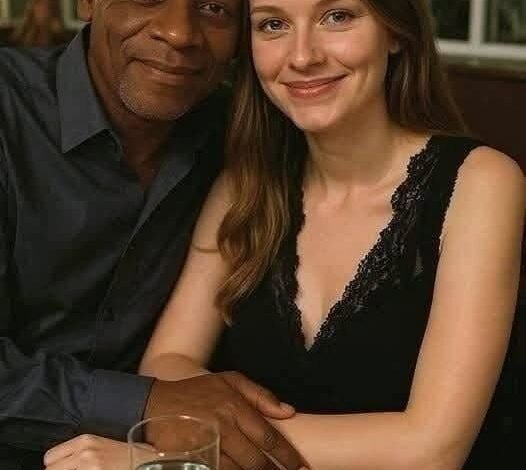
We understood how our relationship might appear to others. We questioned ourselves repeatedly, stepping back more than once to ask whether continuing was the right choice. We wrestled with expectations, with guilt, and with the weight of assumptions that came from circumstances rather than lived experience.
Those conversations were never easy.
But neither of us wanted to build a life on secrecy or self-deception.
Eventually, we reached a place where pretending no longer felt more truthful than acknowledging what had grown between us.
We didn’t make our choices to provoke anyone.
We didn’t seek attention or controversy.
We simply reached a point where living honestly mattered more than living comfortably inside other people’s expectations.
Not everyone understood.
Some people never will.
I’ve learned that others often respond to the version of a story they imagine rather than the one that was actually lived. Sometimes people judge based on a single label without knowing the people behind it or the years that shaped their lives.
I’ve also learned that being misunderstood is one of the hardest prices honesty can demand.
There are moments when I miss the simpler version of myself that existed in other people’s minds—the one that fit neatly into familiar categories and never forced uncomfortable conversations.
But that version wasn’t real.
The life I live now asks more of me.
It asks me to accept that not everyone will agree with my choices.
It asks me to hold compassion for people who see my story differently.
Most of all, it asks me to remain truthful about my own experience rather than editing it to make others more comfortable.
In the end, I discovered that authenticity is rarely the easiest path.
Sometimes it costs approval.
Sometimes it changes relationships.
Sometimes it means letting go of the person others expected you to be.
Yet there is a quiet freedom that comes from living a life that feels genuinely your own.
Not because everyone understands it.
But because, for the first time, you no longer have to pretend to be someone else.