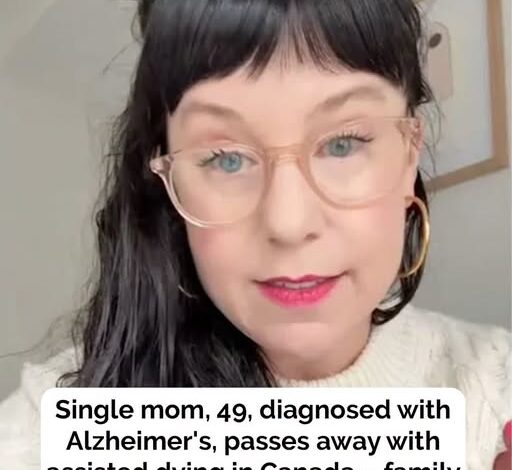
At an age when many people are watching their children grow into adulthood and making plans for the decades ahead, Rebecca Luna received news that would forever divide her life into “before” and “after.” Diagnosed with young-onset Alzheimer’s disease, she faced the devastating reality that her memories, independence, and eventually her ability to recognize the world around her would slowly fade away.
It was a diagnosis that changed not only her future but also the conversations surrounding how we live—and how we choose to face the end of life.
As the disease progressed, Rebecca spoke openly about the losses that arrived long before death itself. Everyday routines became more difficult. Memories that once anchored her identity slipped away. The confidence of navigating the world independently gave way to uncertainty, and even familiar surroundings no longer always felt safe.
For someone who had spent years rebuilding her life after earlier struggles, those changes carried an especially profound weight.
Rebecca had never hidden the difficult chapters of her story.
Known to many online as @wheredidrebeccago, she built a following not through carefully curated perfection but through remarkable honesty. She spoke candidly about surviving trauma, overcoming addiction, rebuilding relationships, and confronting illness with unusual openness. Her willingness to share both victories and setbacks resonated with thousands of people who saw pieces of their own lives reflected in hers.
When Alzheimer’s entered that story, she chose to meet it with the same transparency.
Rather than allowing others to define her experience, Rebecca documented the realities of living with a progressive neurological disease. She shared moments of clarity alongside moments of confusion, helping others better understand what young-onset Alzheimer’s can look like and the emotional toll it places on both patients and their families.
As the illness advanced, Rebecca made one of the most personal decisions of her life.
She chose to pursue medical assistance in dying (MAID), where it was legally available to her, after careful consideration and in accordance with the applicable legal and medical process.
For Rebecca, the decision was not presented as a rejection of life or an absence of hope.
Instead, she described it as a way to retain control over the few things the disease had not yet taken from her.
She could no longer stop Alzheimer’s.
She could not recover the memories that had already disappeared.
But she could still make choices about how she wanted her final chapter to unfold.
She wanted to decide the timing.
She wanted to choose the setting.
Most importantly, she wanted to spend her remaining days surrounded by the people she loved.
In an era when so much of life unfolds online, Rebecca made a deliberate choice during her final days.
She stepped away from social media.
The woman who had shared so much with strangers chose to reserve her last moments for family, close friends, and quiet conversations that required no audience.
Those closest to her became her world.
There were no carefully planned final broadcasts.
No dramatic farewell performances.
Only the simple, deeply human desire to be present with those who had walked beside her throughout her journey.
That decision spoke as loudly as anything she had ever posted online.
It reminded many people that while social media can build communities, some moments belong only to the people holding your hand.
Rebecca’s legacy extends far beyond the heartbreaking reality of Alzheimer’s disease.
Through years of openness, she encouraged conversations about subjects many people struggle to discuss openly: trauma, recovery, addiction, chronic illness, mental health, and the importance of seeking help without shame.
By sharing experiences that others often hide, she helped countless people feel less alone.
Her final decision also brought renewed attention to one of society’s most difficult ethical conversations.
Medical assistance in dying remains the subject of deep personal, medical, legal, cultural, and religious debate around the world. People hold sincere and often profoundly different beliefs about end-of-life choices, dignity, autonomy, and the role of medicine.
Rebecca’s story did not resolve those questions.
Instead, it placed a human face at the center of them.
It reminded people that behind every public debate is an individual confronting circumstances few of us can fully imagine.
Whether people agreed with her decision or not, many were moved by the honesty with which she explained her reasoning and by the compassion shown by those who supported her through the progression of her illness.
Perhaps that is the lasting power of her story.
She invited people not merely to form opinions but to practice empathy.
To recognize that illness is rarely simple.
That grief begins long before death.
And that every family facing a devastating diagnosis must navigate deeply personal decisions with love, uncertainty, and courage.
When Rebecca’s final video gave way to silence, the conversation she had started did not end.
It continued in living rooms, hospitals, support groups, and among families confronting their own impossible choices.
She left behind more than a social media account.
She left behind a record of remarkable honesty, demonstrating that vulnerability can become a source of strength and that telling the truth about suffering can help others feel seen.
In the end, Rebecca Luna’s greatest legacy may not be found in the number of people who followed her online, but in the countless lives she touched by refusing to hide from life’s hardest realities.
Her story reminds us that dignity is deeply personal, compassion is always essential, and even in the face of profound loss, honesty has the power to leave a lasting mark long after the final goodbye.