At our family barbecue, I discovered my son’s toys had been thrown into the fire. My brother only smirked and said, “He needs to toughen up.” I didn’t argue. I picked up my son and left. The very next day, my father appeared at my door, begging me to help save my brother’s job…

The first thing Lucas noticed was the smell.
Smoke.
Charcoal.
Sweet barbecue sauce.
Then something else.
Something that stopped my six-year-old son cold in the middle of my parents’ backyard.
His fingers tightened around the strap of his backpack.
“Dad…”
I looked down.
His face had already changed.
“That’s Mr. Bamboo.”
The entire yard seemed to go silent.
I followed his stare toward the barbecue pit.
Inside were the blackened remains of his stuffed animals.
The blue elephant.
The soft lion.
The patchwork turtle.
And Mr. Bamboo, the panda Lucas had slept with every night since he was three.
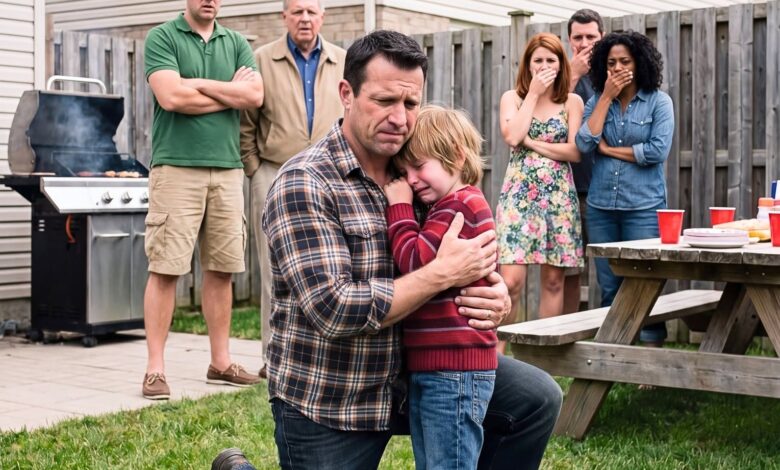
For one second, Lucas didn’t move.
Then his whole body started shaking.
I picked him up before his knees gave out.
He wrapped both arms around my neck and buried his face against my shoulder.
Across the yard, my mother Elaine covered her mouth.
Aunt Sophia stared at the fire.
Uncle Robert looked sick.
Then I saw my older brother Derek standing beside the cooler.
Arms folded.
A small smile on his face.
“Who did this?”
Derek shrugged.
“The boys got carried away.”
Lucas trembled harder.
Then Derek added:
“Honestly, Virgil, it’s probably for the best. He needs to toughen up.”
That sentence told me everything.
My father, Frank, stepped beside him.
After twenty-six years in the Army, Dad had turned toughness into a religion. Anything soft was weakness. Anything emotional needed correcting.
“They were crutches,” he said. “A boy needs to stand on his own two feet.”
“He’s six.”
“I was shooting my first rifle at six.”
I looked at him.
“And look how warm that made this family.”
Nobody laughed.
Because by then we all knew we were no longer arguing about toys.
This was about Lucas.
More specifically, about the kind of boy Dad and Derek thought he was allowed to become.
When he wanted a kitchen playset, Dad called it embarrassing.
When he cried after scraping his knee, Derek told him to “walk it off like a man.”
When Lucas brought Grandpa drawings, Frank barely looked at them.
Burning his stuffed animals wasn’t a prank.
It was a message.
Be harder.
Care less.
Become someone we approve of.
Or we will shame you until you do.
I adjusted Lucas against my shoulder.
“We’re leaving.”
Dad looked almost offended.
“Over stuffed animals?”
“No.”
I looked at Derek.
“Over grown men teaching a six-year-old that hurting someone smaller is strength.”
Mom rushed toward me.
“We can buy new ones. Better ones.”
Lucas finally lifted his face.
His cheeks were wet.
“They were my friends.”
That should have ended everything.
Instead, Dad sighed.
“They were toys, Virgil.”
I looked at him for a long moment.
Then I understood something I should have recognized years earlier.
The fire hadn’t created the problem in our family.
It had only made it visible.
I carried Lucas through the house.
Mom followed.
“Please don’t leave like this. We’re family.”
I stopped at the front door.
“Family protects children.”
I looked back toward Derek.
“It doesn’t break them to prove a point.”
The next morning, I ignored the missed calls and took Lucas to a toy store.
He wandered quietly through the aisles until he found a panda.
He held it carefully.
“This isn’t replacing Mr. Bamboo.”
“No?”
He shook his head.
“Maybe his cousin.”
For the first time since the barbecue, he smiled.
That evening, my father’s truck was parked outside my house.
For half a second, I thought he had come to apologize.
Instead, Dad sat on my porch and said:
“Derek’s in trouble at work.”
Of course he was.
Derek worked in sales at Peterson Tech.
My company.
Dad explained that there had been a complaint. Maybe more than one.
Then came the real reason he was there.
“People respect you. You could smooth this over.”
I stared at him.
“Let me understand.”
He shifted.
“Derek humiliates my six-year-old, shows no remorse, and now you want me to risk my reputation to protect his career?”
“Family helps family.”
“Did family help Lucas yesterday?”
Dad opened his mouth.
Nothing came out.
That silence told me more than an apology could have.
The next morning, I learned Derek’s workplace problem wasn’t one misunderstanding.
There were several complaints.
Different employees.
Same pattern.
Bullying.
Public humiliation.
Aggressive behavior toward people he considered weaker.
Then, when confronted, Derek dismissed them as oversensitive.
I knew that script.
At home, he called it toughness.
At work, it had become misconduct.
Dad later admitted he had known there were concerns before coming to my house.
“Then why ask me to protect him?”
“I thought you could keep it from becoming bigger than it needed to be.”
That sentence explained my entire childhood.
When Derek crossed a line, someone else was expected to shrink the consequences.
When Dad hurt someone, the hurt person was expected to toughen up.
Anyone who objected was accused of making things bigger than they needed to be.
I had spent years learning how not to react.
Lucas hadn’t.
Thank God.
My son cried when something hurt.
He said when something mattered.
He never learned to confuse emotional numbness with strength.
And I decided he never would.
I refused to intervene at Peterson Tech.
Six months later, Derek resigned before the investigation concluded.
He moved through several management jobs afterward, always blaming politics, bad bosses, weak employees, or “soft workplace culture.”
I never celebrated his failures.
By then, I understood consequences only teach people who are willing to learn.
Dad and I grew more distant too.
Mom kept calling.
“Forgive them for the sake of the family.”
Eventually, I realized that saying she was “caught in the middle” gave her too little responsibility.
Every time she asked me to ignore what happened instead of asking Dad or Derek to change, she was choosing whose comfort mattered more.
So I stopped arguing.
I set one rule.
Anyone who wanted access to Lucas had to treat him with respect.
Being related to him was not permission to humiliate him.
Years passed.
Eventually, Lucas and I moved six hundred miles away to Vermont.
Ten years after the barbecue, he was sixteen.
Tall.
Broad-shouldered.
Calm.
But what struck me most was how little he resembled the men who had tried to define masculinity for him.
He didn’t enter rooms looking for threats.
He didn’t hide sadness before someone could use it against him.
He liked animals.
He cooked.
He carved small figures from wood in the garage.
He was kind without being timid.
And when someone crossed a line, he stood up for himself without needing to humiliate them.
The second panda still sat on a shelf above his desk.
Its fur was worn around one ear.
Mr. Bamboo’s cousin.
One evening, Mom called.
“Your father asks about Lucas.”
I looked through the window.
My son was sitting at the kitchen island feeding apple pieces to the stray dog we had adopted.
“He wants to know if Lucas plays sports.”
“Sometimes.”
“If he’s tough.”
I almost smiled.
“He’s strong.”
“That’s what I mean.”
“No, Mom. It isn’t.”
She sighed.
“He needs his grandfather.”
“He has what he needs.”
After we hung up, Lucas came outside carrying two mugs of tea.
“Grandma?”
“Yeah.”
“How’s Grandpa?”
“Getting older.”
He nodded.
Then he pulled a small wooden horse from his pocket.
He had spent three days carving it.
The details were delicate.
The mane carefully shaped.
“Do you think Grandpa would have liked this?”
The question had no bitterness in it.
That made it harder.
“I think he would have thought it was too fragile.”
Lucas ran his thumb over the wood.
“It’s not fragile.”
I looked at him.
“It’s just made carefully.”
For a moment, I was back beside that fire pit.
A six-year-old crying over a panda.
Grown men telling him that caring made him weak.
Ten years later, that same boy had found the words I had spent most of my life searching for.
Careful was not fragile.
Gentle was not weak.
Feeling pain was not failure.
That night, after Lucas went inside, I sat on the porch thinking about the family I had left behind.
For years, I remembered the barbecue because of what Derek destroyed.
Eventually, I understood the more important part was what everyone chose afterward.
Some people looked away because confronting cruelty was uncomfortable.
Others defended it because questioning Derek meant questioning Dad.
And questioning Dad meant challenging an entire definition of manhood that had been passed down like an inheritance.
My father believed strength meant enduring pain without complaint.
Derek learned to believe strength meant causing pain without remorse.
Lucas taught me something better.
Strength was admitting when you hurt someone.
Protecting what mattered.
Caring openly.
Setting boundaries without cruelty.
Knowing that tenderness didn’t make you easier to break.
I couldn’t rewrite Derek’s childhood.
I couldn’t force Dad to reconsider his.
But I could stop those lessons from reaching another generation.
That was enough.
I never taught Lucas to hate them.
He knew why we kept our distance.
He also understood that forgiveness and access were different things.
You can wish someone well without handing them another opportunity to wound you.
You can stop being angry without pretending nothing happened.
And you can love family without sacrificing a child to preserve its traditions.
The barbecue pit has probably rusted by now.
The original stuffed animals are long gone.
Dad is old.
Derek still lives near my parents.
Life moved on.
But inside my Vermont home, my son never has to wonder whether something he loves will be destroyed to teach him how to become a man.
That distance cost me relationships I once assumed would last forever.
I would pay it again.
Because protecting Lucas did not destroy our family.
It stopped an old kind of damage from traveling any farther.
My father believed delicate things were fragile.
Lucas knew better.
Some things are not fragile at all.
They are simply made carefully.
And real strength is knowing they are worth protecting.