Keep it down or get out!” a passenger shouted at me on a flight — then the flight attendant asked to see my mom’s boarding pass.

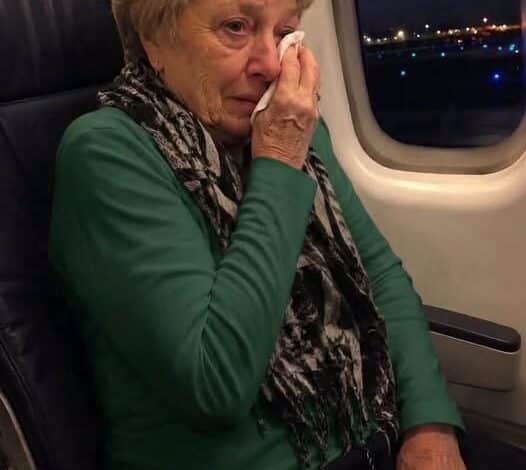
The first time a stranger told my mother to be quiet, I apologized.
The second time, I understood why she had spent her entire life refusing to disappear.
I had booked the window seat because Mom loved clouds.
For six months, hospitals had been her whole world—oncology wards, blood draws, infusion chairs, test results delivered in careful voices. This trip was supposed to prove that life still existed beyond all of that.
She was nervous about flying, so I kept her talking.
I pointed out planes on the runway.
Asked if she wanted water.
Made terrible jokes.
Every few minutes she smiled, leaned closer, and whispered something back.
Then, an hour after takeoff, the man across the aisle slammed his magazine shut.
“Keep it down or get out.”
Half the cabin looked up.
I felt heat rush into my face.
“I’m sorry,” I said. “We’re trying not to bother anyone.”
“Trying?” he snapped. “You’ve been talking nonstop. Some of us paid for a peaceful flight.”
Mom squeezed my hand.
“It’s okay.”
“No,” I whispered. “It isn’t.”
A flight attendant named Claire approached.
“Is there a problem?”
The man pointed at us.
“They need to be moved.”
Claire looked at Mom.
Then she crouched.
“Ma’am, may I see your boarding pass?”
Mom handed it over.
Claire studied the lower corner.
Her expression changed.
Then she picked up the intercom phone.
“Captain, I need you out here.”
The man across the aisle leaned back, satisfied.
He clearly thought we were about to be punished.
Instead, the cockpit door opened.
The captain stepped out.
He saw my mother.
And stopped.
“Margaret?”
Mom’s fingers locked around mine.
“David?”
I stared between them.
The captain moved closer like he was approaching a ghost.
Claire handed him the passenger-care memo attached to Mom’s reservation.
His eyes scanned one highlighted line.
Then he looked at the man across the aisle.
“Before anyone says another word about this woman,” he said quietly, “you should understand exactly who she is.”
Mom immediately shook her head.
“David, don’t.”
But he crouched beside her.
“I’ve waited thirty-one years to say this.”
That was how I learned my mother had once saved his life.
David had been nineteen, a college student learning to fly, when a truck cut across his lane one rainy night.
He arrived at St. Anne’s Hospital after a motorcycle crash.
Young.
Bleeding internally.
And surrounded by people who initially thought he was simply in shock.
Mom had been the emergency nurse who refused to accept that explanation.
“She kept telling them something was wrong,” David said. “My blood pressure was dropping. She pushed for more tests.”
Mom looked irritated.
“Any competent nurse would have.”
“The surgeon said another fifteen minutes could have killed me.”
I looked at her.
“You never told me.”
“There were hundreds of patients.”
David smiled.
“That’s the difference. I was one of hundreds to her.”
He looked directly at me.
“She was one person to me.”
Then the passenger across the aisle appeared near the galley.
His name was Richard Collins.
“I want to apologize,” he said.
Mom looked at him.
“I didn’t know you were sick.”
Her reply came instantly.
“That isn’t why you were wrong.”
He froze.
“You shouldn’t need to know someone has cancer before deciding not to humiliate them.”
Richard’s eyes dropped.
“You’re right.”
He returned to his seat.
And I thought the strange part of the flight was over.
I was wrong.
Minutes later, Mom pressed a hand to her chest.
“I’m fine.”
David gave her a look.
“Apparently you learned nothing.”
Her face had gone pale.
Claire checked her oxygen and blood pressure.
Then another passenger, an internal-medicine physician, examined her.
Mom had finished treatment only weeks earlier.
Her blood pressure was dangerously low.
Her oxygen wasn’t where they wanted it.
David returned to the cockpit.
The plane diverted to Omaha.
When the announcement was made, a few passengers groaned.
Mom heard them.
Her eyes filled.
“I’m ruining everyone’s trip.”
“You survived six months of cancer treatment,” I told her. “You are allowed to inconvenience an airplane.”
Someone behind us started clapping.
Then another person.
Then several more.
Mom closed her eyes.
At the hospital, doctors found severe dehydration, anemia, and an electrolyte imbalance.
Serious, but treatable.
That night, while fluids ran through her IV, an unknown number called.
The woman introduced herself as Dr. Elena Mercer.
Mom sat upright.
“Elena?”
It turned out Elena had been the young resident working the night David crashed.
The same resident Mom had challenged.
The same doctor who initially underestimated his injuries.
“You nearly let your husband bleed to death,” Mom said.
Elena laughed.
“I was twenty-six.”
“You were wrong.”
“I know.”
Then Elena became serious.
“You told me something that night.”
Mom waited.
“Never defend your first answer harder than you defend your patient.”
Mom stared at the phone.
“I said that?”
“I’ve taught it to residents for twenty years.”
Then Elena explained why Mom’s reservation had contained the special note.
She now worked at St. Anne’s.
As an oncologist.
She had seen Mom’s name on the travel-clearance paperwork and recognized it instantly.
Years earlier, after learning from Margaret to question her assumptions, Elena had caught something another doctor nearly missed in a leukemia patient.
One additional test changed that woman’s treatment.
“She lived,” Elena said.
Mom’s eyes filled.
“That woman became a teacher. She had three children.”
My mother began crying.
Not when she was diagnosed.
Not when she lost her hair.
Not during chemotherapy.
But then.
“I didn’t know.”
“I know,” Elena whispered.
“You never know how far one good decision travels.”
Three weeks later, Mom was cleared to travel again.
I expected her to cancel.
Instead, she called.
“Pack.”
“Mom—”
“If I wait until I’m not scared, I’ll never go anywhere.”
We finished the trip.
Same airline.
Another window seat.
This time Mom talked without apologizing.
About clouds.
Nursing.
David.
Elena.
My childhood.
Everything.
Halfway through the flight, the attendant asked if she wanted anything.
“Champagne.”
I stared at her.
“You don’t drink champagne.”
“I do today.”
She lifted the plastic cup.
“What are we drinking to?” I asked.
Mom looked through the window at an ocean of white clouds.
“To being loud while we still can.”
Six months later, her scans showed no evidence of active disease.
A year after the original flight, St. Anne’s invited us to a ceremony.
David and Elena had created a nursing scholarship in Mom’s name.
They called it the Margaret Ellis Speak Up Award.
Mom hated the name.
Naturally, everyone else loved it.
David stood at the podium.
“I spent thirty-one years believing Margaret Ellis saved one life that night,” he said.
Then he looked at Elena.
“My wife taught me she saved many more.”
Afterward, Richard Collins appeared.
He had come to donate to the scholarship.
“I used to think buying a ticket gave me the right to control the space around me,” he told Mom.
She studied him.
“I’ve been trying to stop doing that.”
“That sounds exhausting.”
“It is.”
Mom smiled.
“Good.”
On the drive home, I asked something I had wondered about for months.
“What if Richard had never complained?”
Mom looked at me.
“Maybe Claire never checks your pass. David never recognizes you. We might not divert when we do.”
She shook her head.
“No.”
“No?”
“Don’t give cruelty credit for the good things people choose afterward.”
I went silent.
She pointed toward the scholarship brochure in my lap.
“David surviving created this. Elena learning created this. Claire paying attention created this. You staying beside me created this.”
She was right.
The ugliest moment on that airplane had been loud.
But it hadn’t been the most powerful.
Attention was quieter.
Gratitude was quieter.
Courage was quieter.
My mother had spent her life noticing what others overlooked and speaking when silence would have been easier.
That flight began with a stranger telling her to keep it down.
A year later, I watched an auditorium full of doctors, nurses, pilots, and strangers applaud her for doing exactly the opposite.
Speaking up.
For patients.
For frightened people.
And finally—
for herself.