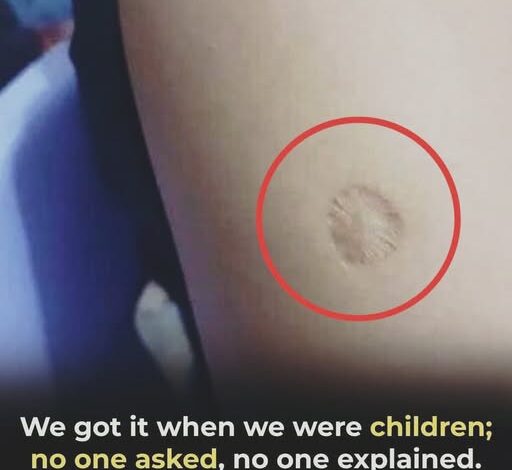
For most of my childhood, I barely noticed it.
It was simply there.
A small, circular mark resting quietly on my mother’s upper arm.
Not large enough to attract attention.
Not dramatic enough to spark questions.
Just a faint round scar that had existed for as long as I could remember.
Like so many details we grow up around, it eventually became invisible.
Children rarely question the familiar.
We accept certain things as permanent parts of the landscape of our lives.
The scar was one of those things.
It sat on her arm through family dinners, summer vacations, holiday photographs, and ordinary afternoons. It appeared in countless memories without ever becoming the focus of any of them.
I saw it thousands of times.
Yet I never truly looked at it.
Years passed.
Life moved forward.
The small mark faded into the background of memory.
Then, unexpectedly, something happened that brought it back into focus.
Not through a history lesson.
Not through a documentary.
Not through a conversation about medicine.
Through a stranger.
I was traveling one afternoon when I noticed an elderly woman stepping carefully off a train.
The platform was crowded.
People moved quickly around her.
She appeared slightly unsteady, so I offered a hand.
As she adjusted her balance, her sleeve shifted upward for just a moment.
And there it was.
The same scar.
The same shape.
The same location.
A small circular mark resting on the upper arm.
Instantly recognizable.
For a brief second, it felt strangely familiar.
Not because I knew the woman.
Because I knew that scar.
I had seen it before.
Countless times.
On my mother’s arm.
The realization lingered with me long after the train disappeared from sight.
What were the chances?
Why did both women have nearly identical marks?
Why did they appear in exactly the same place?
The question followed me throughout the day.
By evening, curiosity had finally overcome years of inattention.
I picked up the phone and called my mother.
When she answered, I asked a question I probably should have asked decades earlier.
“Mom, what’s that small round scar on your arm from?”
Her response arrived immediately.
Simple.
Matter-of-fact.
As though everyone already knew the answer.
“It’s from the smallpox vaccine.”
That was it.
No mystery.
No elaborate explanation.
Just a straightforward answer to a question that had quietly waited years to be asked.
Yet that simple response opened the door to a much larger story.
A story shared by millions of people.
A story written not only in history books but on human skin.
For many adults born before the early 1970s in the United States—and during similar periods throughout much of the world—that small circular scar carries a very specific origin.
It is the lasting mark left behind by the smallpox vaccine.
Some scars remain obvious even decades later.
Others have faded with time.
Some are barely visible.
Others remain distinct enough to recognize instantly.
Regardless of appearance, they all point back to a period of history that younger generations often struggle to imagine.
Because for much of modern history, smallpox was not a distant historical event.
It was a terrifying reality.
Today, most people have never seen a case of smallpox.
Many have never met anyone who survived it.
For younger generations, the disease feels almost abstract.
A chapter in a textbook.
A subject for documentaries.
A historical curiosity.
Yet for centuries, smallpox represented one of humanity’s most feared enemies.
Entire communities dreaded outbreaks.
Parents feared for their children.
Doctors possessed limited options.
Families watched loved ones suffer.
The disease spread relentlessly across continents and generations.
And its consequences were devastating.
Smallpox often began deceptively.
A fever.
Fatigue.
Body aches.
Weakness.
Symptoms that initially resembled many other illnesses.
Then came the rash.
Painful lesions appeared and spread across the body.
Patients endured severe discomfort.
Many survivors carried permanent scars.
Others lost their vision.
Millions never recovered at all.
The death toll associated with smallpox is almost difficult to comprehend.
Across centuries, the disease claimed hundreds of millions of lives.
Entire populations lived under its shadow.
Entire societies feared its arrival.
For people living during those periods, smallpox was not merely a medical concern.
It was a constant threat.
The possibility of infection shaped communities, families, and public health efforts around the world.
Understanding that context makes the little scar on so many arms feel very different.
Because it represents far more than a vaccination.
It represents protection against something people genuinely feared.
What makes the scar especially distinctive is the way the vaccine was administered.
Unlike many modern vaccinations, which often leave little or no visible evidence behind, the smallpox vaccine followed a unique process.
Healthcare workers used a specialized bifurcated needle.
A small instrument with two prongs.
Rather than delivering the vaccine through a single injection, the skin was punctured multiple times in a concentrated area.
The process triggered a very specific reaction.
First, a small bump would appear.
Then a blister would form.
Eventually, the blister dried.
A scab developed.
After healing, many recipients were left with a circular scar.
The resulting mark became so recognizable that people from the same generation often share nearly identical scars.
Same shape.
Same size.
Same location.
Usually the upper arm.
For decades, those scars became almost a badge of participation in one of history’s most ambitious public health efforts.
Yet few people thought about them very often.
They simply existed.
Quiet reminders hiding in plain sight.
The truly remarkable part of the story came later.
Because vaccination efforts did not merely reduce smallpox.
They eliminated it.
That distinction matters.
Many diseases are controlled.
Some become rare.
Others decline significantly.
Smallpox achieved something extraordinary.
It disappeared.
Through coordinated international vaccination campaigns, healthcare workers, governments, scientists, and communities worked together across borders and political systems.
The effort required years of commitment.
Massive logistical coordination.
Scientific innovation.
Public cooperation.
Countless individuals dedicated themselves to a goal many once considered impossible.
The results transformed human history.
Case numbers declined.
Outbreaks became less frequent.
Transmission chains collapsed.
Eventually, the disease had nowhere left to spread.
Then came a moment unlike almost any other in medical history.
In 1980, the World Health Organization officially declared smallpox eradicated.
Gone.
Not controlled.
Not reduced.
Eradicated.
The first human disease successfully eliminated worldwide through coordinated public health action.
It remains one of humanity’s greatest medical achievements.
Think about that for a moment.
For generations, people lived in fear of a disease capable of devastating communities.
Today, the virus no longer circulates naturally anywhere on Earth.
An enemy that once terrified entire civilizations exists only in secured laboratory environments.
The implications are extraordinary.
Millions of lives saved.
Countless families spared.
Entire generations protected from a threat that once seemed unavoidable.
And for many people, the only visible reminder of that victory is a small circular scar.
That realization changed the way I looked at my mother’s arm.
What once appeared ordinary suddenly felt significant.
Not because the scar itself changed.
Because my understanding changed.
The mark stopped looking like an old injury.
It started looking like history.
A piece of living history carried quietly through everyday life.
A reminder of a challenge humanity once faced together.
A reminder of scientific progress.
A reminder of collective effort.
A reminder that enormous achievements sometimes leave surprisingly small traces behind.
We often imagine history as something preserved in museums.
Something stored inside books.
Something displayed behind glass cases and informational plaques.
Yet history also lives in people.
In memories.
In stories.
In habits.
In photographs.
And sometimes, quite literally, in the marks left on our bodies.
The older I get, the more fascinating that idea becomes.
Because every generation carries evidence of experiences younger generations never fully witnessed.
A scar.
A photograph.
A keepsake.
A memory.
Each serves as a bridge connecting one era to another.
The smallpox vaccination scar is one such bridge.
For those who have it, the mark may feel unremarkable.
Something noticed only occasionally.
Something easy to forget.
Yet its meaning extends far beyond the individual carrying it.
It represents survival.
Prevention.
Scientific achievement.
Global cooperation.
And perhaps most importantly, hope.
Hope that seemingly impossible challenges can be overcome.
Hope that collective action can protect future generations.
Hope that today’s problems may someday become tomorrow’s history.
That tiny circle on an arm tells a story larger than itself.
A story about fear and resilience.
About disease and discovery.
About vulnerability and protection.
About what human beings can accomplish when they work together toward a common goal.
So now, whenever I notice that faint scar on my mother’s arm, I see it differently.
Not as an old mark.
Not as an imperfection.
But as a quiet monument.
A reminder of a battle most people alive today will never have to fight.
A reminder of the generations who came before us.
And a reminder that history often hides in the places we stop noticing until one day we finally look again.
Sometimes the smallest marks carry the biggest stories.
And sometimes a tiny circle on someone’s arm contains an entire chapter of human history.