Long before television Westerns became something people streamed on demand, families arranged their evenings around them.
And for millions of viewers, few shows created that ritual quite like The Rifleman.
The opening alone was unforgettable.
Lucas McCain walked down the dusty street carrying his customized Winchester rifle, firing with astonishing speed as the show’s title appeared.
Within seconds, audiences knew exactly what kind of hero they were watching.
Strong.
Capable.
Dangerous when necessary.
But the reason people continued watching wasn’t really the rifle.
It was the man carrying it.
More specifically, it was the relationship between Lucas McCain and his son, Mark.
At first glance, The Rifleman had everything audiences expected from a classic Western.
Outlaws.
Gunfights.
Dusty streets.
Saloons.
Horses.
Sheriffs.
Strangers arriving in town with suspicious intentions.
But underneath all of that was something surprisingly tender:
A story about a single father trying to raise his son.
Lucas wasn’t simply a gunslinger wandering from adventure to adventure.
He was a widower.
A rancher.
A parent.
And that changed everything.
Every dangerous situation carried another question beneath it.
What would Mark learn from watching his father handle this?
That gave the show an emotional dimension many action-driven Westerns didn’t possess.
Lucas could defeat a dangerous man in one scene and then find himself struggling to explain something to his son in the next.
Sometimes the explanation was harder than the gunfight.
That was the point.
Mark didn’t need a superhero.
He needed a father.
And Lucas, despite his extraordinary skill with a rifle, was allowed to be imperfect in that role.
He worried.
He became angry.
He made mistakes.
He occasionally struggled to find the right words.
Then he tried again.
That vulnerability made him more believable.
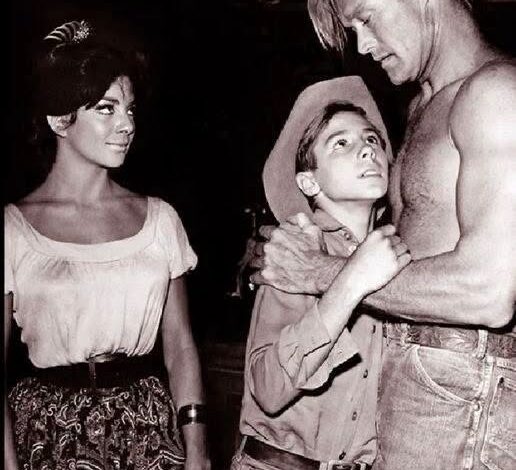
Chuck Connors brought physical authority to Lucas McCain. At well over six feet tall and with the presence of a former professional athlete, he could dominate a scene simply by entering it.
Yet some of his most memorable moments required almost no physical intimidation.
A conversation with Mark.
A hand on his son’s shoulder.
A quiet admission that he didn’t have every answer.
Those scenes revealed what the series actually believed strength looked like.
Strength wasn’t merely the ability to win a fight.
It was knowing when not to fight.
It was accepting responsibility.
It was admitting when you’d been wrong.
It was protecting someone without teaching them to hate.
And it was trying to remain decent in a world that repeatedly rewarded violence.
For young viewers, Mark often served as their doorway into that world.
Johnny Crawford gave the character a mixture of curiosity, innocence, stubbornness, and growing independence.
Mark admired his father enormously.
But he didn’t simply stand beside Lucas agreeing with everything he said.
He questioned him.
He became frightened.
He misunderstood situations.
He sometimes wanted to prove himself before he was ready.
In other words, he behaved like a child gradually becoming a young man.
That gave Lucas’s parenting real stakes.
He wasn’t merely keeping Mark physically alive.
He was shaping the kind of adult his son might eventually become.
Episodes frequently revolved around ideas that sound almost old-fashioned today.
Keep your word.
Don’t judge someone too quickly.
Respect other people.
Stand up for yourself.
Help someone weaker than you.
Accept the consequences of your decisions.
Tell the truth even when lying would be easier.
Those themes could easily have become preachy.
But The Rifleman usually placed them inside situations where Lucas himself had to wrestle with the answer.
That’s what made the lessons work.
Mark wasn’t being lectured by a flawless father.
He was learning beside one who was still figuring things out himself.
That dynamic helped the series stand apart from countless other Westerns filling American television schedules during the late 1950s and early 1960s.
And there were plenty.
The Western was one of television’s dominant genres.
Cowboys seemed to occupy nearly every channel.
Yet The Rifleman, which premiered in 1958, found an identity audiences immediately recognized.
Its frontier setting provided adventure.
Its father-son relationship provided heart.
Then there was the rifle itself.
Lucas’s modified Winchester became almost another character.
The large loop lever and rapid-fire technique gave him an instantly recognizable fighting style.
To viewers, Lucas could seemingly fire before most opponents had finished thinking about reaching for their guns.
It looked spectacular.
Was every aspect of it historically perfect?
Certainly not.
And that’s where watching old episodes today becomes especially entertaining.
Fans have spent decades noticing details that slipped past production.
Continuity errors.
Props appearing where they shouldn’t.
Clothing and equipment that don’t perfectly match the period.
Background locations recognizable from other productions.
Objects changing position between shots.
Occasionally, something appears suspiciously modern for a story supposedly taking place in the nineteenth-century American West.
And then there’s Lucas’s almost supernatural relationship with ammunition.
Like many television heroes of the era, he could sometimes accomplish feats that seemed to stretch the practical limitations of his weapon.
But those imperfections have become part of the fun.
Modern viewers can freeze frames.
Rewind scenes.
Compare episodes.
Research firearms.
Examine costumes.
Notice reused sets.
Audiences watching an original broadcast couldn’t do that nearly as easily.
An episode aired.
You watched it.
Then it was gone until a rerun.
Television production also operated differently.
Shows had schedules to maintain.
Sets were reused.
Props circulated.
Episodes had to be produced quickly.
There wasn’t always time or money to make every historical detail flawless.
The goal was convincing storytelling, not museum-level reconstruction.
And somehow, the imperfections now make the program feel warmer.
They remind us that people made this.
Carpenters built those sets.
Costume departments assembled those clothes.
Writers produced scripts on deadlines.
Actors rehearsed scenes.
Stunt performers took falls.
Editors assembled footage physically rather than endlessly manipulating digital images.
If something tiny slipped through, millions of viewers might never notice.
Today, those mistakes feel almost like fingerprints left behind by the production crew.
They’re evidence of a television era that depended heavily on imagination.
A relatively small set could become an entire frontier town.
The same patch of California landscape could represent countless locations.
A carefully framed street could convince viewers that civilization ended just beyond the camera.
Audiences willingly participated in the illusion.
Because the emotional truth mattered more than perfect geography.
That may explain why The Rifleman remains so watchable.
Its technical limitations aged.
Its central relationship didn’t.
A father worrying about whether he’s raising his child correctly doesn’t belong to any particular decade.
Neither does a child realizing that his parent isn’t invincible.
Those experiences remain recognizable.
Lucas wanted Mark to become strong.
But he also understood that strength without compassion could become cruelty.
That’s a remarkably important distinction for a Western built around a man famous for carrying a rifle.
Violence existed throughout the series.
Sometimes Lucas had no choice but to use it.
But the gun wasn’t supposed to be the source of his morality.
His judgment was.
That tension gave the character depth.
The rifle could protect Mark.
It couldn’t teach him how to become a good person.
Lucas had to do that himself.
And often the lessons moved in both directions.
Mark’s innocence sometimes forced Lucas to reconsider assumptions hardened by adult experience.
A child’s question could expose contradictions that grown men had learned to ignore.
That made their relationship feel less like a television device and more like a genuine bond.
Lucas was raising Mark.
Mark was also changing Lucas.
There was another element audiences responded to as well:
Affection between father and son wasn’t treated as weakness.
Lucas could be one of the toughest men in the territory and still openly care for his boy.
He could comfort him.
Worry about him.
Express pride.
Show fear when Mark was endangered.
The series never suggested that tenderness somehow diminished Lucas’s masculinity.
If anything, it strengthened it.
That’s one reason the character continues to resonate.
Modern entertainment sometimes assumes that complicated characters must be cynical.
Heroes need darkness.
Families need dysfunction.
Morality must always arrive wrapped in ambiguity.
Those stories can be excellent.
But The Rifleman reminds viewers that complexity can exist without hopelessness.
Lucas McCain wasn’t compelling because he secretly wanted to become a villain.
He was compelling because remaining decent was difficult, and he kept trying anyway.
That’s a different kind of drama.
And perhaps a rarer one now.
Watching the series today also creates an unexpected experience.
You notice how quiet television once allowed itself to be.
Not every emotional moment required dramatic music.
Not every disagreement needed an explosive confrontation.
Sometimes a father and son simply talked.
The camera stayed with them.
The audience was trusted to listen.
That simplicity can feel almost radical beside modern entertainment designed to compete constantly for attention.
Of course, nostalgia can make old television seem more perfect than it really was.
The Rifleman was a product of its era.
Some storytelling conventions have aged.
Historical portrayals can be simplified.
Certain episodes reflect assumptions modern audiences may view differently.
The frontier itself was far more complicated than classic television Westerns generally portrayed it.
Recognizing those limitations doesn’t require dismissing everything the show accomplished.
Two things can be true.
The series can be historically imperfect and emotionally powerful.
It can contain continuity mistakes while delivering memorable performances.
Its rifle can occasionally seem capable of impossible things while the relationship between Lucas and Mark remains deeply believable.
That’s part of the pleasure of revisiting it.
You’re watching both a story and an artifact.
A television drama about the Old West.
And a snapshot of how America imagined the Old West in the late 1950s.
Those are not exactly the same thing.
Decades later, viewers still remember the opening gunfire.
They remember Chuck Connors.
They remember Johnny Crawford.
They remember North Fork.
They remember that extraordinary Winchester.
But beneath those images is the reason the series lasted in people’s memories.
A father and his son.
Trying to build a life.
Trying to do the right thing.
Trying to understand each other.
Lucas McCain could shoot faster than almost anyone on television.
But his greatest challenge was never pulling the trigger.
It was teaching Mark when not to.
And maybe that’s why The Rifleman still matters.
The gun made the show exciting.
The imperfections made it human.
But the love between Lucas and Mark gave it something far more difficult to manufacture:
A heart.
More than half a century later, that heart is still beating every time someone sits down, hears that familiar opening, and returns to North Fork for one more episode.