Mom of 5-year-old boy who died after being mistakenly given cow’s milk at school has urgent plea..

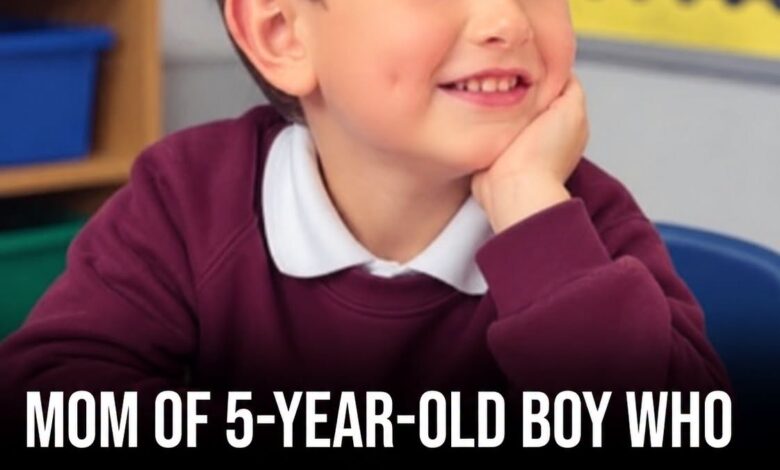
Benedict Blythe was five years old.
That fact should sit at the center of everything that came afterward.
Before the investigations, the policies, the campaigning, the meetings, and the arguments about what schools must do to protect children with severe allergies, there was simply a little boy whose parents had done what parents are repeatedly told to do.
They warned the school.
They explained his allergies.
They provided information about his care.
They made sure emergency medication was available.
They trusted the adults around their son to understand that an allergy wasn’t a preference, an inconvenience, or a dietary eccentricity.
It could be life or death.
Then came the day that trust failed.
Benedict was known to have severe allergies, including to cow’s milk protein. Yet he was given something containing the very allergen his family had worked to protect him from.
For most children, milk is ordinary.
A carton at lunch.
Something poured over cereal.
An ingredient nobody thinks twice about.
For a severely allergic child, ordinary food can become an emergency.
That is one of the hardest realities for people without serious allergies to understand.
The danger often doesn’t look dangerous.
There is no warning label visible from across the room.
No smoke.
No flame.
No obvious threat.
It may look like a biscuit.
A spoonful of dessert.
A sandwich.
A splash of milk.
The difference between harmless and catastrophic can be an ingredient most people consume without thinking.
That is why systems matter.
Memory isn’t enough.
Good intentions aren’t enough.
“I thought someone else had checked” isn’t enough.
When a child has a potentially life-threatening allergy, safety has to exist beyond any one person’s recollection.
The plan has to be known.
The medication has to be accessible.
Staff have to understand what anaphylaxis can look like.
And when an emergency begins, people have to know what to do without losing precious time to uncertainty.
Benedict’s case became devastating not simply because something went wrong, but because his family had tried to make sure people knew what could go wrong.
His parents had provided detailed information.
There were agreed processes.
There was an allergy plan.
Emergency adrenaline was available.
Yet the protections that existed on paper did not protect the child when they mattered most.
As Benedict’s reaction developed, the emergency response became a race against a process already moving inside his body.
Anaphylaxis can escalate rapidly.
Symptoms can affect breathing and circulation, and severe reactions require urgent treatment. Adrenaline auto-injectors exist precisely because hesitation during a suspected severe reaction can be dangerous.
For Benedict, the intervention came too late to save him.
There is no bureaucratic language capable of making that sentence bearable.
A five-year-old went to school.
He did not come home.
His parents were left with the particular agony that follows a preventable or potentially preventable tragedy: not only grief, but questions.
What if the plan had been properly communicated?
What if everyone responsible had understood the severity?
What if the allergen had never reached him?
What if the warning signs had been recognized sooner?
What if adrenaline had been administered earlier?
Grief already asks impossible questions.
System failure gives grief paperwork.
Reports.
Timelines.
Policies.
Procedures.
Meetings.
Recommendations.
A family mourning a child can suddenly find itself becoming an investigator into the circumstances of that child’s final hours.
They learn terminology they never wanted to know.
They read documents they wish did not exist.
They discover the distance between a policy being written and a policy being followed.
And eventually, some families arrive at an unbearable realization:
This cannot happen to another child.
Benedict’s parents turned that realization into action.
Not because campaigning somehow erased their grief.
Nothing could.
A new policy doesn’t restore a child’s footsteps in the hallway.
A training course doesn’t return his voice.
Legislation cannot recreate the morning before everything changed.
But grief can sometimes become a demand.
If Benedict could not be protected, perhaps another Benedict could.
Another child carrying an adrenaline auto-injector.
Another parent standing at a school gate and explaining, again, that “allergic” doesn’t mean “doesn’t like.”
Another teacher wondering whether a reaction is serious enough to act.
Another classroom where seconds could matter.
The campaign associated with Benedict’s name pushed allergy safety in schools into a conversation much larger than one family’s tragedy.
The central principle is painfully simple:
Schools should not improvise their response to life-threatening allergies.
They should prepare before the emergency.
Staff need clear information.
Individual healthcare and allergy plans need to reach the people actually supervising the child.
Medication needs to be available and accessible.
Training needs to be practical enough that adults can recognize a serious reaction and respond appropriately.
Responsibilities need to be clear.
And allergy management cannot become something everyone assumes somebody else understands.
Because emergencies expose vague responsibility.
When five adults each think another adult is responsible, a child can effectively have no one.
This is why allergy safety cannot live only inside a binder in an office.
A beautiful policy nobody remembers during lunch is not protection.
A care plan that doesn’t reach relevant staff is not protection.
Medication that technically exists but cannot be reached quickly when needed is not protection.
Training completed years earlier and forgotten is not protection.
The real test is frighteningly practical.
A child begins reacting.
Does the adult standing beside that child recognize what is happening?
Do they know where the adrenaline is?
Do they know how to use it?
Do they act?
That is where policy becomes reality.
Benedict’s mother has described hearing from teachers who say greater awareness and training have made them feel more confident about responding to allergy emergencies.
Imagine what those messages must mean.
They cannot make what happened acceptable.
But somewhere, a teacher may now notice the signs sooner.
Somewhere, a member of staff may reach for adrenaline instead of waiting to see whether symptoms settle.
Somewhere, a parent may leave a child at school with slightly more confidence that the adults inside understand the responsibility they have accepted.
And somewhere, a child may come home because somebody knew what to do.
That is the strange, painful shape of legacy.
We often speak about legacy as though it were something people consciously build during long lives.
Sometimes it is forced upon a family by a life that was far too short.
Benedict didn’t choose to become a symbol of allergy safety.
He was five.
He should have been allowed to become something entirely different.
He should have had years to discover what he loved.
Years to change his mind about what he wanted to be.
Birthdays.
School photographs.
Friendships.
Arguments.
Holidays.
Ordinary mornings when nothing important happened.
That is what was lost.
And remembering that prevents the policy discussion from becoming abstract.
There is also a danger after any tragedy that institutions respond by producing more paperwork.
A revised document.
A new checklist.
An email.
A training link.
A policy uploaded somewhere.
Those things can matter.
But Benedict’s story demands something harder.
Culture.
A school culture where allergies are taken seriously without isolating allergic children.
Where staff don’t roll their eyes at precautions.
Where substitute teachers and temporary staff can access essential information.
Where children aren’t embarrassed for carrying medication.
Where classmates understand that swapping food can have consequences.
Where parents aren’t made to feel difficult for repeatedly asking whether safety procedures are actually being followed.
And where adults understand that administering emergency treatment in accordance with medical guidance isn’t an overreaction when anaphylaxis is suspected.
Preparedness should happen before fear enters the room.
Because once a severe reaction begins, nobody wants the first question to be:
“What are we supposed to do?”
Benedict’s parents should never have needed to become campaigners.
They should have been allowed to remain simply his parents.
Yet they took the worst thing that had happened to their family and forced institutions to confront what his death revealed.
That doesn’t turn tragedy into something good.
Some losses should never be repackaged as inspirational.
A child died.
No reform makes that fair.
But reform can make remembrance active.
Every allergy plan that is actually read.
Every member of staff properly trained.
Every emergency medication checked and accessible.
Every adult who recognizes anaphylaxis and responds without dangerous delay.
Every allergic child allowed to participate in school life with dignity rather than fear.
Those are not administrative details.
They are the difference between having a policy and having protection.
Benedict was only five years old when his family discovered that distinction in the cruelest possible way.
His name now carries a message every school should understand without needing another tragedy to teach it:
When a child’s allergy can become life-threatening, preparation is not paperwork.
It is care.
It is responsibility.
And sometimes, it is the thing that gets a child safely home.