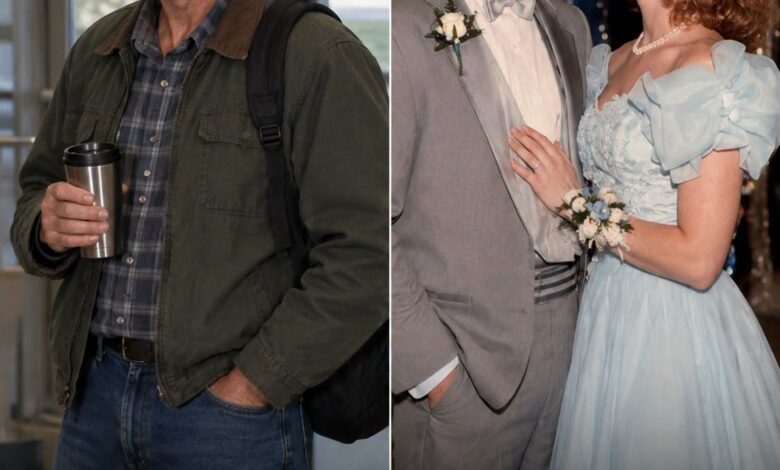
Diane expected dinner to be awkward.
She did not expect to look across the table and see her dead brother’s eyes.
Tyler had warned her that Noah was nervous about meeting her. He had been dating him long enough for the introduction to matter, and Diane had spent the afternoon reminding herself not to interrogate the poor young man.
Be warm.
Don’t ask too many questions.
Don’t embarrass Tyler.
Those were the rules.
Then Noah walked through the door.
“Mom, this is Noah.”
Diane smiled automatically and reached out to greet him.
“It’s wonderful to finally—”
The words disappeared.
Noah had Michael’s eyes.
Not vaguely.
Not in the sentimental way people find similarities when they’re looking for them.
He had the same dark, slightly uneven eyes Diane remembered from childhood, the left narrowing a little more whenever Michael smiled.
Then she noticed the pendant around Noah’s neck.
A small silver compass.
Diane stopped breathing.
“Where did you get that?”
Noah glanced down.
“This?”
His fingers closed around the pendant.
“My dad gave it to me.”
Tyler looked between them.
“Mom?”
Diane barely heard him.
“What’s your father’s name?”
Noah’s expression changed.
The question had become too intense too quickly.
“Michael.”
The room seemed to tilt.
Diane gripped the back of a chair.
“Michael what?”
Noah answered.
And twenty-two years of grief cracked open.
Michael had been Diane’s younger brother.
He had also been, as far as the family understood, gone.
There had been a final argument with their father, a departure filled with anger, then years of silence. At first everyone expected Michael to call when he calmed down.
Weeks became months.
Months became years.
There were searches.
Phone calls.
Questions.
Rumors.
Occasional supposed sightings that led nowhere.
Eventually, the family did what families sometimes do when uncertainty becomes unbearable.
They began grieving someone who had never officially been declared dead.
Diane had hated herself for it.
She had imagined Michael living somewhere.
Then she had imagined him dying somewhere.
Both possibilities hurt.
Now his son was standing in her dining room.
“Noah,” she said carefully, “do you have a picture of your father?”
Tyler stepped closer.
“Mom, you’re scaring him.”
“I’m sorry. I just need to see.”
Noah hesitated before taking out his phone.
He scrolled.
Then turned the screen toward her.
Diane sat down.
Michael was older.
His hair had thinned. There were lines beside his mouth that hadn’t existed when she last saw him. A beard covered part of the face she remembered.
But it was him.
Her little brother.
Alive.
She touched the screen before realizing what she was doing.
“Oh my God.”
Noah pulled the phone slightly back.
“You know him?”
Diane looked up.
“He’s my brother.”
Silence.
Tyler laughed once, nervously.
“What?”
“Michael is my brother.”
Noah stared at her.
“That’s impossible.”
“I wish it were.”
Diane asked questions she never imagined asking her son’s boyfriend.
Michael’s birthday.
Where he’d grown up.
His parents’ names.
A scar near his right elbow.
The compass pendant.
Each answer closed another door through which coincidence might have escaped.
Finally Tyler sank into a chair.
“If he’s your brother…”
Nobody finished the sentence.
They didn’t need to.
The tender relationship Tyler and Noah had been building had just collided with a truth neither of them could have known.
They were family.
The realization was brutal precisely because no one had done anything knowingly wrong.
There was no betrayal between them.
No deception.
Just two young people who had met, cared for each other, and discovered that history had placed a boundary between them neither had been able to see.
Noah began crying first.
“I’m going to be sick.”
Tyler followed him outside.
Diane stayed behind because she understood there are moments when a mother cannot fix what has happened by entering the room.
Later, Tyler came upstairs alone.
His face was swollen.
“We ended it.”
Diane pulled him against her.
“I’m so sorry.”
“How could nobody know?”
There was no good answer.
Because Michael had disappeared.
Because families fracture.
Because pride can outlive arguments.
Because silence, given enough years, becomes architecture.
And because children can inherit consequences from battles they never fought.
The next morning, Diane called Michael.
Noah had given her the number.
She stared at it for nearly an hour before pressing the button.
Michael answered on the fourth ring.
“Hello?”
Her brother’s voice had changed.
And hadn’t.
Diane couldn’t speak.
“Hello?”
Finally she whispered, “Michael.”
Silence.
Then:
“Diane?”
One word erased twenty-two years.
She cried so hard she couldn’t answer.
Michael didn’t hang up.
When they finally managed to speak, the reunion wasn’t beautiful.
Not at first.
There were too many questions.
“Why didn’t you call?”
“I couldn’t.”
“For twenty-two years?”
“You don’t understand.”
“Then make me understand.”
Michael told her he had left believing the family wanted him gone. Pride hardened into shame. Shame hardened into avoidance.
Then life accumulated.
Work.
A relationship.
A child.
Bills.
Responsibilities.
Every year made returning more difficult because every year added another question he would have to answer.
“After a while,” he said, “I didn’t know how to come back.”
“So you stayed dead?”
He inhaled sharply.
“I didn’t know you thought I was dead.”
“What did you think we thought?”
That question finally broke him.
Their first conversation lasted three hours.
It resolved almost nothing.
Their second was shorter.
Their third was easier.
Some days Diane was furious.
Other days she found herself laughing at a childhood memory and suddenly heard the sixteen-year-old Michael beneath the older man’s voice.
Forgiveness did not arrive as a grand decision.
It came in installments.
A phone call returned.
A question answered honestly.
An apology without an excuse attached.
A photograph sent.
A memory confirmed.
Eventually, Diane and Michael met.
When she saw him walking toward her, she discovered something strange about grief.
The body remembers.
Before her mind could reconcile the older man with the brother she’d lost, she was already moving.
Michael stopped several feet away.
“Diane.”
She slapped him.
He closed his eyes.
Then she threw her arms around him.
“You idiot.”
“I know.”
“I hated you.”
“I know.”
“I missed you.”
His arms tightened around her.
“I know.”
No reunion could restore what they had lost.
Michael had missed marriages, funerals, birthdays, holidays, ordinary Sundays.
Diane had missed Noah’s childhood without even knowing he existed.
There were photographs she could see but memories she could never enter.
That loss deserved grief.
Finding someone alive does not automatically return the years spent without them.
Meanwhile, Tyler and Noah were grieving differently.
They kept their distance.
They had made the painful decision that their romantic relationship could not continue after discovering the family connection.
Diane worried about both of them.
Noah eventually told her, “I don’t regret knowing Tyler.”
She understood.
Something can be impossible to continue without becoming meaningless.
Their relationship had been real before they understood the truth.
Ending it didn’t erase the kindness, laughter, or affection that had existed.
It simply acknowledged a boundary reality had placed where neither of them wanted one.
Months passed.
Michael began appearing in Diane’s life cautiously.
Coffee first.
Then dinner.
Eventually holidays.
Nobody pretended everything was normal.
That would have been another kind of lie.
There were still awkward silences.
Still questions Michael couldn’t answer well.
Still moments when Diane looked at him and remembered all the years she’d wondered whether he was buried somewhere without a name.
But there were new memories too.
That mattered.
One evening, Diane and Michael sat together after everyone else had gone home.
The silver compass pendant rested against Noah’s shirt across the room.
Diane looked at it and smiled sadly.
“Dad gave you that.”
Michael nodded.
“The night before everything happened.”
“You kept it.”
“Some things are harder to leave than people.”
Diane looked at him.
“Don’t disappear again.”
Michael’s eyes filled.
“I won’t.”
She couldn’t know whether life would honor that promise.
None of us can.
But she chose to believe the man sitting beside her was finally ready to stop running.
Their family would never become what it might have been.
Tyler and Noah couldn’t unknow what they had learned.
Diane and Michael couldn’t recover twenty-two missing years.
There are losses forgiveness cannot reverse.
But forgiveness was never a time machine.
It was permission to stop letting yesterday decide every tomorrow.
Michael had spent decades believing there was no road home because he’d waited too long to take the first step.
Diane had spent those same years believing her brother was beyond reach.
Both had been wrong.
The road was still there.
Damaged.
Overgrown.
Painfully unfamiliar.
But there.
And this time, instead of mourning the family they should have been, they began building the family they still had time to become.