On September 11, the most powerful sound in Lower Manhattan is often the one deliberately withheld.
No campaign speech.
No partisan argument.
No politician trying to explain what the day means.
Instead, there are names.
One after another.
Names spoken by children who never knew the parents they lost. Names read by husbands, wives, siblings, grandchildren, and relatives who have spent years learning how to carry an absence that never entirely becomes ordinary.
That restraint is not accidental.
For many families of those killed on September 11, 2001, the annual ceremony at Ground Zero is sacred precisely because political leaders are expected to surrender the microphone. They may attend. They may stand beside former presidents and public officials. They may bow their heads and listen.
But the voices at the center belong to the families.
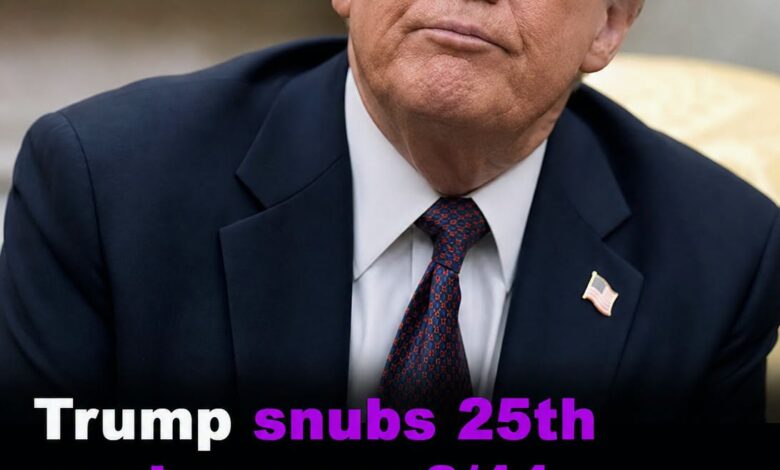
Against that backdrop, Donald Trump’s decision, as described, to skip the New York ceremony and instead attend the Pentagon observance—where he would be able to speak—creates an image almost guaranteed to produce competing interpretations.
Supporters can see principle in it.
Critics can see ego.
And somewhere beneath both arguments is a much older question about September 11:
Who gets to speak for grief?
The rules in New York grew out of painful experience.
Ground Zero has never been merely a ceremonial location. It is a grave site, a national symbol, a tourist destination, a piece of New York City, and a place of intensely personal mourning.
Those meanings have collided repeatedly.
Over the years, arguments erupted over memorial design, rebuilding, security, politics, religion, access, commercialization, and the proper way to commemorate what happened there.
Families did not always agree with one another.
Neither did politicians.
That is partly why simplicity became so valuable.
Read the names.
Observe the silences.
Remember the dead.
Do not turn the microphone into a political prize.
The rule applies regardless of party. A Democratic president does not become more entitled to speak there because supporters believe his words would be comforting. A Republican president does not gain an exception because of the office he holds.
The boundary works only if the boundary remains stronger than the individual.
That is what makes Trump’s choice politically potent.
At the Pentagon, the format is different.
There, he can address the country directly.
For his supporters, that may seem entirely appropriate. A president is not merely another politician on September 11. The presidency carries responsibilities involving national security, military leadership, remembrance, and the government’s response to terrorism.
From that perspective, choosing a ceremony where the commander in chief can actually speak may look less like avoiding New York’s rules and more like fulfilling a presidential role.
Why attend an event where protocol deliberately limits presidential participation when another major September 11 site offers the opportunity to deliver a national message?
That argument has logic.
But critics will inevitably see the same choice differently.
Trump has built much of his political identity around refusing to let institutions dictate the terms on which he communicates.
He speaks.
He responds.
He dominates attention.
Silence has rarely been central to his public style.
So when confronted with a ceremony whose power depends partly on political leaders agreeing not to speak, his absence can easily be interpreted as revealing.
Not because attending the Pentagon is somehow disrespectful. One hundred eighty-four people were killed there and aboard American Airlines Flight 77. The site carries its own enormous weight of grief.
The criticism instead rests on motive.
Did Trump choose the Pentagon because presidential remarks were appropriate there?
Or because New York would not give him a microphone?
Those are very different explanations for the same decision.
And unless Trump explicitly answers the question in a way people find convincing, Americans will probably interpret the choice through what they already believe about him.
That is the problem with political symbolism.
The act itself can be simple.
The meaning rarely is.
Then comes the visual contrast.
In Manhattan, JD Vance would represent the administration while standing in the same commemorative space as Bill Clinton, George W. Bush, and Barack Obama.
Three former presidents.
One sitting vice president.
Families at the microphones.
Names moving slowly through the morning.
Elsewhere, Trump would stand at another site scarred by the same attacks and deliver remarks.
It creates a split screen almost too perfectly constructed for television.
Silence on one side.
A microphone on the other.
Neither location owns September 11.
Neither grief is more legitimate.
The people killed in New York, at the Pentagon, and aboard Flight 93 were victims of the same coordinated attack. Their families have carried different versions of the same national wound for a quarter century.
But television reduces complicated things into images.
And images become arguments.
One frame may show former presidents quietly observing a ceremony designed around the victims’ names.
Another may show the sitting president speaking beneath the weight of the Pentagon.
Supporters will say leadership sometimes requires words.
Critics will say remembrance sometimes requires surrendering the need to be heard.
Both interpretations will spread instantly.
Yet perhaps the deeper significance lies not in Trump himself but in the rule he is encountering.
Political leaders spend their lives in environments designed to amplify them.
Motorcades stop traffic.
Rooms stand when they enter.
Cameras follow them.
Reporters record their words.
Entire institutions exist to transmit presidential speech across the world.
Ground Zero asks something radically different.
Come.
Stand here.
Listen.
For a few hours, your title does not put your voice above the names being read.
There is something profoundly democratic about that.
The most famous person present may not be the most important person present.
A president can stand feet away from a woman reading the name of her dead brother, and for those few seconds, she possesses the microphone.
Not because she won an election.
Because she lost someone.
That distinction helps explain why families have fought so fiercely to protect the ceremony from political appropriation.
September 11 has already carried more politics than almost any tragedy could bear.
Wars followed.
Elections were fought partly around its legacy.
Security laws changed.
Foreign policy changed.
American culture changed.
The dead have been invoked in arguments they never lived to hear.
At the memorial itself, restraint offers something increasingly rare:
A boundary.
Not everything must become a speech.
Not every silence needs to be filled.
Not every sacred space must adapt itself to the preferences of whoever currently holds power.
That does not make the Pentagon ceremony lesser because a president speaks there.
Different memorial traditions can honor the same tragedy differently.
Words can comfort.
Presidential speeches can carry historical significance.
Silence can carry significance too.
The mistake would be assuming only one form of remembrance is legitimate.
Twenty-five years after the attacks, America still has not fully settled what September 11 means.
Perhaps it never will.
For some, it is primarily personal grief.
For others, national trauma.
Military history.
Political history.
A warning.
A memory of extraordinary solidarity.
Or the beginning of decisions whose consequences are still debated.
All those meanings occupy the same date.
That is why motive matters—and why it is so difficult to prove.
Trump’s supporters may watch him at the Pentagon and see a president refusing to be ceremonial furniture, choosing instead to articulate what the country should remember.
His critics may watch and see a politician choosing the memorial that permits him to remain the speaker rather than accepting a tradition that asks him to become a listener.
Meanwhile, in New York, the names will continue.
That may ultimately be the image that survives the political argument.
Not Clinton.
Not Bush.
Not Obama.
Not Vance.
Not Trump.
A family member approaching a microphone.
A photograph held against someone’s chest.
A voice trembling on a familiar name.
A bell.
A moment of silence.
Then another name.
And another.
Politics will inevitably surround September 11 because politics surrounds nearly everything of national importance.
But Ground Zero’s tradition makes a different claim.
For one morning, politicians can be present without being central.
They can honor the dead without interpreting them.
They can stand before history without demanding that history hand them the microphone.
Because sometimes leadership means speaking.
And sometimes the most respectful thing power can do is stand quietly while somebody else says the name.