My 14-Year-Old Son Repaired Our Elderly Neighbor’s Fence After the Storm – The Next Morning, Officers Arrived With a Note She’d Left for Him

The morning everything changed arrived quietly, almost politely, disguised as another ordinary day.
There was no warning.
No phone call in the middle of the night.
No instinctive sense that life was about to reopen wounds I had spent years trying to bury beneath routine.
I was standing in the kitchen staring blankly at a piece of toast that had burned black in the toaster while my coffee cooled untouched beside me. My thoughts had drifted somewhere dangerous again — toward Jeremiah.
They did that more often than I admitted out loud.
Some mornings grief returned gently, like an old song playing faintly from another room. Other days it arrived heavier, sharper, hidden inside tiny things that shouldn’t have mattered:
the sound of boots on wooden stairs,
a familiar laugh in a grocery store,
a teenage boy pushing hair out of his face exactly the same way his father used to.
My son Ethan carried Jeremiah everywhere without realizing it.
The same dark eyes.
The same quiet stubbornness.
Even the way he moved when focused on something reminded me painfully of the man I lost.
Usually those similarities comforted me.
That morning, they felt heavier somehow.
Then flashing red and blue lights reflected across the kitchen window.
The mug slipped slightly in my hands.
My chest tightened instantly because some fears never leave your body once they enter it.
I knew those lights.
Years earlier, police lights had arrived outside another house on another ordinary morning and split my life permanently into before and after. That was the day Jeremiah died. Ever since then, emergency lights no longer looked like help to me.
They looked like endings.
I didn’t think.
I just moved.
The front door flew open so hard it struck the wall behind it. Two officers stood on the porch while cold morning air rushed inside around them. Across the street, my elderly neighbor Mrs. Whitmore’s front door hung partially open.
Something about the stillness felt wrong.
“Are you Devon?” the older officer asked carefully.
“Yes,” I answered too quickly. “What happened?”
They exchanged one of those brief professional glances people share before delivering difficult information.
“Your neighbor was found wandering outside this morning,” he explained gently. “Disoriented. Someone nearby called emergency services.”
My stomach dropped immediately.
“Is she okay?”
“She’s stable,” he said. “But she won’t be returning home alone right away.”
Then the younger officer stepped forward and handed me a sealed envelope.
My son’s name was written neatly across the front in shaky handwriting.
Ethan.
I frowned immediately.
“Why does she have a letter for my son?”
The officer adjusted awkwardly.
“She specifically asked for it to be delivered to him.”
Something cold moved quietly through my chest then.
Not fear exactly.
Recognition.
Like standing near the edge of a memory I couldn’t fully see yet.
“She mentioned he helped her yesterday,” the officer added. “Said it was important.”
And suddenly yesterday replayed itself clearly.
Ethan had come home just before dinner covered in dirt, grass stains, and flecks of white paint.
His hoodie was torn slightly near the sleeve.
“You look like you fought a construction site,” I told him.
He shrugged casually while opening the refrigerator.
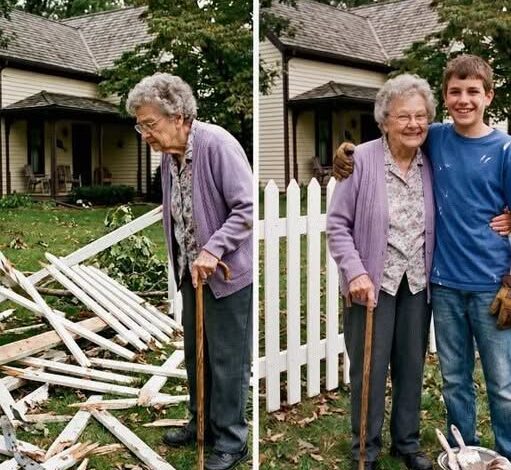
“Mrs. Whitmore’s fence collapsed during the storm. I fixed it.”
“At fourteen?”
“She needed help.”
That was Ethan entirely.
No speeches.
No performance.
No need for praise afterward.
Just quiet kindness delivered like it was the most ordinary thing in the world.
I remembered driving him to the hardware store afterward because he insisted the fence needed proper materials instead of temporary repairs. I remembered watching him measure wood carefully while Mrs. Whitmore sat nearby wrapped in a blanket despite the warm evening air.
At sunset, she hugged him tightly before we left.
“You’ve got your father’s hands,” she whispered softly.
At the time I thought she simply meant hardworking hands.
Now standing in my kitchen holding that envelope, the sentence suddenly sounded different.
Dangerously different.
My fingers trembled slightly as I opened it.
Inside were two separate letters.
One addressed to Ethan.
One addressed to me.
I opened mine first.
“Devon,
If you’re reading this, then I no longer have the courage to say these things face to face.
I need you to understand something.
I am not just your neighbor.
I am Jeremiah’s mother.”
The room disappeared.
For several seconds I genuinely thought I’d misread the sentence.
I read it again.
Then again slower.
Still impossible.
Mrs. Whitmore.
The quiet widow next door who baked blueberry pies every fall and waved from her porch swing every morning.
The woman Ethan helped carry groceries for.
The woman who lived twenty feet away from us for nearly three years.
Jeremiah’s mother.
My knees weakened enough that I had to sit down immediately.
Suddenly old memories came flooding back violently:
Jeremiah standing beside me outside a courthouse promising we’d build our own family if his parents refused to accept us.
The coldness in his mother’s eyes the first time she met me.
The silence after his death.
No phone call.
No flowers.
No acknowledgment at all.
When Jeremiah died in that car accident eight years earlier, his family disappeared completely.
I grieved alone.
Raised Ethan alone.
Buried Jeremiah emotionally without them beside me.
And all this time…
She had been right next door.
The letter continued shakily.
She admitted everything:
the pride,
the distance,
the years of silence she never knew how to undo.
After Jeremiah died, she wrote, shame consumed her. She wanted to reach out eventually but convinced herself too much time had passed. Then years later she accidentally found us through social media and discovered we lived only one town away.
Instead of contacting me honestly, she moved nearby quietly after her husband passed away.
Close enough to watch.
Too ashamed to introduce herself.
“I told myself I had forfeited the right to know my grandson,” she wrote. “So I settled for seeing him from afar.”
Tears blurred the words suddenly.
Then came the sentence that broke me completely:
“The day Ethan repaired my fence without being asked, I realized my son survived in him more than I deserved.”
Behind me, footsteps creaked softly across the hallway.
“Why are there police outside?”
Ethan stood there half-awake rubbing his eyes.
Still a child in so many ways.
Already carrying so much of his father in every movement.
I looked at him for a long moment before speaking.
“Come sit with me.”
He read his letter faster than I expected at first.
Then slower.
Then completely from the beginning again.
Finally he looked up.
“She’s Dad’s mom?”
“So it seems.”
“You didn’t know?”
“No.”
He sat silently processing it.
Unlike adults, teenagers often move through emotional shock differently. They don’t immediately search for complexity or excuses. They search for emotional truth.
“Why wouldn’t she tell us?”
I exhaled slowly.
“Because people sometimes make choices they don’t know how to fix afterward.”
He stared down at the letter again.
“Did she love Dad?”
“Yes,” I answered immediately.
“Then why wasn’t she there after he died?”
That question hurt because I had asked myself versions of it for years.
“She should’ve been,” I admitted quietly. “But loving someone doesn’t always mean people know how to show up correctly.”
He absorbed that silently.
Then:
“She wants to see us.”
I nodded.
“We should go.”
The hospital room smelled faintly of antiseptic and old flowers.
Mrs. Whitmore looked smaller somehow lying there beneath pale blankets. Fragile in ways she never appeared sitting proudly on her porch each morning.
When she saw Ethan, her eyes filled instantly.
Then she looked at me.
“I’m sorry,” she whispered.
And for a moment, anger rose so fast inside me I almost walked out again.
Not because she lied.
Because she stole years from us.
Years Ethan could’ve known his grandmother.
Years Jeremiah’s memory could’ve existed somewhere besides inside me alone.
“You should be,” I replied honestly.
She nodded immediately accepting it.
No defensiveness.
No excuses.
Only exhaustion.
Ethan stepped closer first.
“Why didn’t you tell me?”
Her voice shook badly now.
“Because I was ashamed of who I’d been after your father died.”
She explained everything then:
the guilt,
the regret,
the fear that I would reject her completely.
So instead she chose cowardice disguised as distance.
“I thought watching from nearby was enough,” she admitted softly. “But it wasn’t. It was just easier.”
Ethan looked toward me briefly.
“She was alone,” he said quietly.
That sentence shifted something inside me unexpectedly.
Not forgiveness.
Not yet.
But perspective.
I sat beside her bed slowly.
“I don’t know what to do with this,” I admitted.
“You don’t have to decide today,” she whispered.
For several seconds nobody spoke.
Then I reached carefully for her hand.
Not because everything was healed suddenly.
But because Jeremiah was gone forever, and grief had already stolen enough years from all of us.
“When you leave here,” I said slowly, “you can stay with us awhile.”
Her face crumpled instantly.
“You’d do that?”
“We’ll figure the rest out later.”
Ethan smiled quietly beside me.
And for the first time since entering the hospital room, Mrs. Whitmore — Jeremiah’s mother — finally looked less like a stranger and more like family trying desperately to find her way home too late.
Back at the house that evening, the repaired fence stood strong beneath fading sunset light.
Perfectly straight.
Carefully reinforced.
Built to hold.
Ethan stopped beside it silently.
“I just didn’t want her to see it broken,” he murmured.
I wrapped my arm around his shoulders tightly.
“I know.”
And staring at that fence, I realized something painful and beautiful all at once:
Ethan thought he was repairing damaged wood.
But somehow, without realizing it, he had started rebuilding an entire family from splinters neither of us even knew still existed.