At 4:17 that afternoon, people began walking out of their houses and staring at the sky.
Traffic slowed.
Children pointed upward.
Workers stepped outside businesses with phones raised.
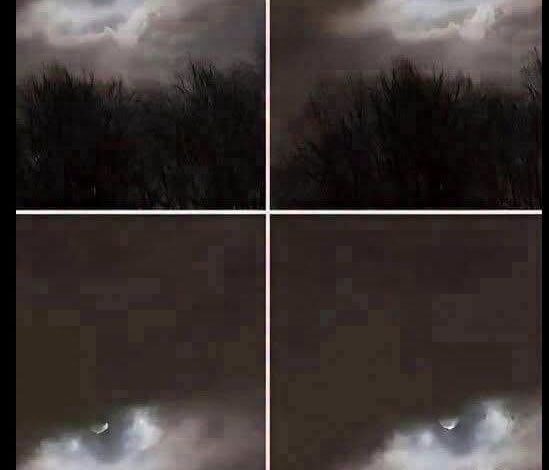
Above the town hung a cloud unlike anything most residents could remember seeing.
Its edges curved with almost unnatural precision. From one angle, it resembled a enormous face. From another, it looked like a doorway opening across the sky.
Within minutes, photographs were everywhere.
And almost immediately, people began arguing about what they meant.
Meteorologists offered the least dramatic explanation.
Clouds can form extraordinary shapes when moisture, temperature, wind, and terrain interact under particular conditions. Air can rise, cool, condense, and produce formations that appear surprisingly structured.
Nature doesn’t need an artist to create something beautiful.
Physics is enough.
But that explanation didn’t satisfy everyone.
Some residents insisted the cloud looked too symmetrical.
Too deliberate.
Too perfect.
One photograph seemed to show what looked like an eye.
Another angle produced something resembling enormous wings.
Someone enhanced the contrast and claimed there were geometric patterns hidden inside.
Then came the theories.
Secret aircraft.
Weather manipulation.
Experimental technology.
A warning.
A sign.
An omen.
By evening, the cloud had become whatever each observer needed it to be.
For some, it was evidence of something being hidden.
For others, it was spiritual.
A few people connected its appearance to recent tragedies in the community.
Others searched historical photographs for similar formations.
One resident reportedly joked that the town hadn’t agreed on anything in years, but had somehow united around arguing about a cloud.
The strange thing was that everyone had seen essentially the same object.
Yet they hadn’t experienced the same event.
One person saw atmospheric physics.
Another saw a message.
Another saw danger.
Another saw beauty.
And that difference reveals something fascinating about the human mind.
Our brains are extraordinarily good at finding patterns.
Sometimes too good.
We see faces in electrical outlets.
Animals in rock formations.
Figures in shadows.
Shapes in flames.
And entire worlds in clouds.
Psychologists call one version of this tendency pareidolia—the perception of recognizable forms in ambiguous visual information.
It isn’t stupidity.
It’s part of how human perception works.
Recognizing patterns quickly helped our ancestors navigate environments filled with uncertainty.
Spotting something that might be a face, predator, or threat could matter enormously.
The brain therefore doesn’t passively record reality like a camera.
It interprets.
It guesses.
It completes incomplete information.
Usually, that ability is incredibly useful.
Occasionally, it makes a cloud look like it’s staring back at us.
Social media adds another layer.
Before smartphones, someone might have noticed an unusual cloud, mentioned it over dinner, and forgotten about it by morning.
Now one photograph can reach thousands of people before the cloud itself disappears.
And each person can modify the story.
Someone circles a shape.
Someone increases the contrast.
Someone posts an ominous caption.
Someone asks, “Does anyone else see this?”
After you’ve been told what to look for, it becomes difficult not to see it.
Suddenly the vague shadow really does resemble an eye.
The curved edge really does look like a wing.
The random formation begins feeling intentional.
Then repetition creates familiarity.
And familiarity can begin feeling like evidence.
By sunset, the original cloud had almost become irrelevant.
The photographs had taken over.
People who hadn’t even been outside were debating what residents had witnessed.
Some demanded scientific explanations.
Others dismissed those explanations before reading them.
The discussion became less about atmospheric conditions and more about trust.
Who do you believe?
Scientists?
Authorities?
Neighbors?
Your own eyes?
That may explain why mysterious events can become so emotionally powerful.
Uncertainty makes people uncomfortable.
We prefer causes.
Stories.
Patterns.
An explanation—even a frightening one—can sometimes feel safer than admitting we don’t completely understand what we’re seeing.
If something is secret technology, then somebody is in control.
If it’s a warning, then it has meaning.
If it’s an omen, then perhaps events aren’t random.
But if it’s simply water droplets suspended in moving air that happened to form an extraordinary shape?
Then nobody planned it.
Nobody sent it.
Nobody chose what it resembled.
It simply happened.
For some people, randomness is the hardest explanation of all.
The following morning, the sky looked completely ordinary.
Blue in some places.
Gray in others.
The strange formation was gone.
Cars moved normally again.
Businesses opened.
Children returned to school.
Nothing had happened.
And yet something had changed.
People kept talking about it.
At lunch counters.
In classrooms.
Across backyard fences.
Online.
Children drew pictures of the cloud from memory, exaggerating the features adults had spent the previous evening debating.
Some drawings gave it enormous eyes.
Others transformed it into an angel.
One child reportedly drew nothing more than a giant smiling face floating over the town.
Everyone had inherited a slightly different cloud.
That’s perhaps the most interesting part of the story.
The physical object lasted minutes.
The interpreted object lasted much longer.
That’s because human beings don’t merely experience events.
We narrate them.
We turn coincidence into stories.
We attach memories to weather.
We transform shapes into symbols.
We search for meaning because meaning makes an unpredictable world easier to carry.
Science and wonder don’t have to be enemies in that process.
Understanding how a cloud forms doesn’t make it less beautiful.
Knowing why the brain recognizes faces in random patterns doesn’t make the experience less fascinating.
Sometimes the most extraordinary explanation isn’t that something supernatural appeared above us.
It’s that ordinary atmospheric processes can produce something capable of stopping an entire town.
And that thousands of human brains can look at the same silent formation and create hundreds of different stories.
Perhaps that’s what truly happened that afternoon.
The sky didn’t change the town.
The town revealed itself through the sky.
People projected fear onto it.
Faith onto it.
Suspicion.
Curiosity.
Hope.
Each person looked upward and found something partly created by the cloud and partly created inside themselves.
Eventually, wind pulled the formation apart.
The doorway closed.
The face disappeared.
The wings dissolved.
Water vapor became ordinary sky again.
But the photographs remained.
So did the arguments.
Years later, people might forget exactly what day it happened.
They might disagree about its shape.
Someone will insist it looked unmistakably like a face.
Someone else will swear it was nothing unusual.
Both will remember being certain.
And perhaps that’s the lesson hidden inside the mystery.
Not that the sky was trying to tell anyone something.
But that humans are remarkably talented at making silent things speak.
The cloud never delivered a message.
It didn’t have to.
Everyone looking at it brought their own.
And long after the last trace of vapor disappeared, those meanings remained—proof that sometimes the greatest mystery isn’t what appears above our heads.
It’s what happens inside them when we look up.